JEE Main 2025 · previous year paper
JEE Main 2025 — 24 January, Morning Shift
71 questions with the verified answer key. Open any question for its step-by-step solution.
- Question 1Mathematics· Vector Algebra
Let and be three vectors such that is coplanar with and . If the vector
is perpendicular to and , then is equal to
- Option A:
- Option B:
18
- Option C:
16
- Option D:
Answer: DStep-by-step solution → - Question 2Mathematics· Definite Integration
In , then is
- Option A:
- Option B:
- Option C:
- Option D:
Answer: DStep-by-step solution → - Question 3Mathematics· Limits, Continuity and Differentiability
Let be a function such that . If the
, then is equal to
- Option A:
3
- Option B:
5
- Option C:
4
- Option D:
6
Answer: CStep-by-step solution → - Question 4Mathematics· Sequence and Series
Let upto n terms. If the sum of the first six terms of an A.P. with first
term -p and common difference p is , then the absolute difference between and
terms of the A.P. is
- Option A:
25
- Option B:
90
- Option C:
20
- Option D:
45
Answer: AStep-by-step solution → - Question 5Mathematics· Functions
Let . Then the value of is equal to
- Option A:
- Option B:
- Option C:
- Option D:
Answer: AStep-by-step solution → - Question 6Mathematics· Quadratic Equations
If and are the roots of the equation , where , then 16. is equal to
- Option A:
398
- Option B:
312
- Option C:
409
- Option D:
441
Answer: DStep-by-step solution → - Question 7Mathematics· Limits, Continuity and Differentiability
is
- Option A:
0
- Option B:
- Option C:
- Option D:
Answer: DStep-by-step solution → - Question 8Mathematics· 3D Geometry
Let in a , the length of the side be 6 , the vertex be and the vertices lie on the line . Then the area (in sq. units) of is
- Option A:
42
- Option B:
21
- Option C:
56
- Option D:
17
Answer: BStep-by-step solution → - Question 9Mathematics· Differential Equations
Let be the solution of the differential equation , .
Then is equal to
- Option A:
- Option B:
- Option C:
- Option D:
Answer: AStep-by-step solution → - Question 10Mathematics· Ellipse
Let the product of the focal distances of the point on the ellipse , be . Then the absolute difference of the eccentricities of two such ellipses is
- Option A:
- Option B:
- Option C:
- Option D:
Answer: CStep-by-step solution → - Question 11Mathematics· Probability
A and B alternately throw a pair of dice. A wins if he throws a sum of 5 before B throws a sum of 8, and B wins if he throws a sum of 8 before A throws a sum of 5. The probability, that A wins if A makes the first throw, is
- Option A:
- Option B:
- Option C:
- Option D:
Answer: BStep-by-step solution → - Question 12Mathematics· Area under the Curves
Consider the region . The area, of the largest rectangle of sides parallel to the coordinate axes and inscribed in , is :
- Option A:
- Option B:
- Option C:
- Option D:
Answer: CStep-by-step solution → - Question 13Mathematics· Area under the Curves
The area of the region is equal to
- Option A:
7
- Option B:
- Option C:
- Option D:
5
Answer: CStep-by-step solution → - Question 14Mathematics· Probability
For a statistical data of 10 values, a student obtained the mean as 5.5 and . He later found that he had noted two values in the data incorrectly as 4 and 5 , instead of the correct values 6 and 8 , respectively. The variance of the corrected data is
- Option A:
7
- Option B:
4
- Option C:
9
- Option D:
5
Answer: AStep-by-step solution → - Question 15Mathematics· Circles
Let circle be the image of in the line and be the point on such that OA is parallel to -axis and lies on the right hand side of the centre of . If , with , lies on such that the length of the arc AB is of the perimeter of C , then is
equal to
- Option A:
3
- Option B:
- Option C:
- Option D:
4
Answer: DStep-by-step solution → - Question 16Mathematics· Binomial Theorem
For some let the coefficients of the and terms in the binomial expansion of be in A.P. Then the largest coefficient in the expansion of is:
- Option A:
70
- Option B:
35
- Option C:
20
- Option D:
10
Answer: BStep-by-step solution → - Question 17Mathematics· Quadratic Equations
The product of all the rational roots of the equation is equal to:
- Option A:
14
- Option B:
7
- Option C:
28
- Option D:
21
Answer: AStep-by-step solution → - Question 18Mathematics· 3D Geometry
Let the line passing through the points and parallel to the line
intersect the line at the point . Then the distance of P from the point is :
- Option A:
- Option B:
- Option C:
- Option D:
Answer: DStep-by-step solution → - Question 19Mathematics· Straight lines
Let the lines , and be concurrent. If the image of the point in the line is , then is equal to :
- Option A:
84
- Option B:
91
- Option C:
113
- Option D:
101
Answer: BStep-by-step solution → - Question 20Mathematics· Matrices
If the system of equations
,
has infinitely many solutions, then is equal to
- Option A:
56
- Option B:
59
- Option C:
55
- Option D:
57
Answer: DStep-by-step solution → - Question 21Mathematics· Definite Integration
Let f be a differentiable function such that ,
. Then is equal to .
Answer: 19Step-by-step solution → - Question 22Mathematics· Inverse Trigonometric Functions
If for some and , then
is .
Answer: 14Step-by-step solution → - Question 23Mathematics· Permutations and Combinations
The number of 3-digit numbers, that are divisible by 2 and 3 , but not divisible by 4 and 9 , is
Answer: 125Step-by-step solution → - Question 24Mathematics· Matrices
Let be a matrix such that for all nonzero matrices
Answer: 44Step-by-step solution → - Question 25Mathematics· Sets and Relations
Let be the set of first ten prime numbers. Let , where is the set
of all possible products of distinct element of . Then the number of all ordered pairs ( ), , ,
such that divides , is .
Answer: 5120Step-by-step solution → - Question 26Chemistry· Electrochemistry
For the given cell
The standard cell potential of the above reaction is Given :
- Option A:
- Option B:
- Option C:
- Option D:
Answer: BStep-by-step solution → - Question 27Chemistry· Aromatic Compounds
Following are the four molecules "P", "Q", "R" and "S".
Which one among the four molecules will react with at the fastest rate ?

- Option A:
- Option B:
- Option C:
- Option D:
Answer: BStep-by-step solution → - Question 28Chemistry· Coordination Compounds
One mole of the octahedral complex compound gives 3 moles of ions on dissolution in water. One mole of the same complex reacts with excess of solution to yield two moles of . The structure of the complex is :
- Option A:
- Option B:
- Option C:
- Option D:
Answer: AStep-by-step solution → - Question 29Chemistry· Chemical Bonding
Which of the following linear combination of atomic orbitals will lead to formation of molecular orbitals in homonuclear diatomic molecules [internuclear axis in z-direction] ?
A. and
B. 2 s and
C. and
D. 2 s and
E. and
- Option A:
E Only
- Option B:
A and B Only
- Option C:
D Only
- Option D:
C and D Only
Answer: CStep-by-step solution → - Question 30Chemistry· d and f Block Elements
Which of the following ions is the strongest oxidizing agent?
(Atomic Number of ]
- Option A:
- Option B:
- Option C:
- Option D:
Answer: CStep-by-step solution → - Question 31Chemistry· Ionic Equilibrium
Ksp for is . What is the molar solubility of this salt in water?
- Option A:
- Option B:
- Option C:
- Option D:
Answer: AStep-by-step solution → - Question 32Chemistry· Thermodynamics & Thermochemistry
Let us consider an endothermic reaction which is non-spontaneous at the freezing point of water. However, the reaction is spontaneous at boiling point of water. Choose the correct option.
- Option A:
Both and are ( +ve )
- Option B:
is but is
- Option C:
is but is
- Option D:
Both and are (-ve)
Answer: AStep-by-step solution → - Question 33Chemistry· Practical Organic Chemistry
Given below are two statements : one is labelled as Statement I and the other is labelled as Statement II :
Statement I : Dumas method is used for estimation of "Nitrogen" in an organic compound.
Statement II : Dumas method involves the formation of ammonium sulphate by heating the organic compound with conc .
In the light of the above statements, choose the correct answer from the options given below
- Option A:
Both Statement I and Statement II are true
- Option B:
Statement I is false but Statement II is true
- Option C:
Both Statement I and Statement II are false
- Option D:
Statement I is true but Statement II is false
Answer: DStep-by-step solution → - Question 34Chemistry· Periodicity of Elements and Periodic Properties
Which of the following statements are NOT true about the periodic table?
A. The properties of elements are function of atomic weights.
B. The properties of elements are function of atomic numbers.
C. Elements having similar outer electronic configuration are arranged in same period.
D. An element's location reflects the quantum numbers of the last filled orbital.
E. The number of elements in a period is same as the number of atomic orbitals available in energy level that is being filled.
In the light of the above statements, choose the correct answer from the options given below :
- Option A:
A, C and E only
- Option B:
D and E only
- Option C:
A and E only
- Option D:
B, C and E only
Answer: AStep-by-step solution → - Question 35Chemistry· Biomolecules
The carbohydrates "Ribose" present in DNA, is A.
A pentose sugar
B. present in pyranose from
C. in "D" configuration
D. a reducing sugar, when free
E. in -anomeric form
Choose the correct answer from the options given below:
- Option A:
A, C and D Only
- Option B:
A, B and E Only
- Option C:
B, D and E Only
- Option D:
A, D and E Only
Answer: AStep-by-step solution → - Question 36Chemistry· d and f Block Elements
Preparation of potassium permanganate from involves two step process in which the step is a reaction with KOH and to produce
- Option A:
- Option B:
- Option C:
- Option D:
Answer: DStep-by-step solution → - Question 37Chemistry· Periodicity of Elements and Periodic Properties
The large difference between the melting and boiling points of oxygen and sulphur may be explained on the basis of:
- Option A:
Atomic size
- Option B:
Atomicity
- Option C:
Electronegativity
- Option D:
Electron gain enthalpy
Answer: BStep-by-step solution → - Question 38Chemistry· Chemical Equilibrium
For a reaction, in a constant volume container, no
products were present initially. The final pressure of the system when of reaction gets
completed is
- Option A:
times of initial pressure
- Option B:
5 times of initial pressure
- Option C:
times of initial pressure
- Option D:
times of initial pressure
Answer: DStep-by-step solution → - Question 39Chemistry· General Organic Chemistry
Which of the following arrangements with respect to their reactivity in nucleophilic addition reaction is correct?
- Option A:
benzaldehyde < acetophenone p-nitrobenzaldehyde p-tolualdehyde
- Option B:
acetophenone benzaldehyde< p-tolualdehyde < p-nitrobenzaldehyde
- Option C:
acetophenone p-tolualdehyde < benzaldehyde < p-nitrobenzaldehyde
- Option D:
p-nitrobenzaldehyde benzaldehyde p-tolualdehyde < acetophenone
Answer: CStep-by-step solution → - Question 40Chemistry· Aldehydes and Ketones
Aman has been asked to synthesise the molecule

He thought of preparing the molecule using an aldol condensation reaction. He found a few cyclic alkenes in his laboratory. He thought of performing ozonolysis reaction on alkene to produce a dicarbonyl compound followed by aldol reaction to prepare "x". Predict the suitable alkene that can lead to the formation of "x".
- Option A:
image

- Option B:
image

- Option C:
image

- Option D:
image

Answer: AStep-by-step solution → - Question 41Chemistry· Chemical Bonding
Which of the following statement is true with respect to and ?
A. The central atoms of all the molecules are hybridized.
B. The and angles in the above molecules are and respectively.
C. The increasing order of dipole moment is .
D. Both and are Lewis acids and is a Lewis base
E. A solution of in is basic. In this solution and act as Lowry-Bronsted acid and base respectively.
Choose the correct answer from the options given below :
- Option A:
A, B and C only
- Option B:
C, D and E only
- Option C:
A, D and E only
- Option D:
A, B, C and E only
Answer: AStep-by-step solution → - Question 42Chemistry· Chemical Equilibrium
was taken in a 1 L reaction vessel and allowed to undergo the following reaction
at 500 K
The total pressure at equilibrium was found to be 18.65 bar.
Then, ___ [nearest integer] Assume to behave ideally under these
conditions
Given : bar
Answer: 962Step-by-step solution → - Question 43Chemistry· Thermodynamics & Thermochemistry
Standard entropies of and are 70, 50 and respectively. The
temperature in Kelvin at which the reaction
Will be at equilibrium is____(Nearest integer)
Answer: 700Step-by-step solution → - Question 44Chemistry· Aromatic Compounds
Xg of benzoic acid on reaction with aq. release that occupied 11.2 L volume
at STP. X is g.
Answer: 61Step-by-step solution → - Question 45Chemistry· Practical Inorganic chemistry (Qualitative Analysis)
Among the following cations, the number of cations which will give characteristic precipitate in
their identification tests with is :
Answer: 3Step-by-step solution → - Question 46Chemistry· Some Basic Concepts of Chemistry (Mole Concept) + Stoichiometry
Consider the following reaction occurring in the blast furnace.
kg of iron is produced when and are brought together in the furnace.
The value of is (nearest integer).
Given: Molar mass of Molar mass of Molar mass of
Answer: 420Step-by-step solution → - Question 47Physics· Capacitors and R-C Circuits
Consider a parallel plate capacitor of area A (of each plate) and separation 'd' between the plates. If E is the electric field and is the permittivity of free space between the plates, then potential energy stored in the capacitor is :-
- Option A:
- Option B:
- Option C:
- Option D:
Answer: AStep-by-step solution → - Question 48Physics· Geometrical Optics
What is the relative decrease in focal length of a lens for an increase in optical power by 0.1 D from 2.5 D? ['D' stands for dioptre]
- Option A:
0.04
- Option B:
0.4
- Option C:
0.1
- Option D:
0.01
Answer: AStep-by-step solution → - Question 49Physics· Mechanical Properties of Matter
An air bubble of radius 0.1 cm lies at a depth of 20 cm below the free surface of a liquid of density . If the pressure inside the bubble is greater than the atmospheric pressure, then the surface tension of the liquid in SI unit is (use )
- Option A:
0.02
- Option B:
0.1
- Option C:
0.25
- Option D:
0.05
Answer: DStep-by-step solution → - Question 50Physics· Units, Dimensions & Error Analysis
For an experimental expression , where all the digits are significant. Then to report the value of we should write :-
- Option A:
- Option B:
- Option C:
- Option D:
Answer: DStep-by-step solution → - Question 51Physics· Atomic Physics
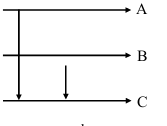
During the transition of electron from state A to state C of a Bohr atom, the wavelength of emitted radiation is and it becomes when the electron jumps from state B to state C. Then the wavelength of the radiation emitted during the transition of electrons from state A to state B is :-
- Option A:
- Option B:
- Option C:
- Option D:
Answer: AStep-by-step solution → - Question 52Physics· Semiconductor and Electronic Devices
Consider the following statements : A. The junction area of solar cell is made very narrow compared to a photo diode. B. Solar cells are not connected with any external bias. C. LED is made of lightly doped p-n junction. D. Increase of forward current results in continuous increase of LED light intensity. E. LEDs have to be connected in forward bias for emission of light.
- Option A:
B, D, E Only
- Option B:
A, C Only
- Option C:
A, C, E Only
- Option D:
B, E Only
Answer: DStep-by-step solution → - Question 53Physics· Mechanical Properties of Matter
The amount of work done to break a big water drop of radius ' R ' into 27 small drops of equal
radius is 10 J . The work done required to break the same big drop into 64 small drops of equal
radius will be :-
- Option A:
15J
- Option B:
10J
- Option C:
20J
- Option D:
5J
Answer: AStep-by-step solution → - Question 54Physics· Motion in Plane
An object of mass ' ' is projected from origin in a vertical xy plane at an angle with the x -axis with an initial velocity . The magnitude and direction of the angular momentum of the object with respect to origin, when it reaches at the maximum height, will be [ g is acceleration due to gravity]
- Option A:
along negative -axis
- Option B:
along positive -axis
- Option C:
along positive z -axis
- Option D:
along negative -axis
Answer: DStep-by-step solution → - Question 55Physics· Wave Optics
The Young's double slit interference experiment is performed using light consisting of 480 nm and 600 nm wavelengths to form interference patterns. The least number of the bright fringes of 480 nm light that are required for the first coincidence with the bright fringes formed by 600 nm light is :-
- Option A:
4
- Option B:
8
- Option C:
6
- Option D:
5
Answer: DStep-by-step solution → - Question 56Physics· Horizontal Circular Motion
A car of mass ' ' moves on a banked road having radius ' r ' and banking angle . To avoid slipping from banked road, the maximum permissible speed of the car is . The coefficient of friction between the wheels of the car and the banked road is :-
- Option A:
- Option B:
- Option C:
- Option D:
Answer: CStep-by-step solution → - Question 57Physics· Rotational Dynamics
A uniform solid cylinder of mass ' m ' and radius ' r ' rolls along an inclined rough plane of inclination . If it starts to roll from rest from the top of the plane then the linear acceleration of the cylinder axis will be:-
- Option A:
- Option B:
- Option C:
- Option D:
Answer: CStep-by-step solution → - Question 58Physics· Geometrical Optics
A thin plano convex lens made of glass of refractive index 1.5 is immersed in a liquid of refractive index 1.2 . When the plane side of the lens is silver coated for complete reflection, the lens immersed in the liquid behaves like a concave mirror of focal length 0.2 m . The radius of curvature of the curved surface of the lens is :-
- Option A:
0.15m
- Option B:
0.10m
- Option C:
0.20m
- Option D:
0.25m
Answer: BStep-by-step solution → - Question 59Physics· Simple Harmonic Motion
A particle is executing simple harmonic motion with time period 2 s and amplitude 1 cm . If D and d are the total distance and displacement covered by the particle in 12.5 s , then D/d is :-
- Option A:
15/4
- Option B:
25
- Option C:
10
- Option D:
16/5
Answer: BStep-by-step solution → - Question 60Physics· Gravitation
A satellite is launched into a circular orbit of radius ' R ' around the earth. A second statellite is launched into an orbit of radius 1.03 R . The time period of revolution of the second satellite is larger than the first one approximately by :-
- Option A:
- Option B:
- Option C:
- Option D:
Answer: BStep-by-step solution → - Question 61Physics· Geometrical Optics
A plano-convex lens having radius of curvature of first surface 2 cm exhibits focal length of in air. Another plano-convex lens with first surface radius of curvature 3 cm has focal length of when it is immersed in a liquid of refractive index 1.2. If both the lenses are made of same glass of refractive index 1.5, the ratio of and will be :-
- Option A:
- Option B:
- Option C:
- Option D:
Answer: BStep-by-step solution → - Question 62Physics· Alternating Current
An alternating current is given by
.
The r.m.s. current will be :-
- Option A:
- Option B:
- Option C:
- Option D:
Answer: CStep-by-step solution → - Question 63Physics· Atomic Physics
An electron of mass ' ' with an initial velocity enters an electric field . If the initial de Broglie wavelength is , the value after time would be :-
- Option A:
- Option B:
- Option C:
- Option D:
Answer: AStep-by-step solution → - Question 64Physics· Capacitors and R-C Circuits
A parallel plate capacitor was made with two rectangular plates, each with a length of
and breath of . The distance
between the plates is . Out of the following, which are the ways
to increase the capacitance by a factor of 10 ?
A.
B.
C.
D.
E.
- Option A:
C and E only
- Option B:
B and D only
- Option C:
A only
- Option D:
C only
Answer: AStep-by-step solution → - Question 65Physics· Work, Power & Energy
A force acts on an object in the x -direction. The work done by the force is 5 J when the object is displaced by 1 m . If the constant then will be
- Option A:
- Option B:
- Option C:
- Option D:
Answer: CStep-by-step solution → - Question 66Physics· Thermodynamics
An ideal gas goes from an initial state to final state. During the process, the pressure of gas increases linearly with temperature.
A. The work done by gas during the process is zero.
B. The heat added to gas is different from change in its internal energy.
C. The volume of the gas is increased.
D. The internal energy of the gas is increased.
E. The process is isochoric (constant volume process)
- Option A:
A, B, C, D Only
- Option B:
A, D, E Only
- Option C:
E Only
- Option D:
A, C Only
Answer: BStep-by-step solution → - Question 67Physics· Electrostatics
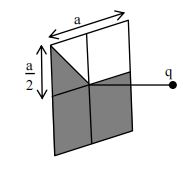
A square loop of sides is held normally in front of a point charge . The flux of the electric field through the shaded region is , where the value of p is
images
 Answer: 48Step-by-step solution →
 - Question 68Physics· Units, Dimensions & Error Analysis
The least count of a screw guage is 0.01 mm . If the pitch is increased by and number of divisions on the circular scale is reduced by , the new least count will be .
Answer: 35Step-by-step solution → - Question 69Physics· Current Electricity
A wire of resistance is bent to form an equilateral triangle. Then the equivalent resistance across any two vertices will be ohm.
Answer: 2Step-by-step solution → - Question 70Physics· Moving Charges and Magnetic Field
A current of 5 A exists in a square loop of side .
Then the magnitude of the magnetic field at the centre of the square loop will be
. where, value of p is .[0pt]
[Take ].
Answer: 8Step-by-step solution → - Question 71Physics· Kinetic Theory of Gases
The temperature of 1 mole of an ideal monoatomic gas is increased by at constant pressure. The total heat added and change in internal energy are and , respectively. If then the value of is .
Answer: 15Step-by-step solution →
Stuck on one of these?
Practise questions like them — free, with a tutor that explains every step.