JEE Main 2025 · previous year paper
JEE Main 2025 — 2 April, Morning Shift
69 questions with the verified answer key. Open any question for its step-by-step solution.
- Question 1Chemistry· Aldehydes and Ketones
Given below are two statements : one is labelled as Statement I and the other is labelled as Statement II:
Statement I: Vanillin

react with NaOH and also with Tollen's reagent.
Statement II: Vanillin
undergo self aldol condensation very easily.
In the light of the above statements, choose the correct answer from the options given below :
- Option A:
Both Statement I and Statement II are correct
- Option B:
Both Statement I and Statement II are incorrect
- Option C:
Statement I is correct but Statement II is incorrect
- Option D:
Statement I is incorrect but Statement II are correct
Answer: CStep-by-step solution → - Question 2Chemistry· Solutions and Colligative Properties
A solution is made by mixing one mole of volatile liquid with 3 moles of volatile liquid . The vapour pressure of pure is 200 mm Hg and that of the solution is 500 mm Hg . The vapour pressure of pure and the least volatile component of the solution, respectively, are
- Option A:
- Option B:
- Option C:
- Option D:
Answer: BStep-by-step solution → - Question 3Chemistry· General Organic Chemistry
The correct order of basic nature in aqueous solution for the bases
and is
- Option A:
- Option B:
- Option C:
- Option D:
Answer: DStep-by-step solution → - Question 4Chemistry· Periodicity of Elements and Periodic Properties
Given below are two statements : one is labelled as Statement I and the other is labelled as Statement II:
Statement I: The metallic radius of AI is less than that of Ga .
Statement II: The ionic radius of is less than that of
In the light of the above statements, choose the correct answer from the options given below :
- Option A:
Statement-I is incorrect but Statement-II is correct
- Option B:
Both Statement-I and Statement-II are incorrect
- Option C:
Both Statement-I and Statement-II are correct
- Option D:
Statement-I is correct but Statement-II is incorrect
Answer: AStep-by-step solution → - Question 5Chemistry· General Organic Chemistry
Consider the following compound ( X )

The most stable and least stable carbon radicals, respectively, produced by homolytic cleavage of corresponding bond are :
- Option A:
II, IV
- Option B:
III, II
- Option C:
II, I
- Option D:
I, IV
Answer: CStep-by-step solution → - Question 6Chemistry· Chemical Bonding
Among and , the hybridization of the molecule with non-zero dipole
moment and highest number of lone-pairs of electrons on the centre atom is :
- Option A:
- Option B:
- Option C:
- Option D:
Answer: DStep-by-step solution → - Question 7Chemistry· Coordination Compounds
Given below are two statements : one is labelled as Statement I and the other is labelled as Statement II:
Statement I: In octahedral complexes, when high spin complex are formed.
Statement II: In tetrahedral complexes because of high spin complex are formed.
In the light of the above statements, choose the correct answer from the options given below :
- Option A:
Both Statement-I and Statement-II are correct
- Option B:
Statement-I is correct but Statement-II is incorrect
- Option C:
Both Statement-I and Statement-II are incorrect
- Option D:
Statement-I is incorrect but Statement-II is correct
Answer: AStep-by-step solution → - Question 8Chemistry· Chemical Bonding
A molecule with the formula has all its elements from p-block. Element is rarest, monoatomic, non-radioactive from its group and has the lowest ionization enthalpy value among , and . Elements and have first and second highest electronegativity values respectively among all the known elements. The shape of the molecule is:
- Option A:
Trigonal bipyramidal
- Option B:
Square pyramidal
- Option C:
Octahedral
- Option D:
Pentagonal planar
Answer: BStep-by-step solution → - Question 9Chemistry· Aromatic Compounds
Designate whether each of the following compounds is aromatic or not aromatic.
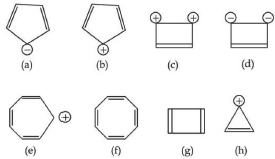
- Option A:
aromatic and e, f, g, h not aromatic
- Option B:
e, g aromatic and not aromatic
- Option C:
a c, d, e, h aromatic and b, f, g not aromatic
- Option D:
b, e, f, g aromatic and a, c, d, h not aromatic
Answer: CStep-by-step solution → - Question 10Chemistry· Thermodynamics & Thermochemistry
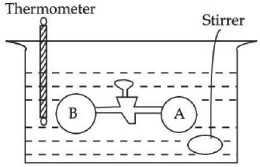
Two vessels and are connected via stopcock. The vessel A is filled with a gas at a certain pressure. The entire assembly is immersed in water and is allowed to come to thermal equilibrium with water. After opening the stopcock the gas from vessel A expands into vessel B and no change in temperature is observed in the thermometer. Which of the following statement is true?
- Option A:
- Option B:
- Option C:
- Option D:
The pressure in the vessel before opening the stopcock is zero
Answer: DStep-by-step solution → - Question 11Chemistry· Ionic Equilibrium
If equal volumes of and XY (both are salts) aqueous solutions are mixed, which of the following combination will give a precipitate of at 300 K ? (Given at 300 K ) for )
- Option A:
- Option B:
- Option C:
- Option D:
Answer: AStep-by-step solution → - Question 12Chemistry· Some Basic Concepts of Chemistry (Mole Concept) + Stoichiometry
On complete combustion 1.0 g of an organic compound ( X ) gave 1.46 g of and 0.567 g of . The
empirical formula mass of compound ( X ) is g. (Given molar mass in )
- Option A:
30
- Option B:
60
- Option C:
15
- Option D:
45
Answer: AStep-by-step solution → - Question 13Chemistry· p-Block Elements (Group 15-18)
The property/properties that show irregularity in first four elements of group-17 is/are
(A) Covalent radius
(B) Electron affinity
(C) Ionic radius
(D) First ionization energy
Choose the correct answer from the options given below:
- Option A:
A and C only
- Option B:
B only
- Option C:
B and D only
- Option D:
A, B C and D
Answer: BStep-by-step solution → - Question 14Chemistry· Practical Inorganic chemistry (Qualitative Analysis)
Choose the correct tests with respective observations.
(A) (acidified with acetic acid) + Chocolate brown precipitate.
(B) Prussian blue precipitate.
(C) , neutralised with White or bluish white precipitate.
(D) Blue precipitate.
(E) , neutralised with White precipitate.
Choose the correct answer from the options given below :
- Option A:
A, D and E only
- Option B:
B, D and E only
- Option C:
C, D and E only
- Option D:
A, B and C only
Answer: DStep-by-step solution → - Question 15Chemistry· Structure of Atom
According to Bohr's model of hydrogen atom, which of the following statement is incorrect?
- Option A:
Radius of orbit is four times larger than that of orbit
- Option B:
Radius of orbit is three times larger than that of orbit
- Option C:
Radius of orbit is four times larger than that of orbit
- Option D:
Radius of orbit is nine times larger than that of orbit
Answer: BStep-by-step solution → - Question 16Chemistry· Some Basic Concepts of Chemistry (Mole Concept) + Stoichiometry
Consider the above reaction, what
mass of will be formed if 250 mL of 0.76 M HCl reacts with 1000 g of ? (Given: Molar mass of
and Cl are 40, and , respectively)
- Option A:
3.908 g
- Option B:
2.636 g
- Option C:
10.545 g
- Option D:
5.272 g
Answer: CStep-by-step solution → - Question 17Chemistry· Biomolecules
Identify the correct statement among the following:
- Option A:
All naturally occurring amino acids exceptglycine contain one chiral centre.
- Option B:
Glutamic acid is the only amino acid that contains a -COOH group at the side chain.
- Option C:
Amino acid, cysteine can easily undergo dimerisation due to the presence of free SH group.
- Option D:
All naturally occurring amino acids are optically active.
Answer: CStep-by-step solution → - Question 18Chemistry· Some Basic Concepts of Chemistry (Mole Concept) + Stoichiometry
0.1 mol of the following given antiviral compound will weigh (Given : molar mass in : 14, O:16, F: 19, I: 127
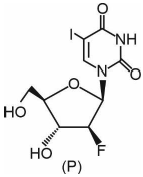 Answer: 372Step-by-step solution →
 - Question 19Chemistry· Chemical Kinetics
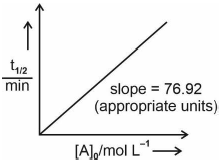
For the reaction products. The concentration of at 10 minutes is (nearest integer). The reaction was started with of A.
From the plot: slope (appropriate units).
 Answer: 2435Step-by-step solution →
 - Question 20Chemistry· Chemical Equilibrium
Consider the following equilibrium,
0.1 mol of CO along with a catalyst is present in a flask maintained at 500 K . Hydrogen is introduced into
the flask until the pressure is 5 bar and 0.04 mol of is formed. The is (nearest
integer). Given : bar Assume only methanol is formed as the product and the
system follows ideal gas behaviour.
Answer: 74Step-by-step solution → - Question 21Chemistry· Ionic Equilibrium
Consider the following electrochemical cell at standard condition.
The couple represents quinhydrone electrode, the half cell reaction is given below :

Given : and
The value of the ammonium halide salt used here is . (nearest integer)
Answer: 6Step-by-step solution → - Question 22Chemistry· Coordination Compounds
A transition metal(M)among Mn,Cr,Co and Fe has the highest standard electrode potential .If forms a metal complex of the type .The number of electrons present in the orbital of the complex is
Answer: 1Step-by-step solution → - Question 23Mathematics· Matrices
Let and be a matrix of order such that and , where
is the identity matrix of order . If is , then
is equal to
- Option A:
- Option B:
- Option C:
- Option D:
Answer: AStep-by-step solution → - Question 24Mathematics· Quadratic Equations
Let . If and , then the quadratic equation having roots and is:
- Option A:
- Option B:
- Option C:
- Option D:
Answer: AStep-by-step solution → - Question 25Mathematics· Vector Algebra
Let be a tetrahedron such that the edges , and are mutually perpendicular. Let the areas of the triangles and be and square units respectively. Then the area (in square units) of the is equal to
- Option A:
- Option B:
- Option C:
- Option D:
12
Answer: AStep-by-step solution → - Question 26Mathematics· Ellipse
If and are the foci of the ellipse and be a point on the ellipse, then is equal to
- Option A:
- Option B:
- Option C:
- Option D:
Answer: AStep-by-step solution → - Question 27Mathematics· Methods of Differentiation
Let be a twice differentiable function such that ), for all . If , then the value of is :
- Option A:
- Option B:
- Option C:
- Option D:
Answer: CStep-by-step solution → - Question 28Mathematics· Binomial Theorem
The term independent of in the expansion of , is:
- Option A:
- Option B:
- Option C:
- Option D:
Answer: CStep-by-step solution → - Question 29Mathematics· Sets and Relations
Let be the set of all function and be a relation on such that
and . Then is:
- Option A:
Symmetric and transitive but not reflective
- Option B:
Reflexive but neither symmetric nor transitive
- Option C:
Transitive but neither reflexive nor symmetric
- Option D:
Symmetric but neither reflective nor transitive
Answer: DStep-by-step solution → - Question 30Mathematics· Sequence and Series
Let , be in an A.P. such that . If , then
is:
- Option A:
- Option B:
- Option C:
- Option D:
Answer: CStep-by-step solution → - Question 31Mathematics· Determinants
If the system of linear equations
has infinitely many solutions, then the value of is:
- Option A:
- Option B:
- Option C:
- Option D:
Answer: DStep-by-step solution → - Question 32Mathematics· Permutations and Combinations
The number of sequences of ten terms, whose terms are either or or that contain exactly five s and exactly three s , is equal to:
- Option A:
- Option B:
- Option C:
- Option D:
Answer: BStep-by-step solution → - Question 33Mathematics· Matrices
Let , such that and . If denotes identity
matrix, then the matrix, is
- Option A:
- Option B:
- Option C:
- Option D:
Answer: AStep-by-step solution → - Question 34Mathematics· Permutations and Combinations
The largest such that divides Is
- Option A:
- Option B:
- Option C:
- Option D:
Answer: AStep-by-step solution → - Question 35Mathematics· Parabola
Let the focal chord of the parabola make an angle of with the positive -axis, where lies in the first quadrant. If the circle, whose one diameter is being the focus of the parabola, touches the -axis at the point , then is equal to:
- Option A:
- Option B:
- Option C:
- Option D:
Answer: AStep-by-step solution → - Question 36Mathematics· 3D Geometry
Let the vertices and of the triangle lie on the line and the
coordinates of the point be . If the area of the triangle is then:
- Option A:
- Option B:
- Option C:
- Option D:
Answer: AStep-by-step solution → - Question 37Mathematics· Application of Derivatives
If the function , where a , attains its local maximum and local
minimum values at and , respectively, such that , then is equal to
- Option A:
- Option B:
- Option C:
- Option D:
Answer: BStep-by-step solution → - Question 38Mathematics· Trigonometry Ratios and Identities
If , then the number of solutions of , is equal to
- Option A:
- Option B:
- Option C:
- Option D:
Answer: CStep-by-step solution → - Question 39Mathematics· Limits, Continuity and Differentiability
For , if , then is equal to
- Option A:
- Option B:
- Option C:
- Option D:
Answer: CStep-by-step solution → - Question 40Mathematics· Hyperbola
Let one focus of the hyperbola be at and the corresponding directrix be
. If and respectively are the eccentricity and the length of the latus rectum of H , then is equal to
- Option A:
- Option B:
- Option C:
- Option D:
Answer: DStep-by-step solution → - Question 41Mathematics· Complex Numbers
Let be a complex number such that . If , then the maximum distance of from the circle is
- Option A:
- Option B:
- Option C:
- Option D:
Answer: AStep-by-step solution → - Question 42Mathematics· Differential Equations
Lef be a thrice differentiable odd function satisfying
. Then is equal to .
Answer: 36Step-by-step solution → - Question 43Mathematics· Area under the Curves
If the area of the region is , where , then is equal to
Answer: 22Step-by-step solution → - Question 44Mathematics· Definite Integration
Let [•] denote the greatest integer function. If , then is equal to -.
Answer: 8Step-by-step solution → - Question 45Mathematics· Probability
Three distinct numbers are selected randomly from the set . If the probability, that the selected members are in an increasing G.P., is , then is equal to
Answer: 4949Step-by-step solution → - Question 46Mathematics· Circles
The absolute difference between the squares of the radii of the twocircles passing through the point and touching the lines and , is equal to .
Answer: 768Step-by-step solution → - Question 47Physics· Work, Power & Energy
The battery of a mobile phone is rated as 4.2 V , 5800 mAh . How much energy is stored in it when fully charged?
- Option A:
43.8 kJ
- Option B:
48.7 kJ
- Option C:
87.7 kJ
- Option D:
24.4 kJ
Answer: CStep-by-step solution → - Question 48Physics· Motion in Plane
A river is flowing from west to east direction with speed of . If a boat capable of moving at a maximum speed of in still water, crosses the river in half a minute, while moving with maximum speed at an angle of to direction of river flow, then the width of the river is
- Option A:
112.5 m
- Option B:
75 m
- Option C:
300 m
- Option D:
Answer: AStep-by-step solution → - Question 49Physics· Rotational Dynamics
Moment of inertia of a rod of mass ' ' and length ' ' about an axis passing through its center and normal to its length is ' '. Now the rod is cut into two equal parts and these parts are joined symmetrically to form a cross shape. Moment of inertia of cross about an axis passing through its center and normal to plane containing cross is
- Option A:
- Option B:
- Option C:
- Option D:
Answer: AStep-by-step solution → - Question 50Physics· Atomic Physics
Considering Bohr's atomic model for hydrogen atom: (A) The energy of H atom in ground state is same as energy of ion in its first excited state. (B) The energy of H atom in ground state is same as that for ion in its second excited state. (C) The energy of H atom in its ground state is same as that of ion for its ground state. (D) The energy of ion in its first excited state is same as that for ion in its ground state. Choose the correct answer from the options given below:
- Option A:
(A), (D) only
- Option B:
(A), (B) only
- Option C:
(A), (C) only
- Option D:
(B), (D) only
Answer: BStep-by-step solution → - Question 51Physics· Units, Dimensions & Error Analysis
The equation for real gas is given by , where and
are the pressure, volume, temperature and gas constant, respectively. The dimension of
is equivalent to that of
- Option A:
Strain
- Option B:
Compressibility
- Option C:
Planck's constant
- Option D:
Energy density
Answer: DStep-by-step solution → - Question 52Physics· Magnetism and Matter
The relationship between the magnetic susceptibility and the magnetic permeability is
given by: ( is the permeability of free space and is relative permeability)
- Option A:
- Option B:
- Option C:
- Option D:
Answer: BStep-by-step solution → - Question 53Physics· Thermodynamics
In an adiabatic process, which of the following statements is true?
- Option A:
The molar heat capacity is zero
- Option B:
The molar heat capacity is infinite
- Option C:
The internal energy of the gas decreases as the temperature increases
- Option D:
Work done by the gas equals the increase in internal energy
Answer: AStep-by-step solution → - Question 54Physics· Units, Dimensions & Error Analysis
Match List-I with List-II. Choose the correct answer from the options given below.
LIST-I LIST-II (A) Coefficient of viscosity (I) (B) Intensity of wave (II) (C) Pressure gradient (III) (D) Compressibility (IV) - Option A:
(A)-(IV), (B)-(I), (C)-(II), (D)-(III)
- Option B:
(A)-(II), (B)-(III), (C)-(IV), (D)-(I)
- Option C:
(A)-(IV), (B)-(II), (C)-(I), (D)-(III)
- Option D:
(A)-(I), (B)-(IV), (C)-(III), (D)-(II)
Answer: AStep-by-step solution → - Question 55Physics· Wave Optics
A light wave is propagating with plane wave fronts of the type constant. The angle made
by the direction of wave propagation with the -axis is
- Option A:
- Option B:
- Option C:
- Option D:
Answer: BStep-by-step solution → - Question 56Physics· Moving Charges and Magnetic Field
Let be the magnitude of magnetic field at centre of a circular coil or radius carrying current . Let be the magnitude of magnetic field at an axial distance ' ' from the center. For is :
- Option A:
- Option B:
- Option C:
- Option D:
Answer: CStep-by-step solution → - Question 57Physics· Simple Harmonic Motion
A particle is subjected to two simple harmonic motions as: and
where is displacement and is
time in seconds. The maximum acceleration of the particle is .
The value of is :
- Option A:
- Option B:
- Option C:
125
- Option D:
175
Answer: DStep-by-step solution → - Question 58Physics· Electrostatics
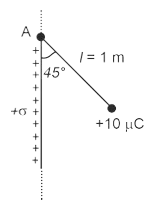
A small bob of mass 100 mg and charge is connected to an insulating string of
length 1 m . It is brought near to an infinitely long non-conducting sheet of charge density ' ' as
shown in figure. If string subtends and angle of with the sheet at equilibrium the charge
density of sheet will be. (Given
and acceleration due to gravity,
- Option A:
- Option B:
- Option C:
- Option D:
Answer: DStep-by-step solution → - Question 59Physics· Atomic Physics
A monochromatic light is incident on a metallic plate having work function . An electron, emitted
normally to the plate from a point with maximum kinetic energy, enters a constant magnetic field, perpendicular to the initial velocity of electron. The electron passes through a curve and hits back the
plate at a point . The distance between and is: (Given: The magnitude of charge of an
electron is and mass is is Planck's constant and is velocity of light. Take the magnetic
field exists throughout the path of electron)
- Option A:
- Option B:
- Option C:
- Option D:
Answer: BStep-by-step solution → - Question 60Physics· Electrostatics
A point charge is placed at the origin. A second point charge is placed at in Cartesian coordinate system. The point in between them where the electric field vanishes is:
- Option A:
- Option B:
- Option C:
- Option D:
Answer: AStep-by-step solution → - Question 61Physics· Semiconductor and Electronic Devices
A zener diode with 5 V zener voltage is used to regulate an unregulated dc voltage input of 25 V . For a resistor connected in series, the zener current is found to be 4 times load current. The load current and load resistance are :
- Option A:
- Option B:
- Option C:
- Option D:
Answer: CStep-by-step solution → - Question 62Physics· Electrostatics
Consider two infinitely large plane parallel conducting plates as shown below. Two plates are uniformly charged with a surface charge density and . The force experienced by a point charge placed at the mid point between two plates will be :

- Option A:
- Option B:
- Option C:
- Option D:
Answer: CStep-by-step solution → - Question 63Physics· Rotational Dynamics
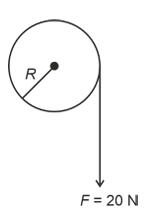
A cord of negligible mass is around the rim of a wheel supported by spokes with negligible mass. The mass of wheel is 10 kg and radius is 10 cm and it can freely rotate without any friction. Initially the wheel is at rest.
If a steady pull of 20 N is applied on the cord, the angular velocity of the wheel, after the cord is unwound by 1 m , would be :
- Option A:
- Option B:
- Option C:
- Option D:
Answer: BStep-by-step solution → - Question 64Physics· Geometrical Optics
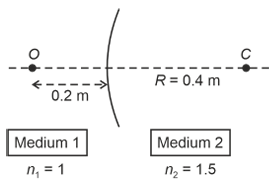
A spherical surface separates two media of refractive indices 1 and 1.5 as shown in figure. Distance of the image of an object ' ', is ( is the center of curvature of the spherical surface and is the radius of curvature)
- Option A:
0.4 m left to the spherical surface
- Option B:
0.24 m left to the spherical surface
- Option C:
0.24 m right to the spherical surface
- Option D:
0.4 m right to the spherical surface
Answer: AStep-by-step solution → - Question 65Physics· Motion in one Dimension
A person travelling on a straight line moves with a uniform velocity for a distance and with a uniform velocity for the next distance. The average velocity in this motion is . If is then .
Answer: 10Step-by-step solution → - Question 66Physics· Thermodynamics
is the specific heat ratio of monoatomic gas having 3 translational degrees of freedom. is the specific heat ratio of polyatomic gas having 3 translational, 3 rotational degrees of freedom and 1 vibrational mode. If , then the value of is .
Answer: 3Step-by-step solution → - Question 67Physics· Fluid Mechanics
A vessel with square cross-section and height of 6 m is vertically partitioned. A small window of with hinged door is fitted at a depth of 3 m in the partition wall. One part of the vessel is filled completely with water and the other side is filled with the liquid having density . What force one needs to apply on the hinged door so that it does not get opened? (Acceleration due to gravity )
Answer: 150Step-by-step solution → - Question 68Physics· Wave Optics
If the measured angular separation between the second minimum to the left to the central maximum and the third minimum to the right of the central maximum is in a single slit diffraction pattern recorded using 628 nm light, then the width of the slit is .
Answer: 6Step-by-step solution → - Question 69Physics· Mechanical Properties of Matter
A steel wire of length 2 m and Young's modulus is stretched by a force. If Poisson ratio and transverse strain for the wire are 0.2 and respectively, then the elastic potential energy density of the wire is (in SI units).
Answer: 25Step-by-step solution →
Stuck on one of these?
Practise questions like them — free, with a tutor that explains every step.