JEE Main 2025 · previous year paper
JEE Main 2025 — 22 January, Evening Shift
63 questions with the verified answer key. Open any question for its step-by-step solution.
- Question 1Mathematics· Binomial Theorem
Let and be the coefficients of and respectively in the expansion of
. If and satisfy the equations
, , then equals :
- Option A:
5
- Option B:
4
- Option C:
3
- Option D:
8
Answer: AStep-by-step solution → - Question 2Mathematics· Permutations and Combinations
In a group of 3 girls and 4 boys, there are two boys and . The number of ways, in which these girls and boys can stand in a queue such that all the girls stand together, all the boys stand together, but and are not adjacent to each other, is :
- Option A:
144
- Option B:
72
- Option C:
96
- Option D:
120
Answer: AStep-by-step solution → - Question 3Mathematics· Parabola
Let be a point on the parabola and PQ be a focal chord of the parabola. If and N are the foot of perpendiculars drawn from P and Q respectively on the directrix of the parabola, then the area of the quadrilateral PQMN is equal to:
- Option A:
- Option B:
- Option C:
- Option D:
Answer: CStep-by-step solution → - Question 4Mathematics· Matrices
For a matrix , let trace denote the sum of all the diagonal elements of M . Let A be a matrix such that and trace . If , then the value of trace equals:
- Option A:
56
- Option B:
132
- Option C:
174
- Option D:
280
Answer: DStep-by-step solution → - Question 5Mathematics· Sequence and Series
Suppose that the number of terms in an A.P. is 2 k , . If the sum of all odd terms of the A.P. is 40 , the sum of all even terms is 55 and the last term of the A.P. exceeds the first term by 27 , then k is equal to :
- Option A:
5
- Option B:
8
- Option C:
6
- Option D:
4
Answer: AStep-by-step solution → - Question 6Mathematics· Vector Algebra
Let a line pass through two distinct points and Q , and be parallel to the vector . If the distance of the point from the point is 5 , then the square of the area of is equal to:
- Option A:
136
- Option B:
140
- Option C:
144
- Option D:
148
Answer: AStep-by-step solution → - Question 7Mathematics· Limits, Continuity and Differentiability
If , then the value of equals :
- Option A:
e
- Option B:
- Option C:
- Option D:
Answer: AStep-by-step solution → - Question 8Mathematics· Application of Derivatives
Let . Then the numbers of local maximum and local minimum points of
f, respectively, are :
- Option A:
2 and 3
- Option B:
3 and 2
- Option C:
1 and 3
- Option D:
2 and 2
Answer: AStep-by-step solution → - Question 9Mathematics· 3D Geometry
The perpendicular distance, of the line from the point , is:
- Option A:
6
- Option B:
- Option C:
- Option D:
Answer: CStep-by-step solution → - Question 10Mathematics· Differential Equations
If is the solution of the differential equation with , then is equal to :
- Option A:
- Option B:
- Option C:
- Option D:
Answer: DStep-by-step solution → - Question 11Mathematics· Indefinite Integration
If ,where C is the constant of integration, then equals :
- Option A:
- Option B:
- Option C:
- Option D:
Answer: CStep-by-step solution → - Question 12Mathematics· Quadratic Equations
Let and be the distinct roots of . If and are the
minimum and the maximum values of , then equals :
- Option A:
24
- Option B:
25
- Option C:
27
- Option D:
17
Answer: BStep-by-step solution → - Question 13Mathematics· Functions
Let and . Then the number of many-one functions such that is equal to :
- Option A:
127
- Option B:
151
- Option C:
163
- Option D:
139
Answer: BStep-by-step solution → - Question 14Mathematics· Matrices
If the system of linear equations :
,
,
,
where , has infinitely many solutions, then is equal to
- Option A:
9
- Option B:
12
- Option C:
16
- Option D:
22
Answer: CStep-by-step solution → - Question 15Mathematics· Vector Algebra
Let and be two unit vectors such that the angle between them is . If and are perpendicular to each other, then the number of values of in is :
- Option A:
3
- Option B:
2
- Option C:
1
- Option D:
0
Answer: DStep-by-step solution → - Question 16Mathematics· Hyperbola
Let and . Let the distance between the foci of E and the
foci of be . If , and the ratio of the eccentricities of E and H is , then the sum of the
lengths of their latus rectums is equal to :
- Option A:
10
- Option B:
7
- Option C:
8
- Option D:
9
Answer: CStep-by-step solution → - Question 17Mathematics· Probability
If A and B are two events such that , and and are the roots of the equation , then the value of is:
- Option A:
- Option B:
- Option C:
- Option D:
Answer: CStep-by-step solution → - Question 18Mathematics· Trigonometry Ratios and Identities
The sum of all values of satisfying and is
- Option A:
- Option B:
- Option C:
- Option D:
Answer: DStep-by-step solution → - Question 19Mathematics· Complex Numbers
Let the curve divide the region into two parts of areas and Then equals:
- Option A:
- Option B:
- Option C:
- Option D:
Answer: AStep-by-step solution → - Question 20Mathematics· Area under the Curves
The area of the region enclosed by the curves and is:
- Option A:
- Option B:
- Option C:
- Option D:
Answer: AStep-by-step solution → - Question 21Mathematics· Differential Equations
Let y = f(x) be the solution of the differential equation such that If then is equal to
Answer: 27Step-by-step solution → - Question 22Mathematics· Straight lines
Let and C , be the vertices of a triangle. If
and be its orthocenter and centroid respectively, then is
equal to
Answer: 145Step-by-step solution → - Question 23Mathematics· Straight lines
Let the distance between two parallel lines be 5 units and a point lie between the lines at a unit distance from one of them. An equilateral triangle PQR is formed such that Q lies on one of the parallel lines, while R lies on the other. Then is equal to .
Answer: 28Step-by-step solution → - Question 24Mathematics· Binomial Theorem
If , then is equal to .
Answer: 465Step-by-step solution → - Question 25Mathematics· Sets and Relations
Let . The number of relations on A , containing and , which are reflexive and transitive but not symmetric, is .
Answer: 3Step-by-step solution → - Question 26Chemistry· Chemical Bonding
Arrange the following compounds in increasing order of their dipole moment :
and
- Option A:
- Option B:
- Option C:
- Option D:
Answer: AStep-by-step solution → - Question 27Chemistry· Biomolecules
Identify the number of structure/s from the following which can be correlated to D-glyceraldehyde.

- Option A:
three
- Option B:
two
- Option C:
four
- Option D:
one
Answer: BStep-by-step solution → - Question 28Chemistry· p-Block Elements (Group 15-18)
The maximum covalency of a non-metallic group 15 element ' E ' with weakest bond is :
- Option A:
5
- Option B:
3
- Option C:
6
- Option D:
4
Answer: DStep-by-step solution → - Question 29Chemistry· Redox Reactions
The species which does not undergo disproportionation reaction is :
- Option A:
- Option B:
- Option C:
- Option D:
Answer: BStep-by-step solution → - Question 30Chemistry· Biomolecules
Match the Compounds (List-I) with the appropriate Catalyst/Reagents (List-II) for their reduction into corresponding amines.

Choose the correct answer from the options given below:
- Option A:
(A)-(III), (B)-(II), (C)-(IV), (D)-(I)
- Option B:
(A)-(II), (B)-(IV), (C)-(III), (D)-(I)
- Option C:
(A)-(II), (B)-(I), (C)-(III), (D)-(IV)
- Option D:
(A)-(III), (B)-(IV), (C)-(II), (D)-(I)
Answer: DStep-by-step solution → - Question 31Chemistry· Thermodynamics & Thermochemistry

The maximum number of RBr producing 2-methylbutane by above sequence of reactions is___. (Consider the structural isomers only)
- Option A:
4
- Option B:
5
- Option C:
3
- Option D:
1
Answer: AStep-by-step solution → - Question 32Chemistry· Thermodynamics & Thermochemistry
Match List-I with List-II.
List-I (Partial Derivatives) List-II (Thermodynamic Quantity) (A) (I) (B) (II) -S (C) (III) (D) (IV) V Choose the correct answer from the options given below:
- Option A:
(A)-(II), (B)-(I), (C)-(III), (D)-(IV)
- Option B:
(A)-(II), (B)-(I), (C)-(IV), (D)-(III)
- Option C:
(A)-(I), (B)-(II), (C)-(IV), (D)-(III)
- Option D:
(A)-(II), (B)-(III), (C)-(I), (D)-(IV)
Answer: BStep-by-step solution → - Question 33Chemistry· Coordination Compounds
The correct order of the following complexes in terms of their crystal field stabilization energies is :
- Option A:
- Option B:
- Option C:
- Option D:
Answer: BStep-by-step solution → - Question 34Chemistry· Some Basic Concepts of Chemistry (Mole Concept) + Stoichiometry
Density of solution is . The molality of the solution is:
- Option A:
1.79 m
- Option B:
2 m
- Option C:
3 m
- Option D:
2.79 m
Answer: DStep-by-step solution → - Question 35Chemistry· Ionic Equilibrium
The molar solubility(s) of zirconium phosphate with molecular formula is given by relation :
- Option A:
- Option B:
- Option C:
- Option D:
Answer: AStep-by-step solution → - Question 36Chemistry· General Organic Chemistry
The most stable carbocation from the following is :
- Option A:
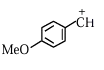
- Option B:

- Option C:
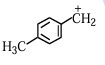
- Option D:

Answer: AStep-by-step solution → - Question 37Chemistry· Periodicity of Elements and Periodic Properties
Given below are two statements : one is labelled as Statement I and the other is labelled as Statement II :
Statement (I) : An element in the extreme left of the periodic table forms acidic oxides.
Statement (II) : Acid is formed during the reaction between water and oxide of a reactive element present in the extreme right of the periodic table.
In the light of the above statements, choose the correct answer from the options given below :
- Option A:
Statement-I is false but Statement-II is true.
- Option B:
Both Statement-I and Statement-II are false.
- Option C:
Statement-I is true but Statement-II is false.
- Option D:
Both Statement-I and Statement-II are true.
Answer: BStep-by-step solution → - Question 38Chemistry· Structure of Atom
Given below are two statements, one is labelled as Statement I and the other is labelled as Statement II.
Statement (I): A spectral line will be observed for a transition.
Statement (II): and are degenerate orbitals.
In the light of the above statements, choose the correct answer from the options given below :
- Option A:
Both Statement-I and Statement-II are true.
- Option B:
Both Statement-I and Statement-II are false.
- Option C:
Statement-I is true but Statement-II is false.
- Option D:
Statement-I is false but Statement-II is true.
Answer: DStep-by-step solution → - Question 39Chemistry· Practical Inorganic chemistry (Qualitative Analysis)
Given below are two statements : one is labelled as Statement I and the other is labelled as Statement II :
Statement (I) : Nitrogen, sulphur, halogen and phosphorus present in an organic compound are detected by Lassaigne's Test.
Statement (II) : The elements present in the compound are converted from covalent form into ionic form by fusing the compound with Magnesium in Lassaigne's test.
In the light of the above statements, choose the correct answer from the options given below :
- Option A:
Both Statement I and Statement II are true
- Option B:
Both Statement I and Statement II are false
- Option C:
Statement I is true but Statement II is false
- Option D:
Statement I is false but Statement II is true
Answer: CStep-by-step solution → - Question 40Chemistry· Coordination Compounds
Identify the homoleptic complex(es) that is/are low spin.
(A)
(B)
(C)
(D)
(E)
Choose the correct answer from the options given below :
- Option A:
(B) and (E) only
- Option B:
(A) and (C) only
- Option C:
(C) and (D) only
- Option D:
(C) only
Answer: CStep-by-step solution → - Question 41Chemistry· Electrochemistry
Given below are two statements : one is labelled as Statement I and the other is labelled as Statement II :
Statement (I) : Corrosion is an electrochemical phenomenon in which pure metal acts as an anode and impure metal as a cathode.
Statement (II) : The rate of corrosion is more in alkaline medium than in acidic medium.
In the light of the above statements, choose the correct answer from the options given below :
- Option A:
Both Statement I and Statement II are false
- Option B:
Statement I is false but Statement II is true
- Option C:
Both Statement I and Statement II are true
- Option D:
Statement I is true but Statement II is false
Answer: DStep-by-step solution → - Question 42Chemistry· IUPAC Nomenclature
The alkane from below having two secondary hydrogens is :
- Option A:
4-Ethyl-3,4-dimethyloctane
- Option B:
2,2,4,4-Tetramethylhexane
- Option C:
2,2,3,3-Tetramethylpentane
- Option D:
2,2,4,5-Tetramethylheptane
Answer: CStep-by-step solution → - Question 43Chemistry· Aromatic Compounds
The compound with molecular formula , which gives only one monobromo derivative and takes up four moles of hydrogen per mole for complete hydrogenation has____ electrons.
Answer: 8Step-by-step solution → - Question 44Chemistry· Structure of Atom
Niobium and ruthenium ( Ru ) have " " and " " number of electrons in their respective orbitals. The value of is____
Answer: 11Step-by-step solution → - Question 45Chemistry· Coordination Compounds
The complex of ion and dimethyl glyoxime contains____number of Hydrogen atoms.
Answer: 14Step-by-step solution → - Question 46Chemistry· Thermodynamics & Thermochemistry
Consider the following cases of standard enthalpy of reaction in
C (graphite)
The magnitude of is____ (Nearest integer).
Answer: 95Step-by-step solution → - Question 47Chemistry· Some Basic Concepts of Chemistry (Mole Concept) + Stoichiometry
of solution is added to of solution. The final concentration of the solution is (nearest integer).
Answer: 57.1Step-by-step solution → - Question 48Physics· Fluid Mechanics
A small rigid spherical ball of mass is dropped in a long vertical tube
containing glycerine. The velocity of the ball becomes constant after some
time. If the density of glycerine is half of the density of the ball, then the viscous
force acting on the ball will be (consider g as
acceleration due to gravity)
- Option A:
- Option B:
- Option C:
Mg
- Option D:
2 Mg
Answer: BStep-by-step solution → - Question 49Physics· Units, Dimensions & Error Analysis
The maximum percentage error in the measurment of density of a wire
is[0pt] [Given, mass of wire radius of
wire length of wire
]
- Option A:
4
- Option B:
5
- Option C:
8
- Option D:
7
Answer: BStep-by-step solution → - Question 50Physics· Alternating Current
A series LCR circuit is connected to an alternating source of emf E .
The current amplitude at resonant frequency is . If the value of
resistance becomes twice of its initial value then amplitude of current
at resonance will be
- Option A:
- Option B:
- Option C:
- Option D:
Answer: BStep-by-step solution → - Question 51Physics· Electrostatics
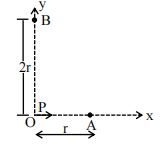
For a short dipole placed at origin O , the dipole moment P is along x -axis,
as shown in the figure. If the electric potential and electric field at A are
and , respectively, then the correct combination of the
electric potential and electric field, respectively, at point on the -axis is given by
- Option A:
and
- Option B:
zero and
- Option C:
zero and
- Option D:
and
Answer: CStep-by-step solution → - Question 52Physics· Units, Dimensions & Error Analysis
Which one of the following is the correct dimensional formula for the
capacitance in F? M, and C stand for unit of
mass, length, time and charge,
- Option A:
- Option B:
- Option C:
- Option D:
Answer: DStep-by-step solution → - Question 53Physics· Atomic Physics
An electron projected perpendicular to a uniform magnetic field B moves in a circle. If Bohr's quantization is applicable, then the radius of the electronic orbit in the first excited state is :
- Option A:
- Option B:
- Option C:
- Option D:
Answer: AStep-by-step solution → - Question 54Physics· Kinetic Theory of Gases
For a diatomic gas, if for rigid molecules and for another diatomic molecules, but also having vibrational modes. Then, which one of the following options is correct ? ( Cp and Cv are specific heats of the gas at constant pressure and volume)
- Option A:
- Option B:
- Option C:
- Option D:
Answer: DStep-by-step solution → - Question 55Physics· Atomic Physics
A light source of wavelength illuminates a metal surface and electrons
are ejected with maximum kinetic energy of 2 eV . If the same surface is illuminated
by a light source of wavelength , then the maximum kinetic energy of
ejected electrons will be (The work function of metal is 1 eV )
- Option A:
2 Ev
- Option B:
6 eV
- Option C:
5 eV
- Option D:
3 eV
Answer: CStep-by-step solution → - Question 56Physics· Rotational Dynamics
The torque due to the force about the origin,
acting on a particle whose position vector is
, would be
- Option A:
- Option B:
- Option C:
- Option D:
Answer: CStep-by-step solution → - Question 57Physics· Work, Power & Energy
A force is applied on a particle and it
undergoes a displacement .
What will be the value of , if work done on the particle is zero.
- Option A:
0
- Option B:
- Option C:
- Option D:
2
Answer: BStep-by-step solution → - Question 58Physics· Wave Optics
Given below are two statements. On is labelled as Assertion (A) and the other is labelled as Reason (R).
Assertion (A) : In Young's double slit experiment, the fringes produced by red light are closer as compared to those produced by blue light.
Reason (R) : The fringe width is directly proportional to the wavelength of light.
In the light of above statements, choose the correct answer from the options given below :
- Option A:
Both (A) and (R) are true and (R) is the correct explanation of (A)
- Option B:
(A) is false but (R) is true
- Option C:
Both (A) and (R) are true but (R) is NOT the correct explanation of (A)
- Option D:
(A) is true but ( ) is false
Answer: BStep-by-step solution → - Question 59Physics· Motion in Plane
A ball of mass 100 g is projected with velocity
at with horizontal. The decrease in kinetic energy of the ball during
the motion from point of projection to highest point is :
- Option A:
20 J
- Option B:
15 J
- Option C:
zero
- Option D:
5 J
Answer: BStep-by-step solution → - Question 60Physics· Fluid Mechanics
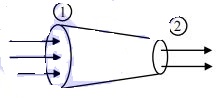
The tube of length is shown in the figure. The radius of cross section at the
point (1) is 2 cm and at the point (2) is 1 cm , respectively. If the velocity of water
entering at point (1) is , then velocity of water
leaving the point (2) will be :
- Option A:
- Option B:
- Option C:
- Option D:
Answer: DStep-by-step solution → - Question 61Physics· Thermodynamics
Given are statements for certain thermodynamic variables, (A) Internal energy,
volume (V) and mass (M) are extensive variables. (B) Pressure (P), temperature (T)
and density ( ) are intensive variables. (C) Volume (V), temperature (T) and
density ( ) are intensive variables. (D) Mass (M), temperature (T) and internal
energy are extensive variables. Choose the correct answer from the points given below :
- Option A:
(C) and (D) only
- Option B:
(D) and (A) only
- Option C:
(A) and (B) only
- Option D:
(B) and (C) only
Answer: CStep-by-step solution → - Question 62Physics· Moving Charges and Magnetic Field
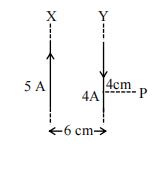
Two long parallel wires and , separated by a distance of 6 cm , carry
currents of 5 A and 4 A , respectively, in opposite directions as shown in the figure.
Magnitude of the resultant magnetic field at point P at a distance of 4 cm from
wire Y is . The value of is .
Take permeability of free space as SI units.
 Answer: 1Step-by-step solution →
 - Question 63Physics· Electromagnetic Waves
A parallel plate capacitor of area and separation
between the plates 10 cm , is charged by a DC current. Consider a hypothetical
plane surface of area inside the capacitor and
parallel to the plates. At an instant, the current through the circuit is 6 A . At the
same instant the displacement current through is mA .
Answer: 1200Step-by-step solution →
Stuck on one of these?
Practise questions like them — free, with a tutor that explains every step.