JEE Main 2025 · previous year paper
JEE Main 2025 — 3 April, Morning Shift
67 questions with the verified answer key. Open any question for its step-by-step solution.
- Question 1Chemistry· Solutions and Colligative Properties
moles each of ethylene glycol and glucose are dissolved in of water. The boiling point of the resulting solution is:
(Given: )
- Option A:
377.3 K
- Option B:
375.3 K
- Option C:
379.2 K
- Option D:
277.3 K
Answer: AStep-by-step solution → - Question 2Chemistry· Aldehydes and Ketones
Which compound would give 3-methyl-6oxoheptanal upon ozonolysis?
- Option A:

- Option B:

- Option C:

- Option D:

Answer: CStep-by-step solution → - Question 3Chemistry· Some Basic Concepts of Chemistry (Mole Concept) + Stoichiometry
Among (each) of the following elements, which one will have the highest number of atoms?
Elements: Pb, Po, Pr and Pt
- Option A:
Po
- Option B:
Pb
- Option C:
Pt
- Option D:
Pr
Answer: DStep-by-step solution → - Question 4Chemistry· Electrochemistry
Correct order of limiting molar conductivity for cations in water at 298 K is :
- Option A:
- Option B:
- Option C:
- Option D:
Answer: CStep-by-step solution → - Question 5Chemistry· Structure of Atom
Which of the following postulate of Bohr's model of hydrogen atom is not in agreement with quantum mechanical model of an atom?
- Option A:
The electron in a H-atom's stationary state moves in a circle around the nucleus.
- Option B:
An atom in a stationary state does not emit electromagnetic radiation as long as it stays in the same state.
- Option C:
When an electron makes a transition from a higher energy stationary state to a lower energy stationary state, then it emits a photon of light.
- Option D:
An atom can take only certain distinct energies , etc. These allowed states of constant energy are called the stationary states of atom.
Answer: AStep-by-step solution → - Question 6Chemistry· Aldehydes and Ketones
Number of molecules from below which cannot give iodoform reaction is : Ethanol, Isopropyl alcohol, Bromoacetone, 2Butanol, 2-Butanone, Butanal, 2-Pentanone, 3Pentanone, Pentanal and 3-Pentanol.
- Option A:
2
- Option B:
5
- Option C:
3
- Option D:
4
Answer: DStep-by-step solution → - Question 7Chemistry· Surface Chemistry
Given below are two statements :
Statement (I) : A catalyst cannot alter the equilibrium constant of the reaction, temperature remaining constant.
Statement (II) : A homogenous catalyst can change the equilibrium composition of a system, temperature remaining constant.
In the light of the above statements, choose the correct answer from the options given below.
- Option A:
Both Statement-I and Statement-II are false
- Option B:
Both Statement-I and Statement-II are true
- Option C:
Statement-I is true but Statement-II is false
- Option D:
Statement-I is false but Statement-II is true
Answer: CStep-by-step solution → - Question 8Chemistry· Coordination Compounds
Match the LIST-I with LIST-II
LIST-I (Molecules/ion) LIST-II (Hybridisation of central atmn) A. I. B. II. C. III. D. IV. Choose the correct answer from the options given below:
- Option A:
A-III, B-I, C-IV, D-II
- Option B:
A-II, B-III, C-IV, D-I
- Option C:
A-I, B-II, C-III, D-IV
- Option D:
A-IV, B-I, C-II, D-III
Answer: BStep-by-step solution → - Question 9Chemistry· Chemical Kinetics
In a reaction , initial concentrations of and are related as . The half lives of and are 10 min and 40 min , respectively, If they start to disappear at the same time, both following first order kinetics, after how much time will the concentration of both the reactants be same?
- Option A:
40 min
- Option B:
20 min
- Option C:
80 min
- Option D:
60 min
Answer: AStep-by-step solution → - Question 10Chemistry· General Organic Chemistry
The least acidic compound, among the following is

- Option A:
A
- Option B:
D
- Option C:
C
- Option D:
B
Answer: BStep-by-step solution → - Question 11Chemistry· Coordination Compounds
The metal ions that have the calculated spin only magnetic moment value of 4.9 B.M. are
A.
B.
C.
D.
E.
Choose the correct answer from the options given below:
- Option A:
B and E only
- Option B:
A, B and E only
- Option C:
A, D and E only
- Option D:
A, C and E only
Answer: BStep-by-step solution → - Question 12Chemistry· p-Block Elements (Group 15-18)
Given below are two statements, one is labelled as Statement I and the other is labelled as Statement II.
Statement I: The single bond is weaker and longer than that of single bond.
Statement II: Compounds of group 15 elements in +3 oxidation states readily undergo disproportionation reactions.
In the light of the above statements, choose the correct answer from the options given below :
- Option A:
Statement I is false but Statement II is true
- Option B:
Statement I is true but Statement II is false
- Option C:
Both Statement I and Statement II are true
- Option D:
Both Statement I and Statement II are false
Answer: DStep-by-step solution → - Question 13Chemistry· Periodicity of Elements and Periodic Properties
Which of the following statements are correct?
A. The process of adding an electron to a neutral gaseous atom is always exothermic.
B. The process of removing an electron from an isolated gaseous atom is always endothermic.
C. The 1st ionization energy of boron is less than that of beryllium.
D. The electronegativity of C is 2.5 in and
E. Li is the most electropositive among elements of group 1 .
Choose the correct answer from the options given below:
- Option A:
B and D Only
- Option B:
B, C and E Only
- Option C:
A, C and D Only
- Option D:
B and C Only
Answer: DStep-by-step solution → - Question 14Chemistry· Coordination Compounds
The correct order of the complexes
(C) and
in terms of wavelength of light absorbed is
- Option A:
C B A D
- Option B:
D C B A
- Option C:
C B D A
- Option D:
Answer: DStep-by-step solution → - Question 15Chemistry· Coordination Compounds
The number of optical isomers exhibited by the iron complex (A) obtained from the following reaction is .
Answer: 2Step-by-step solution → - Question 16Chemistry· Practical Organic Chemistry
During estimation of nitrogen by Dumas' method of compound X (0.42 g)

mL of gas will be liberated at STP. (nearest integer)
(Given molar mass in )
Answer: 109Step-by-step solution → - Question 17Chemistry· Thermodynamics & Thermochemistry
Given : graphite
The for is (nearest integer value)
Answer: 25Step-by-step solution → - Question 18Chemistry· Some Basic Concepts of Chemistry (Mole Concept) + Stoichiometry
0.5 g of an organic compound on combustion gave 1.46 g of and 0.9 g of . The percentage of carbon in the compound is . (Nearest integer) [Given : Molar mass (in ) : 16]
Answer: 80Step-by-step solution → - Question 19Chemistry· d and f Block Elements
Consider the following reactions
The number of terminal ' ' present in the compound ' ' is
Answer: 6Step-by-step solution → - Question 20Mathematics· Matrices
Let A be a matrix of order and . If then
is equal to
- Option A:
25
- Option B:
26
- Option C:
27
- Option D:
28
Answer: CStep-by-step solution → - Question 21Mathematics· 3D Geometry
Let a line passing through the point intersect the line at the point A
and the line at the point . Then is equal to
- Option A:
8
- Option B:
16
- Option C:
12
- Option D:
6
Answer: AStep-by-step solution → - Question 22Mathematics· Quadratic Equations
Let and be the roots of , and and be the roots of . If
and , then is equal to
- Option A:
3
- Option B:
4
- Option C:
5
- Option D:
7
Answer: CStep-by-step solution → - Question 23Mathematics· Binomial Theorem
The sum of all rational terms in the expansion of is
- Option A:
16923
- Option B:
3763
- Option C:
33845
- Option D:
18817
Answer: DStep-by-step solution → - Question 24Mathematics· Sets and Relations
Let ,. Let be a relation on A defined by xRy if and only if . Let be the number of elements in R and be the minimum number of elements required
to be added in R to make it a reflexive relation. then is equal to
- Option A:
19
- Option B:
20
- Option C:
17
- Option D:
18
Answer: DStep-by-step solution → - Question 25Mathematics· Ellipse
A line passing through the point intersects the ellipse at and such that
is maximum. Then is equal to :
- Option A:
218
- Option B:
377
- Option C:
290
- Option D:
338
Answer: DStep-by-step solution → - Question 26Mathematics· Sequence and Series
The sum .. upto 20 terms, is equal to
- Option A:
7240
- Option B:
7130
- Option C:
6982
- Option D:
8124
Answer: AStep-by-step solution → - Question 27Mathematics· Functions
If the domain of the function is , then is
equal to
- Option A:
5
- Option B:
4
- Option C:
3
- Option D:
7
Answer: BStep-by-step solution → - Question 28Mathematics· Binomial Theorem
If , then is equal to
- Option A:
27
- Option B:
9
- Option C:
81
- Option D:
18
Answer: CStep-by-step solution → - Question 29Mathematics· Application of Derivatives
The number of solutions of the equation is :
- Option A:
6
- Option B:
5
- Option C:
4
- Option D:
3
Answer: BStep-by-step solution → - Question 30Mathematics· Methods of Differentiation
If , then is equal to:
- Option A:
-1
- Option B:
28
- Option C:
27
- Option D:
1
Answer: AStep-by-step solution → - Question 31Mathematics· Differential Equations
Let be a differentiable function such that and let
satisfy the differential equation . If , then
is equal to
- Option A:
- Option B:
- Option C:
- Option D:
Answer: BStep-by-step solution → - Question 32Mathematics· Straight lines
A line passes through the origin and makes equal angles with the positive coordinate axes. It intersects the lines
and , at the points A and B , respectively. If
and the foot of the perpendicular from the point A on the line is , then is equal to
- Option A:
5
- Option B:
4
- Option C:
2
- Option D:
3
Answer: DStep-by-step solution → - Question 33Mathematics· Complex Numbers
Let be such that . Then the sum of all possible values of is
- Option A:
- Option B:
- Option C:
- Option D:
Answer: BStep-by-step solution → - Question 34Mathematics· Indefinite Integration
Let . If , then is equal to
- Option A:
- Option B:
- Option C:
- Option D:
Answer: DStep-by-step solution → - Question 35Mathematics· Sequence and Series
Let be a G. P. of increasing positive numbers. If and , then
is equal to
- Option A:
131
- Option B:
130
- Option C:
129
- Option D:
128
Answer: CStep-by-step solution → - Question 36Mathematics· Functions
Let the domain of the function be . If
, where is the greatest integer
function, then is equal to
- Option A:
10
- Option B:
8
- Option C:
11
- Option D:
9
Answer: AStep-by-step solution → - Question 37Mathematics· Parabola
The radius of the smallest circle which touches the parabolas and is
- Option A:
- Option B:
- Option C:
- Option D:
Answer: DStep-by-step solution → - Question 38Mathematics· Limits, Continuity and Differentiability
Let be continuous at . Then is equal to
- Option A:
64
- Option B:
72
- Option C:
48
- Option D:
36
Answer: CStep-by-step solution → - Question 39Mathematics· 3D Geometry
Line passes through the point and is parallel to z-axis. Line passes through the point
and is parallel to -axis. Let for , the shortest distance between the two lines be 3 . Then the square of the distance of the point from the line is
- Option A:
40
- Option B:
32
- Option C:
25
- Option D:
37
Answer: CStep-by-step solution → - Question 40Mathematics· Probability
All five letter words are made using all the letters A, B, C, D, E and arranged as in an English dictionary with serial
numbers. Let the word at serial number be denoted by . Let the probability of choosing the word
satisfy . If , then is
equal to:
Answer: 183Step-by-step solution → - Question 41Mathematics· Hyperbola
Let the product of the focal distances of the point on the hyperbola be 32.
Let the length of the conjugate axis of H be p and the length of its latus rectum be q . Then is equal to ......
Answer: 120Step-by-step solution → - Question 42Mathematics· Vector Algebra
Let and be a unit vector such that and
, If is perpendicular to , then is equal to .
Answer: 5Step-by-step solution → - Question 43Mathematics· Permutations and Combinations
If the number of seven-digit numbers, such that the sum of their digits is even, is ;
, then is equal to
Answer: 14Step-by-step solution → - Question 44Mathematics· Area under the Curves
The area of the region bounded by the curve , then -axis and the lines and is equal to .
Answer: 12Step-by-step solution → - Question 45Physics· Nuclear Physics
Match the List-I with List-II Choose the correct answer from the options given below:
List-I List-II A. I. Chemical reaction B. II. Fusion with +ve Q value C. III. Fission D. IV. Fusion with -ve Q value - Option A:
A-III, B-I, C-IV, D-II
- Option B:
A-II, B-I, C-IV, D-III
- Option C:
A-III, B-I, C-II, D-IV
- Option D:
A-II, B-I, C-III, D-IV
Answer: CStep-by-step solution → - Question 46Physics· Gravitation
A particle is released from height above the surface of the earth. At certain height its kinetic energy is three times its potential energy. The height from the surface of the earth and the speed of the particle at that instant are respectively.
- Option A:
- Option B:
- Option C:
- Option D:
Answer: BStep-by-step solution → - Question 47Physics· Geometrical Optics
Consider following statements for refraction of light through prism, when angle of deviation is minimum.
A. The refracted ray inside prism becomes parallel to the base.
B. Larger angle prisms provide smaller angle of minimum deviation.
C. Angle of incidence and angle of emergence becomes equal.
D. There are always two sets of angle of incidence for which deviation will be same except at minimum deviation setting.
E. Angle of refraction becomes double of prism angle.
Choose the correct answer from the options given below:
- Option A:
A, B and E only
- Option B:
B, D and E only
- Option C:
B, C and D only
- Option D:
A, C and D only
Answer: DStep-by-step solution → - Question 48Physics· Atomic Physics
The radiation pressure exerted by a 450 W light source on a perfectly reflecting surface placed at 2 m away from it, is
- Option A:
Pascals
- Option B:
0
- Option C:
Pascals
- Option D:
Pascals
Answer: CStep-by-step solution → - Question 49Physics· Capacitors and R-C Circuits
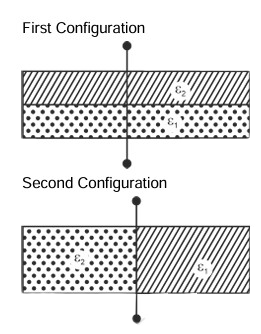
A parallel plate capacitor is filled equally (half) with two dielectrics of dielectric constants and , as shown in figures. The distance between the plates is and area of each plate is . If capacitance in first configuration and second configuration are and respectively, then is
- Option A:
- Option B:
- Option C:
- Option D:
Answer: AStep-by-step solution → - Question 50Physics· Units, Dimensions & Error Analysis
A person measures mass of 3 different particles as and 0.125 g . According to the rules for arithmetic operations with significant figures, the addition of the masses of 3 particles will be
- Option A:
661.8 g
- Option B:
661.84 g
- Option C:
662 g
- Option D:
661.845 g
Answer: AStep-by-step solution → - Question 51Physics· Thermodynamics
During the melting of a slab of ice at 273 K at atmospheric pressure:
- Option A:
Internal energy of ice-water system remains unchanged
- Option B:
Internal energy of the ice-water system decreases
- Option C:
Positive work is done by the ice-water system on the atmosphere
- Option D:
Positive work is done on the ice-water system by the atmosphere
Answer: DStep-by-step solution → - Question 52Physics· Atomic Physics
The work function of a metal is 3 eV . The color of the visible light that is required to cause emission of photoelectrons is
- Option A:
Red
- Option B:
Yellow
- Option C:
Green
- Option D:
Blue
Answer: DStep-by-step solution → - Question 53Physics· Units, Dimensions & Error Analysis
Match the List-I with List-II Choose the correct answer from the options given below:
List-I List-II A. Gravitational constant I. B. Gravitational potential energy II. C. Gravitational potential III. D. Acceleration due to gravity IV. - Option A:
A-II, B-IV, C-III, D-I
- Option B:
A-IV, B-III, C-II, D-I
- Option C:
A-I, B-III, C-IV, D-II
- Option D:
A-III, B-II, C-I, D-IV
Answer: BStep-by-step solution → - Question 54Physics· Rotational Dynamics
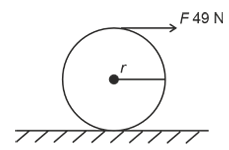
A force of 49 N acts tangentially at the highest point of a sphere (solid) of mass 20 kg , kept on a rough horizontal plane. If the sphere rolls without slipping, then the acceleration of the center of the sphere is
- Option A:
- Option B:
- Option C:
- Option D:
Answer: CStep-by-step solution → - Question 55Physics· Semiconductor and Electronic Devices
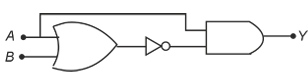
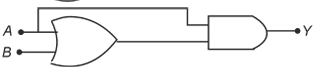
Choose the correct logic circuit for the given truth table having inputs and .
Inputs Output A B Y 0 0 0 0 1 0 1 0 1 1 1 1 - Option A:
- Option B:
- Option C:
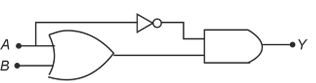
- Option D:
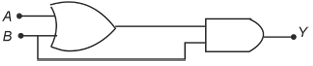
Answer: BStep-by-step solution → - Question 56Physics· Electrostatics
The electrostatic potential on the surface of uniformly charged spherical shell of radius is 120 V . The potential at the centre of shell, at a distance cm from centre, and at a distance from the centre of the shell respectively, are:
- Option A:
- Option B:
- Option C:
- Option D:
Answer: AStep-by-step solution → - Question 57Physics· Fluid Mechanics
Consider a completely full cylindrical water tank of height 1.6 m and of cross-sectional area . It has a small hole in its side at a height 90 cm from the bottom. Assume, the cross-sectional area of the hole to be negligibly small as compared to that of the water tank. If a load 50 kg is applied at the top surface of the water in the tank then the velocity of the water coming out at the instant when the hole is opened is: ( )
- Option A:
- Option B:
- Option C:
- Option D:
Answer: DStep-by-step solution → - Question 58Physics· Thermodynamics
A gas is kept in a container having walls which are thermally non-conducting. Initially the gas has a volume of and temperature . The change in temperature when the gas is adiabatically compressed to is : (Take ; is the ratio of specific heats at constant pressure and at constant volume)
- Option A:
300 K
- Option B:
522 K
- Option C:
327 K
- Option D:
600 K
Answer: AStep-by-step solution → - Question 59Physics· Simple Harmonic Motion
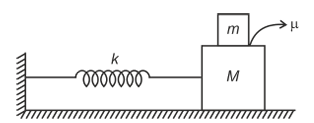
Two blocks of masses and are placed on a frictionless table as shown in figure. A massless spring with spring constant is attached with the lower block. If the system is slightly displaced and released, then ( coefficient of friction between the two blocks)
A. The time period of small oscillation of the two blocks is
B. The acceleration of the blocks is ( displacement of the blocks from the mean position)
C. The magnitude of the frictional force on the upper block is
D. The maximum amplitude of the upper block, if it does not slip, is E. Maximum frictional force can be Choose the correct answer from the options given below :
- Option A:
B, C, D only
- Option B:
A, B, C only
- Option C:
A, B, D only
- Option D:
C, D, E only
Answer: CStep-by-step solution → - Question 60Physics· Geometrical Optics
The radii of curvature for a thin convex lens are 10 cm and 15 cm respectively. The focal length of the lens is 12 cm . The refractive index of the lens material is
- Option A:
1.5
- Option B:
1.2
- Option C:
1.4
- Option D:
1.8
Answer: AStep-by-step solution → - Question 61Physics· Motion in one Dimension
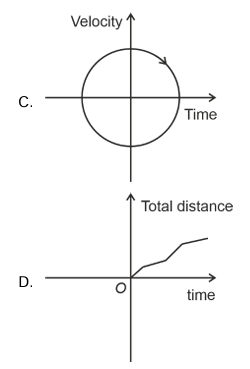
Which of the following curves possibly represent onedimensional motion of a particle? Choose the correct answer from the options given below :
A.

B.

- Option A:
A and B only
- Option B:
A, C and D only
- Option C:
A, B and C only
- Option D:
A, B and D only
Answer: DStep-by-step solution → - Question 62Physics· Current Electricity
A wire of length 25 m and cross-sectional area having resistivity is bent into a complete circle. The resistance between diametrically opposite points will be
- Option A:
- Option B:
- Option C:
- Option D:
Answer: DStep-by-step solution → - Question 63Physics· Moving Charges and Magnetic Field
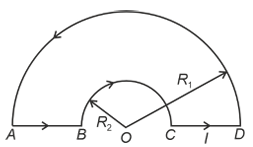
A loop , carrying current , is placed in a plane,
consists of two semi-circular segments of radius
and .
The magnitude of the resultant magnetic field at center is .
The value of is .
(Given )
 Answer: 1Step-by-step solution →
 - Question 64Physics· Current Electricity
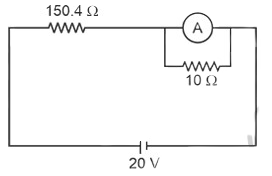
In the figure shown below, a resistance of is connected in series to an ammeter A of resistance . A shunt resistance of is connected in parallel with the ammeter. The reading of the ammeter is mA .
 Answer: 5Step-by-step solution →
 - Question 65Physics· Gravitation
Three identical spheres of mass , are placed at the vertices of an equilateral triangle of length .
When released, they interact only through gravitational force and collide after a time seconds.
If the sides of the triangle are increased to length and also the masses of the spheres are
made , then they will collide after seconds.
Answer: 8Step-by-step solution → - Question 66Physics· Wave Optics
Two coherent monochromatic light beams of intensities and are superimposed. The difference between the maximum and minimum intensities in the resulting interference pattern is I. The value of is
Answer: 24Step-by-step solution → - Question 67Physics· Moving Charges and Magnetic Field
A 4.0 cm long straight wire carrying a current of 8 A is placed perpendicular to a uniform magnetic field of strength 0.15 T . The magnetic force on the wire is mN .
Answer: 48Step-by-step solution →
Stuck on one of these?
Practise questions like them — free, with a tutor that explains every step.