JEE Main 2025 · previous year paper
JEE Main 2025 — 23 January, Evening Shift
71 questions with the verified answer key. Open any question for its step-by-step solution.
- Question 1Mathematics· Binomial Theorem
If in the expansion of , the coefficients of x and are 1 and -2 , respectively, then is equal to :
- Option A:
8
- Option B:
18
- Option C:
13
- Option D:
20
Answer: CStep-by-step solution → - Question 2Mathematics· Sets and Relations
Let and . If
or , then is :
- Option A:
15
- Option B:
18
- Option C:
24
- Option D:
12
Answer: DStep-by-step solution → - Question 3Mathematics· Matrices
The system of equations , , , has no solution if
- Option A:
- Option B:
- Option C:
- Option D:
Answer: AStep-by-step solution → - Question 4Mathematics· Indefinite Integration
Let , where is the constant of integration. If
, Then equals :
- Option A:
55
- Option B:
47
- Option C:
48
- Option D:
62
Answer: AStep-by-step solution → - Question 5Mathematics· Straight lines
A rod of length eight units moves such that its ends and always lie on the lines and ,
respectively. If the locus of the point , that divides the rod AB internally in the ratio is
, then is equal to :
- Option A:
24
- Option B:
23
- Option C:
21
- Option D:
22
Answer: BStep-by-step solution → - Question 6Mathematics· 3D Geometry
The distance of the line from the point along the line
is :
- Option A:
- Option B:
- Option C:
- Option D:
Answer: BStep-by-step solution → - Question 7Mathematics· Vector Algebra
Let the point A divide the line segment joining the points and
internally in the ratio . If O is the origin and , then the
value of r is :
- Option A:
- Option B:
- Option C:
- Option D:
Answer: DStep-by-step solution → - Question 8Mathematics· Area under the Curves
If the area of the region
is , then the value of is :
- Option A:
7
- Option B:
6
- Option C:
8
- Option D:
5
Answer: DStep-by-step solution → - Question 9Mathematics· Application of Derivatives
A spherical chocolate ball has a layer of ice-cream of uniform thickness around it. When the thickness of the ice-cream layer is 1 cm , the ice-cream melts at the rate of and the thickness of the ice-cream layer decreases at the rate of . The surface area (in ) of the chocolate ball (without the ice-cream layer) is :
- Option A:
- Option B:
- Option C:
- Option D:
Answer: DStep-by-step solution → - Question 10Mathematics· Probability
A board has 16 squares as shown in the figure : Out of these 16 squares, two squares are chosen at random. The probability that they have no side in common is :

- Option A:
- Option B:
- Option C:
- Option D:
Answer: AStep-by-step solution → - Question 11Mathematics· Differential Equations
Let be the solution of the differential equation and
. Then is equal to :
- Option A:
- Option B:
- Option C:
- Option D:
Answer: BStep-by-step solution → - Question 12Mathematics· Functions
Let the range of the function
be . Then the distance of the point from the line is :
- Option A:
11
- Option B:
8
- Option C:
10
- Option D:
9
Answer: AStep-by-step solution → - Question 13Mathematics· Parabola
Let the shortest distance from , to the parabola be 4 . Then the equation of the circle passing through the point and the focus of the parabola, and having its centre on the axis of the parabola is:
- Option A:
- Option B:
- Option C:
- Option D:
Answer: AStep-by-step solution → - Question 14Mathematics· Sets and Relations
Given below are two statements : one is labelled as Statement I and the other is labelled as Statement II:
Let . Define a relation on as: .
Statement I: R is an equivalence relation.
Statement II: For some , the set represents a line parallel to .
In the light of the above statements, choose the correct answer from the options given below :
- Option A:
Both Statement-I and Statement-II are false.
- Option B:
Statement-I is true but Statement-II is false.
- Option C:
Both Statement-I and Statement-II are true.
- Option D:
Statement-I is false but Statement-II is true.
Answer: BStep-by-step solution → - Question 15Mathematics· Ellipse
The length of the chord of the ellipse , whose mid-point is , is:
- Option A:
- Option B:
- Option C:
- Option D:
Answer: AStep-by-step solution → - Question 16Mathematics· Matrices
- Option A:
3
- Option B:
0
- Option C:
2
- Option D:
1
Answer: AStep-by-step solution → - Question 17Mathematics· Complex Numbers
The number of complex numbers , satisfying and ; , is :
- Option A:
6
- Option B:
4
- Option C:
10
- Option D:
8
Answer: DStep-by-step solution → - Question 18Mathematics· 3D Geometry
If the square of the shortest distance between the lines and is , where are coprime numbers, then is equal to:
- Option A:
6
- Option B:
9
- Option C:
21
- Option D:
14
Answer: BStep-by-step solution → - Question 19Mathematics· Definite Integration
If , then equals:
- Option A:
- Option B:
- Option C:
- Option D:
Answer: AStep-by-step solution → - Question 20Mathematics· Limits, Continuity and Differentiability
- Option A:
- Option B:
- Option C:
- Option D:
Answer: DStep-by-step solution → - Question 21Mathematics· Permutations and Combinations
The number of ways, 5 boys and 4 girls can sit in a row so that either all the boys sit together or no two boys sit together, is .
Answer: 17280Step-by-step solution → - Question 22Mathematics· Quadratic Equations
Let be the roots of the equation with . Let
. If and , then
is equal to .
Answer: 31Step-by-step solution → - Question 23Mathematics· Circles
The focus of the parabola is the centre of the circle C of radius 5 . If the values of , for which C passes through the point of intersection of the lines and , are and , then is equal to .
Answer: 15Step-by-step solution → - Question 24Mathematics· Statistics
The variance of the numbers , is
Answer: 8788Step-by-step solution → - Question 25Mathematics· Sequence and Series
The roots of the quadratic equation are and terms of an arithmetic progression with common difference . If the sum of the first 11 terms of this arithmetic progression is 88 , then is equal to
Answer: 474Step-by-step solution → - Question 26Chemistry· Thermodynamics & Thermochemistry
The effect of temperature on spontaneity of reactions are represented as:
H S Temperature Spontaneity (A) + - any T Non Spontaneity (B) + + low T Spontaneity (C) - - low T Non Spontaneity (D) - + any T Spontaneity - Option A:
(B) and (D) only
- Option B:
(A) and (D) only
- Option C:
(B) and (C) only
- Option D:
(A) and (C) only
Answer: CStep-by-step solution → - Question 27Chemistry· Electrochemistry
Standard electrode potentials for a few half cells are mentioned below:
Which one of the following cells gives the most negative value of ?
- Option A:
- Option B:
- Option C:
- Option D:
Answer: AStep-by-step solution → - Question 28Chemistry· Biomolecules
The - Helix and - Pleated sheet structures of protein are associated with its:
- Option A:
quaternary structure
- Option B:
primary structure
- Option C:
secondary structure
- Option D:
tertiary structure
Answer: CStep-by-step solution → - Question 29Chemistry· General Organic Chemistry
Given below are two statements:
Consider the following reaction

Statement (I): In the case of formaldehyde

Statement (II) : In the case of trichloro acetaldehyde

In the light of the above statements,
choose the correct answer from the options given below:
- Option A:
Statement I true but Statement II is false
- Option B:
Both Statement I and Statement II are true
- Option C:
Statement I is false but Statement II is true
- Option D:
Both Statement I and Statement II are false
Answer: BStep-by-step solution → - Question 30Chemistry· Chemical Equilibrium
Consider the reaction
The equation representing correct relationship between the degree of dissociation ( x ) of
with its equilibrium constant Kp is____.
Assume x to be very very small.
- Option A:
- Option B:
- Option C:
- Option D:
Answer: BStep-by-step solution → - Question 31Chemistry· Ionic Equilibrium
Identify and C in the given below reaction sequence

- Option A:
- Option B:
- Option C:
- Option D:
Answer: BStep-by-step solution → - Question 32Chemistry· Alcohols, Ethers and Phenols
Given below are two statements : one is labelled as Statement I and the other is labelled as Statement II :
Statement (I) : The boiling points of alcohols and phenols increase with increase in the number of C atoms.
Statement (II) : The boiling points of alcohols and phenols are higher in comparison to other class of compounds such as ethers, haloalkanes.
In the light of the above statements, choose the correct answer from the options given below:
- Option A:
Both Statement I and Statement II are false
- Option B:
Statement I is false but Statement II is true
- Option C:
Statement I is true but Statement II is false
- Option D:
Both Statement I and Statement II are true
Answer: BStep-by-step solution → - Question 33Chemistry· Solutions and Colligative Properties
When a non-volatile solute is added to the solvent, the vapour pressure of the solvent decreases by 10 mm of Hg . The mole fraction of the solute in the solution is 0.2 . What would be the mole fraction of the solvent if decrease in vapour pressure is 20 mm of Hg ?
- Option A:
0.6
- Option B:
0.4
- Option C:
0.2
- Option D:
0.8
Answer: AStep-by-step solution → - Question 34Chemistry· Structure of Atom
Given below are two statements, one is labelled as Statement I and the other is labelled as Statement II.
Statement (I) : For a given shell, the total number of allowed orbitals is given by .
Statement (II) : For any subshell, the spatial orientation of the orbitals is given by to values including zero.
In the light of the above statements, choose the correct answer from the options given below:
- Option A:
Statement I is true but Statement II is false
- Option B:
Statement I is false but Statement II is true
- Option C:
Both Statement I and Statement II are true
- Option D:
Both Statement I and Statement II are false
Answer: CStep-by-step solution → - Question 35Chemistry· Aromatic Compounds
The ascending order of relative rate of solvolysis of following compounds is

- Option A:
(D) (A) (B) (C)
- Option B:
(C) (B) (A) (D)
- Option C:
(D) (B) (A) (C)
- Option D:
C (D) (B) (A)
Answer: AStep-by-step solution → - Question 36Chemistry· d and f Block Elements
Match List - I with List - II.
List - I List - II (A) Bronze (I) (B) Brass (II) (C) UK silver coin (III) (D) Stainless Steel (IV) Choose the correct answer from the options given below :
- Option A:
(A)-(IV), (B)-(II), (C)-(III), (D)-(I)
- Option B:
(A)-(IV), (B)-(III), (C)-(I), (D)-(II)
- Option C:
(A)-(III), (B)-(I), (C)-(IV), (D)-(II)
- Option D:
(A)-(III), (B)-(IV), (C)-(II), (D)-(I)
Answer: BStep-by-step solution → - Question 37Chemistry· Coordination Compounds
Identify the coordination complexes in which the central metal ion has configuration.
(A)
(B)
(C)
(D) (E)
Choose the correct answer from the options given below :
- Option A:
(C) and (E) only
- Option B:
(B), (C) and (D) only
- Option C:
(B) and (D) only
- Option D:
(A), (B) and (E) only
Answer: CStep-by-step solution → - Question 38Chemistry· p-Block (I) (Grp. 13, 14)
Given below are the atomic numbers of some group 14 elements. The atomic number of the element with lowest melting point is :
- Option A:
14
- Option B:
6
- Option C:
82
- Option D:
50
Answer: DStep-by-step solution → - Question 39Chemistry· Ionic Equilibrium
The pH of water is at . If water is heated to , its pH will:
- Option A:
Decrease
- Option B:
Remains the same
- Option C:
concentration increases, concentration decreases
- Option D:
Increase
Answer: AStep-by-step solution → - Question 40Chemistry· Solutions and Colligative Properties
Consider a binary solution of two volatile liquid components 1 and and are the mole fractions of component 1 in liquid and vapour phase, respectively. The slope and intercept of the linear plot of vs are given respectively as :
- Option A:
- Option B:
- Option C:
- Option D:
Answer: AStep-by-step solution → - Question 41Chemistry· Structure of Atom
Given below are two statements about X-ray spectra of elements :
Statement (I) : A plot of frequency of X-rays emitted) vs atomic mass is a straight line.
Statement (II) : A plot of frequency of X-rays emitted) vs atomic number is a straight line.
In the light of the above statements choose the correct answer from the options given below :
- Option A:
Statement I is true but Statement II is false
- Option B:
Both Statement I and Statement II are true
- Option C:
Both Statement I and Statement II are false
- Option D:
Statement I is false but Statement II is true
Answer: CStep-by-step solution → - Question 42Chemistry· d and f Block Elements
Consider the following reactions:
The products and , respectively are :
- Option A:
and
- Option B:
and
- Option C:
and
- Option D:
and
Answer: CStep-by-step solution → - Question 43Chemistry· Some Basic Concepts of Chemistry (Mole Concept) + Stoichiometry
mole of an organic compound containing hydrogen, on complete combustion, produced of .
Find the molar mass of in .
Answer: 100Step-by-step solution → - Question 44Chemistry· Nitrogen Containing Organic Compounds
Consider the following sequence of reactions.

Total number of hybridised carbon atoms in the major product C formed is___ .
Answer: 4Step-by-step solution → - Question 45Chemistry· Some Basic Concepts of Chemistry (Mole Concept) + Stoichiometry
When of reacts with of , find the mass of formed (nearest integer).
(Given: molar mass of and molar mass of .)
Answer: 153Step-by-step solution → - Question 46Chemistry· Thermodynamics & Thermochemistry
The bond dissociation enthalpy of
calculated from the given data is . (Nearest integer)
[Given : is a pure ionic compound and X forms a diatomic molecule is gaseous state]
Answer: 200Step-by-step solution → - Question 47Chemistry· Hydrocarbons
A compound ' X ' absorbs 2 moles of hydrogen and ' X ' upon oxidation with gives

The total number of bonds present in the compound ' X ' is .
Answer: 27Step-by-step solution → - Question 48Physics· Motion in Plane
A ball having kinetic energy KE , is projected at an angle of from the horizontal. What will be the kinetic energy of ball at the highest point of its flight?
- Option A:
- Option B:
- Option C:
- Option D:
Answer: BStep-by-step solution → - Question 49Physics· Electrostatics
Two charges and are placed at ( -7 cm , and ( ) respectively. Given, , the electrostatic potential energy of the charge configuration is :
- Option A:
-1.5 J
- Option B:
-2.0 J
- Option C:
-1.2 J
- Option D:
-1.8 J
Answer: DStep-by-step solution → - Question 50Physics· Geometrical Optics
The refractive index of the material of a glass prism is . The angle
of minimum deviation is equal to the angle of the prism. What is the angle of the prism?
- Option A:
- Option B:
- Option C:
- Option D:
Answer: BStep-by-step solution → - Question 51Physics· Transverse waves
The equation of a transverse wave travelling along a string is
, where x is in the mm
and t is in second. The velocity of the wave is :
- Option A:
- Option B:
- Option C:
- Option D:
Answer: CStep-by-step solution → - Question 52Physics· Units, Dimensions & Error Analysis
The energy of a system is given as , where is the time and . The errors in the measurement of and t are and , respectively. At , maximum percentage error in the energy is :
- Option A:
0.04
- Option B:
0.116
- Option C:
0.06
- Option D:
0.084
Answer: CStep-by-step solution → - Question 53Physics· Atomic Physics
In photoelectric effect an em-wave is incident on a metal surface and electrons are ejected from the surface. If the work function of the metal is 2.14 eV and stopping potential is 2 V , what is the wavelength of the em-wave?
(Given hc where h is the Planck's constant and c is the speed of light in vaccum.)
(1) 400 nm
- Option A:
400nm
- Option B:
600nm
- Option C:
200nm
- Option D:
300nm
Answer: DStep-by-step solution → - Question 54Physics· Rotational Dynamics
A circular disk of radius meter and mass is rotating around the axis perpendicular to the disk. An external torque is applied to the disk such that , where is the angular position of the rotating disc as a function of time .
How much power is delivered by the applied torque, when ?
- Option A:
- Option B:
- Option C:
- Option D:
Answer: AStep-by-step solution → - Question 55Physics· Fluid Mechanics
Water flows in a horizontal pipe whose one end is closed with a valve. The reading of the pressure gauge attached to the pipe is . The reading of the pressure gauge falls to when the valve is opened. The speed of water flowing in the pipe is proportional to
- Option A:
- Option B:
- Option C:
- Option D:
Answer: AStep-by-step solution → - Question 56Physics· Units, Dimensions & Error Analysis
Match List-I with List-II.
List-I List-II A Permeability of free space I B Magnetic field II C Magnetic moment III D Torsional constant IV Choose the correct answer from the options given below :
- Option A:
(A)-(I), (B)-(IV), (C)-(II), (D)-(III)
- Option B:
(A)-(II), (B)-(I), (C)-(III), (D)-(IV)
- Option C:
(A)-(IV), (B)-(III), (C)-(I), (D)-(II)
- Option D:
(A)-(III), (B)-(II), (C)-(IV), (D)-(I)
Answer: DStep-by-step solution → - Question 57Physics· Gravitation
If a satellite orbiting the Earth is 9 times closer to the Earth than the Moon, what is the time period of rotation of the satellite? Given rotational time period of Moon days and gravitational attraction between the satellite and the moon is neglected.
- Option A:
1 Day
- Option B:
81 days
- Option C:
27 days
- Option D:
3 days
Answer: AStep-by-step solution → - Question 58Physics· Electrostatics
Two point charges and , constituting an electric dipole, are placed at and in a uniform electric field of strength . The work done on the dipole in rotating it from the equilibrium through is :
- Option A:
14.4mJ
- Option B:
18.4mJ
- Option C:
12.4mJ
- Option D:
16.4mJ
Answer: AStep-by-step solution → - Question 59Physics· Current Electricity
A galvanometer having a coil of resistance need 20 mA of current for full-scale deflection. If a maximum current of 3 A is to be measured using this galvanometer, the resistance of the shunt to be added to the galvanometer should be , where X is
- Option A:
447
- Option B:
298
- Option C:
149
- Option D:
596
Answer: CStep-by-step solution → - Question 60Physics· Wave Optics
The width of one of the two slits in Young's double slit experiment is d while that of the other slit is xd . If the ratio of the maximum to the minimum intensity in the interference pattern on the screen is then what is the value of ?
(Assume that the field strength varies according to the slit width.)
- Option A:
2
- Option B:
3
- Option C:
5
- Option D:
4
Answer: CStep-by-step solution → - Question 61Physics· Nuclear Physics
Given below are two statements. One is labelled as Assertion (A) and the other is labelled as Reason (R).
Assertion (A) : The binding energy per nucleon is found to be practically independent of the atomic number A, for nuclei with mass numbers between 30 and 170.
Reason (R): Nuclear force is long range.
In the light of the above statements, choose the correct answer from the options given below :
- Option A:
(A) is false but (R) is true
- Option B:
(A) is true but ( R ) is false
- Option C:
Both (A) and (R) are true and (R) is the correct explanation of (A)
- Option D:
Both (A) and (R) are true but (R) is NOT the correct explanation of (A)
Answer: BStep-by-step solution → - Question 62Physics· Thermodynamics
Water of mass gram is slowly heated to increase the temperature from to . The change in entropy of the water, given specific heat of water is , is :
- Option A:
zero
- Option B:
- Option C:
- Option D:
Answer: DStep-by-step solution → - Question 63Physics· Semiconductor and Electronic Devices
What is the current through the battery in the circuit shown below? Images
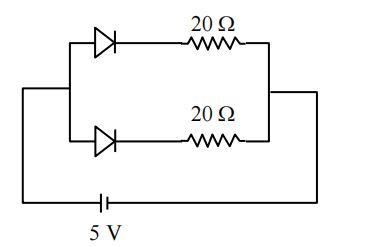
- Option A:
1.0A
- Option B:
1.5A
- Option C:
0.5A
- Option D:
0.25A
Answer: CStep-by-step solution → - Question 64Physics· Electromagnetic Waves
A plane electromagnetic wave of frequency 20 MHz travels in free space along the +x direction. At a particular point in space and time, the electric field vector of the wave is . Then, the magnetic field vector of the wave at that point is-
- Option A:
- Option B:
- Option C:
- Option D:
Answer: DStep-by-step solution → - Question 65Physics· Geometrical Optics
A concave mirror of focal length f in air is dipped in a liquid of refractive index μ. Its focal length in the liquid will be :
- Option A:
- Option B:
- Option C:
- Option D:
Answer: DStep-by-step solution → - Question 66Physics· Newton's Laws of Motion
A massless spring gets elongated by amount under a tension of 5 N . Its elongation is under the tension of 7 N . For the elongation of , the tension in the spring will be,
- Option A:
15N
- Option B:
20N
- Option C:
11N
- Option D:
39N
Answer: CStep-by-step solution → - Question 67Physics· Mechanical Properties of Matter
An air bubble of radius 1.0 mm is observed at a depth of 20 cm below the free surface of a liquid having surface tension and density . The difference between pressure inside the bubble and atmospheric pressure .
(Take )
Answer: 2190Step-by-step solution → - Question 68Physics· Gravitation
A satellite of mass M/2 is revolving around earth in a circular orbit at a height of R/3 from earth surface. The angular momentum of the satellite is M√(GMR/x). The value of x is , where M and R are the mass and radius of earth, respectively. ( G is the gravitational constant)
Answer: 3Step-by-step solution → - Question 69Physics· Capacitors and R-C Circuits
At steady state the charge on the capacitor, as shown in the circuit below, is .
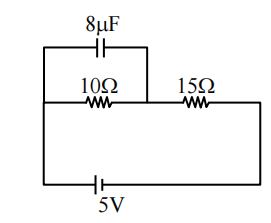 Answer: 16Step-by-step solution →
 - Question 70Physics· Capacitors and R-C Circuits
A time varying potential difference is applied between the plates of a parallel plate capacitor of capacitance . The dielectric constant of the medium between the capacitor plates is 1 . It produces an instantaneous displacement current of 0.25 mA in the intervening space between the capacitor plates, the magnitude of the rate of change of the potential difference will be .
Answer: 100Step-by-step solution → - Question 71Physics· Alternating Current
In a series LCR circuit, a resistor of , a capacitor of 25 nF and an inductor of 100 mH are used. For maximum current in the circuit, the angular frequency of the ac source is radians .
Answer: 2Step-by-step solution →
Stuck on one of these?
Practise questions like them — free, with a tutor that explains every step.