JEE Main 2025 · previous year paper
JEE Main 2025 — 29 January, Morning Shift
69 questions with the verified answer key. Open any question for its step-by-step solution.
- Question 1Chemistry· General Organic Chemistry
Total number of nucleophiles from the following is :,
- Option A:
5
- Option B:
4
- Option C:
7
- Option D:
6
Answer: AStep-by-step solution → - Question 2Chemistry· Electrochemistry
The standard reduction potential values of some of the p-block ions are given below. Predict the one with the strongest oxidising capacity.
- Option A:
- Option B:
- Option C:
- Option D:
Answer: DStep-by-step solution → - Question 3Chemistry· Chemical Equilibrium
At temperature , compound dissociates as having degree of dissociation x (small compared to unity). The correct expression for x in terms of and p is
- Option A:
- Option B:
- Option C:
- Option D:
Answer: CStep-by-step solution → - Question 4Chemistry· Some Basic Concepts of Chemistry (Mole Concept) + Stoichiometry
Choose the correct statements.
(A) Weight of a substance is the amount of matter present in it
(B) Mass is the force exerted by gravity on an object.
(C) Volume is the amount of space occupied by a substance
(D) Temperatures below are possible in Celsius scale, but in Kelvin scale negative temperature is not possible.
(E) Precision refers to the closeness of various measurements for the same quantity.
- Option A:
(B), (C) and (D) Only
- Option B:
(A), (B) and (C) Only
- Option C:
(A), (D) and (E) Only
- Option D:
(C), (D) and (E) Only
Answer: DStep-by-step solution → - Question 5Chemistry· Coordination Compounds
The correct increasing order of stability of the complexes based on value is :
(I)
(II)
(III)
(IV)
- Option A:
II III I IV
- Option B:
IV III II I
- Option C:
I II IV III
- Option D:
III II IV I
Answer: CStep-by-step solution → - Question 6Chemistry· Coordination Compounds
Match List-I with List-II.
List-I (Complex) List-II (Hybridisation & Magnetic characters) (A) [ (I) diamagnetic (B) (II) & paramagnetic (C) (III) & diamagnetic (D) (IV) paramagnetic - Option A:
(A)-(III), (B)-(II), (C)-(I), (D)-(IV)
- Option B:
(A)-(III), (B)-(I), (C)-(II), (D)-(IV)
- Option C:
(A)-(IV), (B)-(I), (C)-(II), (D)-(III)
- Option D:
(A)-(IV), (B)-(II), (C)-(I), (D)-(III)
Answer: DStep-by-step solution → - Question 7Chemistry· Nitrogen Containing Organic Compounds
In the following substitution reaction :

- Option A:
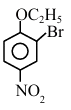
- Option B:
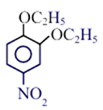
- Option C:
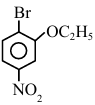
- Option D:
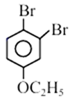
Answer: AStep-by-step solution → - Question 8Chemistry· d and f Block Elements
The correct option with order of melting points of the pairs and is :
- Option A:
and
- Option B:
and
- Option C:
and
- Option D:
and
Answer: CStep-by-step solution → - Question 9Chemistry· Solutions and Colligative Properties
1.24 g of (molar mass ) is dissolved in 1 kg of water to form a solution with boiling point of , while 25.4 g of (molar mass ) in 2 kg of water constitutes a solution with a boiling point of .
Which of the following is correct?
- Option A:
and (both) are completely unionised.
- Option B:
and (both) are fully ionised.
- Option C:
is completely unionised while is fully ionised.
- Option D:
is fully ionised while is completely unionised.
Answer: DStep-by-step solution → - Question 10Chemistry· Thermodynamics & Thermochemistry
500 J of energy is transferred as heat to 0.5 mol of Argon gas at 298 K and 1.00 atm . The final temperature and the change in internal energy respectively are: Given :
- Option A:
348 K and 300 J
- Option B:
378 K and 300 J
- Option C:
368 K and 500 J
- Option D:
378 K and 500 J
Answer: AStep-by-step solution → - Question 11Chemistry· Chemical Kinetics
The reaction follows the mechanism
(slow) (fast) The overall order of the reaction is :
- Option A:
1.5
- Option B:
3
- Option C:
1.5
- Option D:
2
Answer: AStep-by-step solution → - Question 12Chemistry· Structure of Atom
If is denoted as the Bohr radius of hydrogen atom, then what is the de-Broglie wavelength () of the electron present in the second orbit of hydrogen atom? [ n : any integer]
- Option A:
- Option B:
- Option C:
- Option D:
Answer: CStep-by-step solution → - Question 13Chemistry· Aldehydes and Ketones
The product formed in the following reaction is :
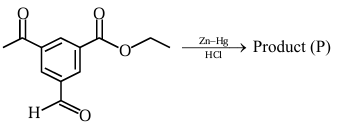
- Option A:
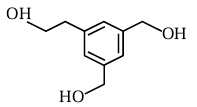
- Option B:
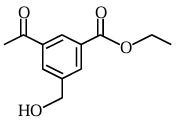
- Option C:
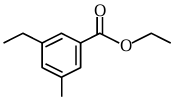
- Option D:
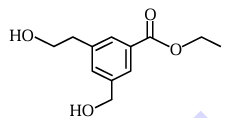
Answer: CStep-by-step solution → - Question 14Chemistry· Periodicity of Elements and Periodic Properties
An element has the ionisation enthalpy value of . reacts with elements , , and having electron gain enthalpy values of , respectively.
The correct order of the products , , and in terms of ionic character is:
- Option A:
EA EC ED
- Option B:
- Option C:
- Option D:
Answer: AStep-by-step solution → - Question 15Chemistry· Biomolecules
Match List - I with List - II.
List – I (Carbohydrate) List – II (Linkage Source) (A) Amylose (B) Cellulose (C) Glycogen (III) , , plant (D) Amylopectin (IV) , plant - Option A:
(A)-(III), (B)-(II), (C)-(I), (D)-(IV)
- Option B:
(A)-(IV), (B)-(I), (C)-(II), (D)-(III)
- Option C:
(A)-(IV), (B)-(I), (C)-(II), (D)-(III)
- Option D:
(A)-(IV), (B)-(I), (C)-(III), (D)-(II)
Answer: BStep-by-step solution → - Question 16Chemistry· Nitrogen Containing Organic Compounds
The steam volatile compounds among the following are :

Choose the correct answer from the options given below :
- Option A:
(B) and (D) only
- Option B:
(A) and (C) only
- Option C:
(A) and (B) only
- Option D:
(A),(B) and (C) only
Answer: CStep-by-step solution → - Question 17Chemistry· Periodicity of Elements and Periodic Properties
Given below are two statements, one is labelled as Statement I and the other is labelled as Statement II.
Statement I: The radii of isoelectronic species increases in the order .
Statement II: The magnitude of electron gain enthalpy of halogen decreases in the order .
In the light of the above statements, choose the correct answer from the options given below :
- Option A:
Statement I is incorrect but Statement II is correct
- Option B:
Both Statement I and Statement II are incorrect
- Option C:
Statement I is correct but Statement II is incorrect
- Option D:
Both Statement I and Statement II are correct
Answer: DStep-by-step solution → - Question 18Chemistry· Nitrogen Containing Organic Compounds
Given below are some nitrogen containing compounds.

Each of them is treated with HCl separately. 1.0 g of the most basic compound will consume mg of HCl . (Given molar mass in .
Answer: 341Step-by-step solution → - Question 19Chemistry· Some Basic Concepts of Chemistry (Mole Concept) + Stoichiometry
The molar mass of the water insoluble product formed from the fusion of chromite ore with in the presence of is .
Answer: 160Step-by-step solution → - Question 20Chemistry· Chemical Bonding
The sum of sigma and bonds in
Hex-1,3-dien-5-yne is .
Answer: 15Step-by-step solution → - Question 21Chemistry· Solutions and Colligative Properties
If is ionised in an aqueous solution, then the value of van't Hoff factor (i) is .
Answer: 16Step-by-step solution → - Question 22Chemistry· Alcohols, Ethers and Phenols

mole of compound will weigh g. (Given molar masses in : , , )
Answer: 13Step-by-step solution → - Question 23Physics· Alternating Current
Given below are two statements: One is labelled as Assertion (A) and the other is labelled as Reason (R)
Assertion (A): Choke coil is simply a coil having a large inductance but a small resistance. Choke coils are used with fluorescent mercury-tube fittings. If household electric power is directly connected to a mercury tube, the tube will be damaged.
Reason (R): By using the choke coil, the voltage across the tube is reduced by a factor , where is frequency of the supply across resistor and inductor . If the choke coil were not used, the voltage across the resistor would be the same as the applied voltage.
In the light of the above statements, choose the correct answer from the options given below
- Option A:
Both (A) and (R) are true but (R) is not the correct explanation of (A).
- Option B:
(A) is false but (R) is true.
- Option C:
Both (A) and (R) are true and (R) is the correct explanation of .
- Option D:
(A) is true but ( ) is false.
Answer: DStep-by-step solution → - Question 24Physics· Motion in Plane
Two projectiles are fired with same initial speed from same point on ground at angles of
and ,
respectively, with the horizontal direction. The ratio of their maximum heights attained is :
- Option A:
- Option B:
- Option C:
- Option D:
Answer: CStep-by-step solution → - Question 25Physics· Electrostatics
An electric dipole of mass , charge , and length is placed in a uniform electric field . When the dipole is rotated slightly from its equilibrium position and released, the time period of its oscillations will be :
- Option A:
- Option B:
- Option C:
- Option D:
Answer: DStep-by-step solution → - Question 26Physics· Units, Dimensions & Error Analysis
The pair of physical quantities not having same dimensions is :
- Option A:
Torque and energy
- Option B:
Surface tension and impulse
- Option C:
Angular momentum and Planck's constant
- Option D:
Pressure and Young's modulus
Answer: BStep-by-step solution → - Question 27Physics· Simple Harmonic Motion
Given below are two statements: One is labelled as Assertion (A) and the other is labelled as Reason (R)
Assertion (A): Time period of a simple pendulum is longer at the top of a mountain than that at the base of the mountain.
Reason (R): Time period of a simple pendulum decreases with increasing value of acceleration due to gravity and vice-versa.
In the light of the above statements, choose the correct answer from the options given below
- Option A:
Both (A) and (R) are true but (R) is not the correct explanation of (A).
- Option B:
Both (A) and (R) are true and (R) is the correct explanation of (A).
- Option C:
(A) is true but (R) is false.
- Option D:
(A) is false but ( ) is true.
Answer: BStep-by-step solution → - Question 28Physics· Units, Dimensions & Error Analysis
The expression given below shows the variation of velocity (v) with time ( ),
. The dimension of ABC is :
- Option A:
- Option B:
- Option C:
- Option D:
Answer: AStep-by-step solution → - Question 29Physics· Electromagnetic Induction
Consider and are the currents flowing simultaneously in two nearby coils
, respectively. If self inductance of coil 1 ,
mutual inductance of coil 1 with respect to coil 2 , then the value of induced emf in coil 1 will be
- Option A:
- Option B:
- Option C:
- Option D:
Answer: CStep-by-step solution → - Question 30Physics· Moving Charges and Magnetic Field
Consider a long straight wire of a circular cross-section (radius a) carrying a steady current I. The current is uniformly distributed across this cross-section. The distances from the centre of the wire's cross-section at which the magnetic field [inside the wire, outside the wire] is half of the maximum possible magnetic field, any where due to the wire, will be
- Option A:
- Option B:
- Option C:
- Option D:
Answer: BStep-by-step solution → - Question 31Physics· System Of Particles
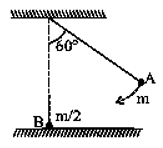
As shown below, bob A of a pendulum having massless string of length ' R ' is released from to the vertical. It hits another bob B of half the mass that is at rest on a friction less table in the centre. Assuming elastic collision, the magnitude of the velocity of bob A after the collision will be (take as acceleration due to gravity)
- Option A:
- Option B:
- Option C:
- Option D:
Answer: AStep-by-step solution → - Question 32Physics· Atomic Physics
Given below are two statements: One is labelled as Assertion (A) and the other is labelled as Reason (R)
Assertion (A): Emission of electrons in photoelectric effect can be suppressed by applying a sufficiently negative electron potential to the photoemissive substance.
Reason (R): A negative electric potential, which stops the emission of electrons from the surface of a photoemissive substance, varies linearly with frequency of incident radiation.
In the light of the above statements, choose the correct answer from the options given below
- Option A:
(A) is false but (R) is true.
- Option B:
(A) is true but (R) is false.
- Option C:
Both (A) and (R) are true and (R) is the correct explanation of .
- Option D:
Both (A) and (R) are true but ( ) is not the correct explanation of (A).
Answer: DStep-by-step solution → - Question 33Physics· Electromagnetic Induction
A coil of area A and N turns is rotating with angular velocity in a uniform magnetic field about an axis perpendicular to
. Magnetic flux and induced emf
across it, at an instant when is parallel to the plane of coil, are :
- Option A:
- Option B:
- Option C:
- Option D:
Answer: BStep-by-step solution → - Question 34Physics· Fluid Mechanics
The fractional compression of water at the depth of 2.5 km below the sea level is . Given, the Bulk modulus of water , density of water , acceleration due to gravity .
- Option A:
1.75
- Option B:
1
- Option C:
1.5
- Option D:
1.25
Answer: DStep-by-step solution → - Question 35Physics· Work, Power & Energy
A body of mass ' m ' connected to a massless and unsearchable string goes in vertical circle of radius ' R ' under gravity g . The other end of the string is fixed at the centre of circle. If velocity at top of circular path is , where, , then ratio of kinetic energy of the body at bottom to that at top of the circle is
- Option A:
- Option B:
- Option C:
- Option D:
Answer: DStep-by-step solution → - Question 36Physics· Geometrical Optics
Let and be the distances of the object and the image from a lens of focal length . The correct graphical representation of u and v for a convex lens when , is
- Option A:
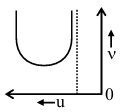
- Option B:
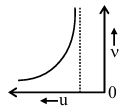
- Option C:
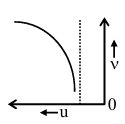
- Option D:
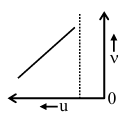
Answer: BStep-by-step solution → - Question 37Physics· Electrostatics
Match List-I with List-II.
List-I List-II (A) Electric field inside (distance r > 0 from center) of a uniformly charged spherical shell with surface charge density s, and radius R. (I) (B) Electric field at distance from a uniformly charged infinite plane sheet with surface charge density . (II) (C) Electric field outside (distance r > 0 from center) of a uniformly charged spherical shell with surface charge density s, and radius R (III) 0 (D) Electric field between 2 oppositely charged infinite plane parallel sheets with uniform surface charge density . (IV) Choose the correct answer from the options given below :
- Option A:
(A)-(IV), (B)-(I), (C)-(III), (D)-(II)
- Option B:
(A)-(IV), (B)-(II), (C)-(III), (D)-(I)
- Option C:
(A)-(II), (B)-(I), (C)-(IV), (D)-(III)
- Option D:
(A)-(III), (B)-(II), (C)-(IV), (D)-(I)
Answer: DStep-by-step solution → - Question 38Physics· Thermodynamics
The workdone in an adiabatic change in an ideal gas depends upon only :
- Option A:
change in its pressure
- Option B:
change in its specific heat
- Option C:
change in its volume
- Option D:
change in its temperature
Answer: DStep-by-step solution → - Question 39Physics· Electromagnetic Waves
Given below are two statements: One is labelled as Assertion (A) and the other is labelled as Reason (R)
Assertion (A): Electromagnetic waves carry energy but not momentum.
Reason (R): Mass of a photon is zero.
In the light of the above statements, choose the correct answer from the options given below
- Option A:
(A) is true but (R) is false.
- Option B:
(A) is false but ( ) is true.
- Option C:
Both (A) and (R) are true but (R) is not the correct explanation of (A).
- Option D:
Both (A) and (R) are true and (R) is the correct explanation of (A).
Answer: BStep-by-step solution → - Question 40Physics· Rotational Dynamics
The coordinates of a particle with respect to origin in a given reference frame is meters. If a force of acts on the particle, then the magnitude of torque (with respect to origin) in -direction is .
Answer: 2Step-by-step solution → - Question 41Physics· Kinetic Theory of Gases
A container of fixed volume contains a gas at . To double the pressure of the gas, the temperature of gas should be raised to .
Answer: 327Step-by-step solution → - Question 42Physics· Geometrical Optics
Two light beams fall on a transparent material block at point 1 and 2 with angle
and , respectively, as shown in figure.
After refraction, the beams intersect at point 3 which is exactly on the interface at other end of the block.
Given : the distance between 1 and and ,
where refractive index of the block
refractive index of the outside medium , then the thickness of the block is cm .
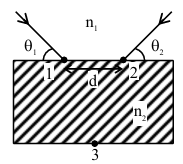 Answer: 6Step-by-step solution →
 - Question 43Physics· Fluid Mechanics
In a hydraulic lift, the surface area of the input piston is
and that of the output piston is .
If 100 N force is applied to the input piston to raise the output piston by 20 cm ,
then the work done is kJ.
Answer: 5Step-by-step solution → - Question 44Physics· Motion in Plane
The maximum speed of a boat in still water is .
Now this boat is moving downstream in a river flowing at .
A man in the boat throws a ball vertically upwards with speed of .
Range of the ball as observed by an observer at rest on the river bank, is cm . (Take )
Answer: 2000Step-by-step solution → - Question 45Mathematics· Circles
Let the line meet the circle at the points and . If the line perpendicular to and passing through the mid point of the chord AB intersects is the circle at C and D , then the area of the quadrilateral ADBC is equal to
- Option A:
- Option B:
- Option C:
- Option D:
Answer: BStep-by-step solution → - Question 46Mathematics· Determinants
Let and respectively be the maximum and the minimum values of Then is equal to
- Option A:
1280
- Option B:
1295
- Option C:
1040
- Option D:
1215
Answer: AStep-by-step solution → - Question 47Mathematics· Parabola
Two parabolas have the same focus and their directrices are the -axis and the -axis, respectively.
If these parabolas intersects at the points and , then is equal to
- Option A:
192
- Option B:
384
- Option C:
96
- Option D:
392
Answer: AStep-by-step solution → - Question 48Mathematics· Straight lines
Let ABC be a triangle formed by the lines and , Let the point
be the image of the centroid of in the line . Then is equal to
- Option A:
37
- Option B:
47
- Option C:
40
- Option D:
36
Answer: AStep-by-step solution → - Question 49Mathematics· Vector Algebra
Let and be a vector such that
and . Then the maximum value of is
- Option A:
77
- Option B:
462
- Option C:
308
- Option D:
154
Answer: CStep-by-step solution → - Question 50Mathematics· Permutations and Combinations
Let be the set of seven digit numbers with sum of their digits equal to 11 . If the numbers in P are formed by using the digits 1,2 and 3 only, then the number of elements in the set P is
- Option A:
158
- Option B:
173
- Option C:
164
- Option D:
161
Answer: DStep-by-step solution → - Question 51Mathematics· Area under the Curves
Let the area of the region , be A. Then is equal to:
- Option A:
16
- Option B:
12
- Option C:
18
- Option D:
14
Answer: DStep-by-step solution → - Question 52Mathematics· Binomial Theorem
The least value of for which the number of integral terms in the Binomial expansion of is 183 , is :
- Option A:
2184
- Option B:
2148
- Option C:
2172
- Option D:
2196
Answer: AStep-by-step solution → - Question 53Mathematics· Quadratic Equations
The number of solutions of the equation is
- Option A:
2
- Option B:
4
- Option C:
1
- Option D:
3
Answer: BStep-by-step solution → - Question 54Mathematics· Differential Equations
Let be the solution of the differential equation . If , then is
- Option A:
- Option B:
- Option C:
- Option D:
Answer: DStep-by-step solution → - Question 55Mathematics· Sets and Relations
Define a relation R on the interval by x R y if and only if . Then is
- Option A:
an equivalence relation
- Option B:
both reflexive and transitive but not symmetric
- Option C:
both reflexive and symmetric but not transitive
- Option D:
reflexive but neither symmetric not transitive
Answer: AStep-by-step solution → - Question 56Mathematics· Ellipse
Let the ellipses and have the same eccentricity . Let the product of their lengths of latus rectum be and the distance between the foci of be . If and meet at points and , then the area of the quadrilateral equals:
- Option A:
- Option B:
- Option C:
- Option D:
Answer: DStep-by-step solution → - Question 57Mathematics· Sequence and Series
Consider an A.P. of positive integers, whose sum of the first three terms is 54 and the sum of the first twenty terms lies between 1600 and 1800 .
Then its term is
- Option A:
84
- Option B:
122
- Option C:
90
- Option D:
108
Answer: CStep-by-step solution → - Question 58Mathematics· 3D Geometry
Let and . Let and be two lines. If the line passes through the point of intersection of and , and is parallel to , then passes through the point
- Option A:
- Option B:
- Option C:
- Option D:
Answer: BStep-by-step solution → - Question 59Mathematics· Limits, Continuity and Differentiability
The value of is
- Option A:
- Option B:
2
- Option C:
- Option D:
Answer: DStep-by-step solution → - Question 60Mathematics· Definite Integration
The integral is equal to
- Option A:
- Option B:
- Option C:
- Option D:
Answer: CStep-by-step solution → - Question 61Mathematics· 3D Geometry
Let and be two lines. Let be a line passing through the point and be perpendicular to both and . If intersects , then equals
- Option A:
18
- Option B:
16
- Option C:
25
- Option D:
20
Answer: CStep-by-step solution → - Question 62Mathematics· Probability
Let be ten observations such that
and
their variance is . If and are respectively the mean and the variance of
,
then is equal to
- Option A:
100
- Option B:
110
- Option C:
120
- Option D:
90
Answer: AStep-by-step solution → - Question 63Mathematics· Complex Numbers
Let and , . Then the minimum value of is
- Option A:
3
- Option B:
7
- Option C:
13
- Option D:
10
Answer: BStep-by-step solution → - Question 64Mathematics· Matrices
Let .
If is the cofactor of
, ,
and , then is equal to
- Option A:
262
- Option B:
288
- Option C:
242
- Option D:
222
Answer: CStep-by-step solution → - Question 65Mathematics· Functions
Let be a twice differentiable function. If for some , and , then is equal to :
Answer: 112Step-by-step solution → - Question 66Mathematics· Matrices
Let , where . Then is equal to -
Answer: 2Step-by-step solution → - Question 67Mathematics· Limits, Continuity and Differentiability
Let be the greatest integer less than or equal to .
Then the least value of for which
is equal to .
Answer: 24Step-by-step solution → - Question 68Mathematics· Permutations and Combinations
The number of 6 -letter words, with or without meaning, that can be formed using the letters of the word MATHS
such that any letter that appears in the word must appear at least twice, is 4
Answer: 1405Step-by-step solution → - Question 69Mathematics· Inverse Trigonometric Functions
Let .
Then is equal to .
Answer: 5Step-by-step solution →
Stuck on one of these?
Practise questions like them — free, with a tutor that explains every step.