JEE Main 2025 · previous year paper
JEE Main 2025 — 8 April, Evening Shift
70 questions with the verified answer key. Open any question for its step-by-step solution.
- Question 1Chemistry· Structure of Atom
Correct statements for an element with atomic number 9 are
A. There can be 5 electrons for which and 4 electrons for which
B. There is only one electron in orbital
C. The last electron goes to orbital with and
D. The sum of angular nodes of all the atomic orbitals is 1
Choose the correct answer from the options given below :
- Option A:
A and B only
- Option B:
C and D only
- Option C:
A and C only
- Option D:
A, C and D only
Answer: CStep-by-step solution → - Question 2Chemistry· Coordination Compounds
Match List-I with List-II :
List-I List-II A. I. Tetrahedral, 2.8 BM B. II. Square planar, 0 BM C. III. Tetrahedral, 0 BM D. IV. Tetrahedral, 5.9 BM Choose the correct answer from the options given below
- Option A:
III)
- Option B:
- Option C:
- Option D:
Answer: AStep-by-step solution → - Question 3Chemistry· Solutions and Colligative Properties
The freezing point depression of a 0.1 m aqueous solution of a monobasic
weak acid HA is . The dissociation constant for the acid is Given: ,
molality molarity
- Option A:
- Option B:
- Option C:
- Option D:
Answer: BStep-by-step solution → - Question 4Chemistry· Coordination Compounds
Given below are two statements : one is labelled as Statement I and the other is labelled as Statement II:
Statement I: A homoleptic octahedral complex, formed using monodentate ligands, will not show stereoisomers
Statement II: cis and trans platin are heteroleptic complexes of Pd
In the light of the above statements, choose the correct answer from the options given below :
- Option A:
Both Statement I and Statemnet II are true
- Option B:
Statement I is true but Statement II is false
- Option C:
Both Statement I and Statement II are false
- Option D:
Statement I is false but Statement II is true
Answer: BStep-by-step solution → - Question 5Chemistry· Solutions and Colligative Properties
Which of the following binary mixture does not show the behaviour of minimum boiling azeotropes?
- Option A:
- Option B:
- Option C:
- Option D:
Answer: AStep-by-step solution → - Question 6Chemistry· General Organic Chemistry
Match the List-I with List-II
List-I List-II A. Carbocation I. Species that can supply a pair of electrons B. C-Free radical II. Species that can receive a pair of electrons C. Nucleophile III. sp hybridized carbon with empty p-orbital D. Electrophile IV. sp2/sp hybridised carbon with one unpaired electron Choose the correct answer from the options given below:
- Option A:
- Option B:
- Option C:
- Option D:
Answer: DStep-by-step solution → - Question 7Chemistry· d and f Block Elements
The correct decreasing order of spin only magnetic moment values (BM) of and ions is
- Option A:
- Option B:
- Option C:
- Option D:
Answer: DStep-by-step solution → - Question 8Chemistry· Biomolecules
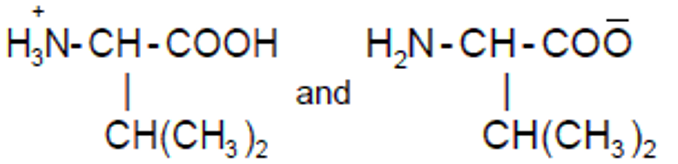
Choose the correct option for structures of A and B, respectively
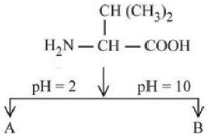
- Option A:
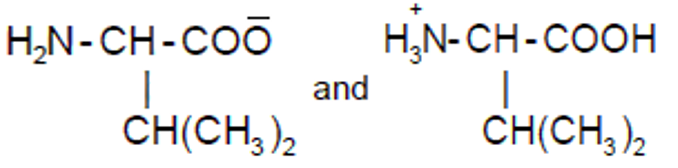
- Option B:
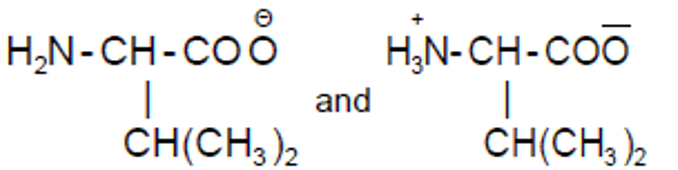
- Option C:
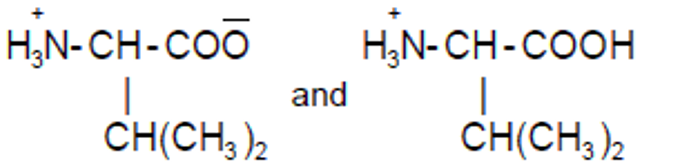
- Option D:
Answer: DStep-by-step solution → - Question 9Chemistry· IUPAC Nomenclature
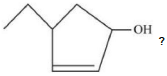
What is the correct IUPAC name of
- Option A:
4-Ethylcyclopent-2-en-1-ol
- Option B:
4-Ethyl-1-hydroxycyclopent-2-ene
- Option C:
1-Ethyl-3-hydroxycyclopent-2-ene
- Option D:
1-Ethylcyclopent-2-en-3-ol
Answer: AStep-by-step solution → - Question 10Chemistry· p-Block Elements (Group 15-18)
Given below are two statements:
Statement I: is more acidic than
Statement II : has higher bond enthalpy for dissociation than
In the light of the above statement, choose the correct answer from the options given
- Option A:
Both Statement I and Statement II are false
- Option B:
Both Statement I and Statement II are true
- Option C:
Statement I is false but Statement II is true
- Option D:
Statement I is true but Statement II is false
Answer: CStep-by-step solution → - Question 11Chemistry· Chemical Kinetics
In a first order decomposition reaction, the time taken for the decomposition of reactant to one fourth and one eighth of its initial concentration are and , respectively. The ratio will be:
- Option A:
- Option B:
- Option C:
- Option D:
Answer: DStep-by-step solution → - Question 12Chemistry· Some Basic Concepts of Chemistry (Mole Concept) + Stoichiometry
On combustion of 0.210 g of an organic compound containing and O gave and 0.307 . The percentage of hydrogen and oxygen in the given organic compound respectively are:
- Option A:
- Option B:
- Option C:
- Option D:
Answer: CStep-by-step solution → - Question 13Chemistry· Coordination Compounds
The number of species from the following that are involved in hybridization is ,
and
- Option A:
4
- Option B:
6
- Option C:
5
- Option D:
3
Answer: DStep-by-step solution → - Question 14Chemistry· Periodicity of Elements and Periodic Properties
The atomic number of the element from the following with lowest ionisation enthalpy is
- Option A:
35
- Option B:
19
- Option C:
32
- Option D:
87
Answer: DStep-by-step solution → - Question 15Chemistry· Practical Organic Chemistry
Match the List-I with List-II
List-I (Reagent) List-II (Functional detected) A. Sodium bicarbonate solution I. Double bond/unsaturation B. Neutral ferric chloride II. Carboxylic acid C. Ceric ammonium nitrate III. Phenolic - OH D. Alkaline IV. Alcoholic - OH Choose the correct answer from the options given below:
- Option A:
A-III, B-II, C-IV, D-I
- Option B:
A-II, B-IV, C-III, D-I
- Option C:
A-II, B-III, C-IV, D-I
- Option D:
A-II, B-III, C-I, D-IV
Answer: CStep-by-step solution → - Question 16Chemistry· Practical Organic Chemistry
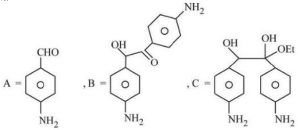
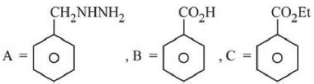
' A ' shows positive Lassaigne's test for N and its molar mass is 121.
'B' gives effervescence with aq
'C' gives fruity smell
Identify and C from the following
- Option A:
- Option B:
- Option C:
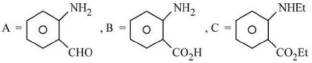
- Option D:
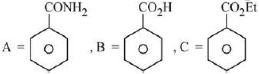
Answer: DStep-by-step solution → - Question 17Chemistry· Electrochemistry
Consider the following half cell reaction
The reaction was conducted with the ratio of . The pH value at which the EMF of the half
cell will become zero is . (nearest integer value)
[Given : standard half cell reduction potential
Answer: 10Step-by-step solution → - Question 18Chemistry· Thermodynamics & Thermochemistry
The equilibrium constant for decomposition of
is at 2300 K and total
pressure at equilibrium is 1 bar. Under this condition, the degree of dissociation ( ) of water is
(nearest integer value) [Assume is negligible with respect to 1]
Answer: 5Step-by-step solution → - Question 19Chemistry· Some Basic Concepts of Chemistry (Mole Concept) + Stoichiometry
20 mL of sodium iodide solution gave 4.74 g silver iodide when treated with excess of silver nitrate solution. The
molarity of the sodium iodide solution is M. (Nearest Integer Value)
(Given: )
Answer: 1Step-by-step solution → - Question 20Chemistry· Structure of Atom
The energy of an electron in first Bohr orbit of H atom is -13.6 eV . The magnitude of energy value of electron in the first excited state of is eV (nearest integer value)
Answer: 54Step-by-step solution → - Question 21Chemistry· Thermodynamics & Thermochemistry
Resonance in can be represented as

The enthalpy of formation of is .
The magnitude of resonance energy of is (nearest integer value) Given : Bond energies of
and are 940, 410, 500 and respectively.
Valence
Answer: 98Step-by-step solution → - Question 22Mathematics· Ellipse
Let the ellipse pass through the centre of the circle of radius . Let be the focal distances of the point on the ellipse. Then is equal to
- Option A:
68
- Option B:
74
- Option C:
70
- Option D:
78
Answer: CStep-by-step solution → - Question 23Mathematics· Definite Integration
The integral is equal to:
- Option A:
- Option B:
- Option C:
- Option D:
Answer: DStep-by-step solution → - Question 24Mathematics· Inverse Trigonometric Functions
The value of
\cot ^{-1}\left(\frac{\sqrt{1+\tan ^{2}(2)}-1}{\tan (2)}\right)-\cot ^{-1}\left(\frac{\sqrt{1+\tan ^{2}\left(\frac{1}{2}\right)}+1}{\tan \left(\frac{1}{2}\right)}\right) $$ is equal to- Option A:
- Option B:
- Option C:
- Option D:
Answer: BStep-by-step solution → - Question 25Mathematics· Straight lines
A line passing through the point makes an acute angle with the positive -axis. Let this line be rotated about the point through an angle in the clock-wise direction. If in the new position, the slope of the line is and its distance from the origin is , then the value of is
- Option A:
8
- Option B:
6
- Option C:
5
- Option D:
4
Answer: DStep-by-step solution → - Question 26Mathematics· Matrices
Let . If , then is equal to
- Option A:
20
- Option B:
26
- Option C:
22
- Option D:
24
Answer: DStep-by-step solution → - Question 27Mathematics· Limits, Continuity and Differentiability
Given below are two statements : one is labelled as Statement I and the other is labelled as Statement II:
Statement I:
Statement II:
In the light of the above statements, choose the correct answer from the options given below :
- Option A:
Statement I is false but Statement II is true
- Option B:
Both Statement I and Statement II are false
- Option C:
Both Statement I and Statement II are true
- Option D:
Statement I is true but Statement II is false
Answer: CStep-by-step solution → - Question 28Mathematics· Vector Algebra
Let and . Let be a unit vector in the plane of the vector and and be perpendicular to . Then such a vector is:
- Option A:
- Option B:
- Option C:
- Option D:
Answer: CStep-by-step solution → - Question 29Mathematics· 3D Geometry
Let the value of for which the shortest distance between the lines and
is be and . Then the radius of the circle passing through the points , ( ) and ( ) is
- Option A:
- Option B:
- Option C:
3
- Option D:
4
Answer: BStep-by-step solution → - Question 30Mathematics· Sets and Relations
Given below are two statements : one is labelled as Statement I and the other is labelled as Statement II:
Let . Let be a relation on defined by if and only if . Then among the statements
Statement I: The number of elements in is 18.
Statement II: The relation is symmetric but neither reflexive nor transitive.
In the light of the above statements, choose the correct answer from the options given below :
- Option A:
Both statement I and statement Il are correct.
- Option B:
Statement I is correct and statement Il is incorrect.
- Option C:
Statement I is incorrect and statement Il is correct.
- Option D:
Both statements 1 and statements ll are incorrect.
Answer: CStep-by-step solution → - Question 31Mathematics· Sequence and Series
If ,
, Then is equal to
- Option A:
14
- Option B:
15
- Option C:
18
- Option D:
23
Answer: BStep-by-step solution → - Question 32Mathematics· Application of Derivatives
Let the function be strictly increasing in and strictly
decreasing in . Then is equal to
- Option A:
48
- Option B:
40
- Option C:
36
- Option D:
28
Answer: CStep-by-step solution → - Question 33Mathematics· Probability
If and are two events such that and , where denotes the complement of , then is equal to
- Option A:
- Option B:
- Option C:
- Option D:
Answer: BStep-by-step solution → - Question 34Mathematics· Differential Equations
Let and for . If ,
then is
- Option A:
- Option B:
- Option C:
- Option D:
Answer: DStep-by-step solution → - Question 35Mathematics· Quadratic Equations
The sum of the squares of the roots of and the squares of the roots of , is
- Option A:
24
- Option B:
30
- Option C:
36
- Option D:
26
Answer: CStep-by-step solution → - Question 36Mathematics· Complex Numbers
Let . Then is equal to
- Option A:
- Option B:
- Option C:
- Option D:
Answer: DStep-by-step solution → - Question 37Mathematics· Straight lines
Let be the length of a side of a square with being the origin. Its side makes an acute angle with the positive -axis and the equations of its diagonals are and . Then is equal to
- Option A:
24
- Option B:
32
- Option C:
16
- Option D:
48
Answer: DStep-by-step solution → - Question 38Mathematics· Definite Integration
Let be a positive function and and .
Then the value of is equal to .
- Option A:
- Option B:
- Option C:
- Option D:
Answer: BStep-by-step solution → - Question 39Mathematics· Binomial Theorem
The number of integral terms in the expansion of is :
- Option A:
127
- Option B:
128
- Option C:
129
- Option D:
130
Answer: BStep-by-step solution → - Question 40Mathematics· Permutations and Combinations
There are 12 points in a plane, no three of which are in the same straight line, except 5 points which are collinear. Then the total number of triangles that can be formed with the vertices at any three of these 12 points is
- Option A:
230
- Option B:
200
- Option C:
220
- Option D:
210
Answer: DStep-by-step solution → - Question 41Mathematics· Determinants
Let be a solution of , and for some and in ,
. If , then is equal to
-
- Option A:
7
- Option B:
11
- Option C:
3
- Option D:
8
Answer: BStep-by-step solution → - Question 42Mathematics· Binomial Theorem
The product of the last two digits of is -
Answer: 63Step-by-step solution → - Question 43Mathematics· Functions
Let the domain of the function be and the domain of
) be . Then is equal to .
Answer: 96Step-by-step solution → - Question 44Mathematics· Parabola
Let be the radius of the circle, which touches axis at point and the parabola at the point . Then is equal to .
Answer: 30Step-by-step solution → - Question 45Mathematics· Area under the Curves
Let the area of the bounded region be . Then is equal to .
Answer: 13.5Step-by-step solution → - Question 46Mathematics· 3D Geometry
Let the area of the triangle formed by the lines and
be . Then is equal to .
Answer: 56Step-by-step solution → - Question 47Physics· Rotational Dynamics
A rod of linear mass density ' ' and length ' ' is bent to form a ring of radius ' '. Moment of inertia of ring about any of its diameter is
- Option A:
- Option B:
- Option C:
- Option D:
Answer: BStep-by-step solution → - Question 48Physics· Wave Optics
In a Young's double slit experiment, the source is white light. One of the slits is covered by red filter and another by a green filter. In this case
- Option A:
There shall be alternate interference fringes of red and green.
- Option B:
There shall be an interference pattern for red distinct from that for green.
- Option C:
There shall be no interference fringes.
- Option D:
There shall be an interference pattern, where each fringe's pattern center is green and outer edges is red.
Answer: CStep-by-step solution → - Question 49Physics· Motion in Plane
Two balls with same mass and initial velocity, are projected at different angles in such a way that maximum height reached by first ball is 8 times higher than that of the second ball. and are the total flying times of first and second ball, respectively, then the ratio of and is
- Option A:
- Option B:
- Option C:
- Option D:
Answer: AStep-by-step solution → - Question 50Physics· Nuclear Physics
For a nucleus of mass number and radius , the mass density of nucleus can be represented as
- Option A:
- Option B:
- Option C:
- Option D:
Independent of
Answer: DStep-by-step solution → - Question 51Physics· Moving Charges and Magnetic Field
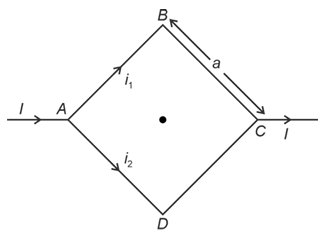
Figure shows a current carrying square loop of edge length is 'a' lying in a plane. If the resistance of the part is and that of part is , then the magnitude of the resultant magnetic field at centre of the square loop is
- Option A:
- Option B:
- Option C:
- Option D:
Answer: AStep-by-step solution → - Question 52Physics· Geometrical Optics
A convex lens of focal length 30 cm is placed in contact with a concave lens of focal length 20 cm . An object is placed at 20 cm to the left of this lens system. The distance of the image from the lens in cm is .
- Option A:
30
- Option B:
- Option C:
15
- Option D:
45
Answer: CStep-by-step solution → - Question 53Physics· Transverse waves
The amplitude and phase of a wave that is formed by the superposition of two harmonic travelling waves, and , are : (Take the angular frequency of initial waves same as )
- Option A:
- Option B:
- Option C:
- Option D:
Answer: AStep-by-step solution → - Question 54Physics· Newton's Laws of Motion
A body of mass 2 kg moving with velocity of enters into a constant force field of 6 N directed along positive z -axis. If the body remains in the field for a period of seconds, then velocity of the body when it emerges from force field is :
- Option A:
- Option B:
- Option C:
- Option D:
Answer: AStep-by-step solution → - Question 55Physics· Units, Dimensions & Error Analysis
A quantity is formulated as and are independent parameters which have fractional errors of and 0.5 , respectively in measurement. The maximum fractional error of is
- Option A:
0.1
- Option B:
0.6
- Option C:
0.7
- Option D:
0.8
Answer: CStep-by-step solution → - Question 56Physics· Thermodynamics
A monoatomic gas having is stored in a thermally insulated container and the gas is suddenly compressed to of its initial volume. The ratio of final pressure and initial pressure is ( is the ratio of specific heats of the gas at constant pressure and at constant volume)
- Option A:
40
- Option B:
28
- Option C:
32
- Option D:
16
Answer: CStep-by-step solution → - Question 57Physics· Transverse waves
Two strings with circular cross section and made of same material are stretched to have same amount of tension. A transverse wave is then made to pass through both the strings. The velocity of the wave in the first string having the radius of cross section is , and that in the other string having radius of cross section is . Then
- Option A:
8
- Option B:
2
- Option C:
- Option D:
4
Answer: BStep-by-step solution → - Question 58Physics· Electrostatics
An infinitely long wire has uniform linear charge density . The net flux through a Gaussian cube of side length , if the wire passes through any two corners of the cube, that are maximally displaced from each other, would be , where is[0pt] [Neglect any edge effects and use SI units]
- Option A:
- Option B:
- Option C:
- Option D:
Answer: BStep-by-step solution → - Question 59Physics· Work, Power & Energy
A block of mass 2 kg is attached to one end of a massless spring whose other end is fixed at a wall. The spring-mass system moves on a frictionless horizontal table. The spring's natural length is 2 m and spring constant is . The block is pushed such that the length of the spring becomes 1 m and then released. At distance from the wall, the speed of the block will be
- Option A:
- Option B:
- Option C:
- Option D:
Answer: BStep-by-step solution → - Question 60Physics· Electrostatics
Given below are two statements: one is labelled as Assertion A and the other is labelled as Reason R.
Assertion A: Work done in moving a test charge between two points inside a uniformly charged spherical shell is zero, no matter which path is chosen.
Reason : Electrostatic potential inside a uniformly charged spherical shell is constant and is same as that on the surface of the shell.
In the light of the above statements, choose the correct answer from the options given below
- Option A:
is false but is true
- Option B:
Both and are true and is the correct explanation of
- Option C:
Both and are true but is NOT the correct explanation of
- Option D:
is true but is false
Answer: BStep-by-step solution → - Question 61Physics· Electrostatics
Two metal spheres of radius and have same surface charge density . If they are brought in contact and then separated, the surface charge density on smaller and bigger sphere becomes and , respectively. The ratio is
- Option A:
9
- Option B:
3
- Option C:
- Option D:
Answer: BStep-by-step solution → - Question 62Physics· Semiconductor and Electronic Devices
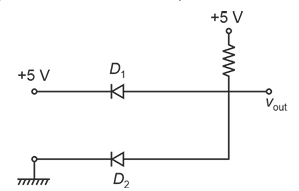
The output voltage in the following circuit is (Consider ideal diode case)
- Option A:
10 V
- Option B:
0 V
- Option C:
- Option D:
Answer: BStep-by-step solution → - Question 63Physics· Thermal Properties of Matter
Water falls from a height of 200 m into a pool. Calculate the rise in temperature of the water assuming no heat dissipation from the water in the pool. (Take , specific heat of water K))
- Option A:
0.36 K
- Option B:
0.23 K
- Option C:
0.48 K
- Option D:
0.14 K
Answer: CStep-by-step solution → - Question 64Physics· Mechanical Properties of Matter
A 3 m long wire of radius 3 mm shows an extension of 0.1 mm when loaded vertically by a mass of 50 kg in an experiment to determine Young's modulus. The value of Young's modulus of the wire as per this experiment is , where the value of is: (Take )
- Option A:
2.5
- Option B:
25
- Option C:
5
- Option D:
10
Answer: CStep-by-step solution → - Question 65Physics· Geometrical Optics
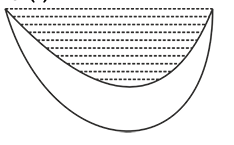
A concave-convex lens of refractive index 1.5 and the radii of curvature of its surfaces are 30 cm and 20 cm , respectively. The concave surface is upwards and is filled with a liquid of refractive index 1.3. The focal length of the liquid-glass combination will be
- Option A:
- Option B:
- Option C:
- Option D:
Answer: AStep-by-step solution → - Question 66Physics· Capacitors and R-C Circuits
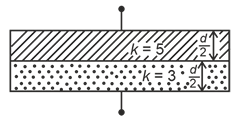
Space between the plates of a parallel plate capacitor of plate area and separation of
, is filled with uniform dielectric materials with dielectric constants (3 and 5)as
shown in figure. Another capacitor of capacitance 7.5 pF is connected in parallel with it. The effective
capacitance of this combination is pF . (Given )
 Answer: 15Step-by-step solution →
 - Question 67Physics· Atomic Physics
An electron is released from rest near an infinite non-conducting sheet of uniform charge density ' '. The rate of change of de-Broglie wave length associated with the electron varies inversely as power of time. The numerical value of is .
Answer: 2Step-by-step solution → - Question 68Physics· Fluid Mechanics
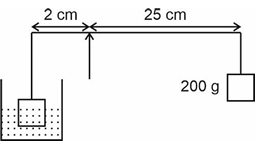
A cube having a side of 10 cm with unknown mass and 200 gm mass were hung at two ends of an uniform rigid rod of 27 cm long. The rod along with masses was placed on a wedge keeping the distance between wedge point and 200 gm weight as 25 cm . Initially the masses were not at balance. A beaker is placed beneath the unknown mass and water is added slowly to it. At given point the masses were in balance and half volume of the unknown mass was inside the water. (Take the density of unknown mass is more than that of the water, the mass did not absorb water and water density is .) The unknown mass is kg .
 Answer: 3Step-by-step solution →
 - Question 69Physics· Mechanical Properties of Matter
A sample of a liquid is kept at 1 atm. It is compressed to 5 atm which leads to change of volume of . If the bulk modulus of the liquid is 2 GPa , the initial volume of the liquid was litre. (Take 1 atm )
Answer: 4Step-by-step solution → - Question 70Physics· Rotational Dynamics
A thin solid disk of 1 kg is rotating along its diameter axis at the speed of 1800 rpm . By applying an external torque of
for 40s, the speed increases to 2100 rpm . The diameter of the disk is m.
Answer: 40Step-by-step solution →
Stuck on one of these?
Practise questions like them — free, with a tutor that explains every step.