JEE Main 2026 · previous year paper
JEE Main 2026 — 2 April, Morning Shift
61 questions with the verified answer key. Open any question for its step-by-step solution.
- Question 1Physics· Units, Dimensions & Error Analysis
The diameter of a wire measured by a screw gauge of least count 0.001 cm is 0.08 cm. The length measured by a scale of least count 0.1 cm is 150 cm. When a weight of 100 N is applied to the wire, the extension in length is 0.5 cm, measured by a micrometer of least count 0.001 cm. The error in the measured Young's modulus is . The value of is _____
- Option A:
1.3
- Option B:
1.65
- Option C:
0.13
- Option D:
0.25
Answer: BStep-by-step solution → - Question 2Physics· Motion in one Dimension
The velocity of a particle is given as The magnitude of acceleration at point (1, 2, 4) is m/s2.
- Option A:
- Option B:
9
- Option C:
- Option D:
0
Answer: BStep-by-step solution → - Question 3Physics· Rotational Dynamics
The position of an object having mass as a function of time t is given as At , which of the following statements are correct? A. The linear momentum B. The force acting on the object C. The angular momentum of the object about its origin D. The torque acting on the object about its origin Choose the correct answer from the option given below.
- Option A:
A, B and C only
- Option B:
B, C and D only
- Option C:
A, C and D only
- Option D:
A, B and D only
Answer: DStep-by-step solution → - Question 4Physics· Gravitation
A planet is moving around the star of mass 2M in the orbit of radius R. Another planet is moving around another star of mass 4M in a orbit of radius 2R. Ratio of time periods of revolution of and is
- Option A:
- Option B:
2
- Option C:
4
- Option D:
Answer: BStep-by-step solution → - Question 5Physics· Horizontal Circular Motion
A particle is rotating in a circular path and at any instant its motion can be described as The angular acceleration of the particle after 10 seconds is rad/s2.
- Option A:
150
- Option B:
120
- Option C:
130
- Option D:
170
Answer: CStep-by-step solution → - Question 6Physics· Thermodynamics
Heat is supplied to a diatomic gas at constant pressure. Then the ratio of is
- Option A:
- Option B:
- Option C:
- Option D:
Answer: DStep-by-step solution → - Question 7Physics· Electrostatics
Two charged conducting spheres and of radii and are connected to each other by a wire. After equilibrium is established, the ratio of electric fields on and spheres are and respectively. The value of is
- Option A:
- Option B:
- Option C:
- Option D:
Answer: DStep-by-step solution → - Question 8Physics· Sound Waves
The equation of a plane progressive wave is given by where and are in cm and t is in second. The velocity of the wave is m/s
- Option A:
120
- Option B:
150
- Option C:
200
- Option D:
300
Answer: DStep-by-step solution → - Question 9Physics· Electrostatics
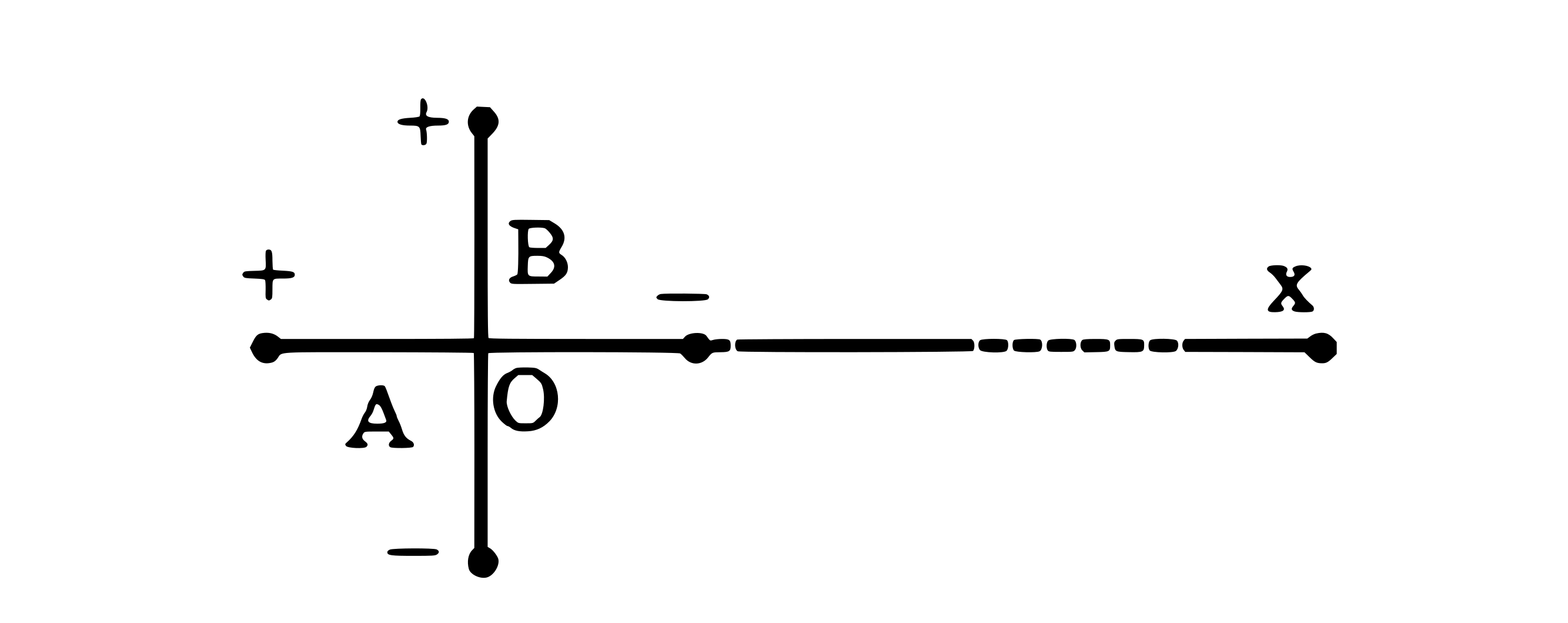
Two short electric dipoles A and B having dipole moment and respectively are placed with their axis mutually perpendicular as shown in the figure. The resultant electric field at a point is making an angle of with the line joining points O and . The ratio of the dipole moments is ______.
- Option A:
- Option B:
- Option C:
- Option D:
Answer: BStep-by-step solution → - Question 10Physics· Electromagnetic Induction
When a coil is placed in a time dependent magnetic field the power dissipated in it is P. The number of turns, area of the coil and radius of the coil wire are N, A and r respectively. For a second coils number of turns, area of the coil and radius of the coil wire are 2N, 2A and 3r respectively. When the first coil is replaced with second coil the power dissipated in it is . The value of is
- Option A:
36
- Option B:
128√2
- Option C:
16
- Option D:
64
Answer: AStep-by-step solution → - Question 11Physics· Geometrical Optics
For a thin symmetric prism made of glass (refractive index 1.5), the ratio of incident angle and minimum deviation will be
- Option A:
- Option B:
- Option C:
- Option D:
Answer: BStep-by-step solution → - Question 12Physics· Atomic Physics
For a certain metal, when monochromatic light of wavelength is incident, the stopping potential for photoelectrons is . When the same metal is illuminated by light of wavelength , then the stopping potential becomes . The threshold wavelength for photoelectric emission for the given metal is . The value of is
- Option A:
1
- Option B:
4
- Option C:
2
- Option D:
3
Answer: BStep-by-step solution → - Question 13Physics· Electromagnetic Waves
An electromagnetic wave travelling in x- direction is described by field equation . If the electron is restricted to move in y- direction only with speed of then ratio of maximum electric and magnetic forces acting on the electron is
- Option A:
200
- Option B:
150
- Option C:
400
- Option D:
300
Answer: AStep-by-step solution → - Question 14Physics· Atomic Physics
Angular momentum of an electron in a hydrogen atom is , then the energy of the electron is .
- Option A:
- Option B:
- Option C:
- Option D:
Answer: CStep-by-step solution → - Question 15Physics· Wave Optics
In single slit diffraction pattern, the wavelength of light used is and slit width is , the angular width of central maximum is degrees. The value of is ______.
Answer: 36Step-by-step solution → - Question 16Physics· Thermodynamics
A vessel contains of a gas at pressure 8 bar and temperature with and . It is expanded adiabatically till pressure falls to 1 bar. The work done during this process is ______ kJ. (R is gas constant)
Answer: 120Step-by-step solution → - Question 17Physics· Moving Charges and Magnetic Field
1 μC charge moving with velocity in the region of magnetic field . The magnitude of force acting on it is . The value of is
Answer: 171Step-by-step solution → - Question 18Physics· Mechanical Properties of Matter
A uniform wire of length of weight w is suspended from the roof with a weight of W at the other end. The stress in the wire at distance from the top is , where, A is the cross sectional area of the wire. The value of is
Answer: 3Step-by-step solution → - Question 19Physics· Fluid Mechanics
A tube is filled with water and a wooden cube is placed in the water. The wooden cube is found to float on the water with a part of it submerged in water. When a metal coin is placed on the wooden cube, the submerged part is increased by . The mass of the metal coin is gram. (Take water density as and density of wood as )
Answer: 387Step-by-step solution → - Question 20Mathematics· Quadratic Equations
Let be the roots of the quadratic equation for some . Then is equal to:
- Option A:
0
- Option B:
1
- Option C:
2
- Option D:
3
Answer: CStep-by-step solution → - Question 21Mathematics· Complex Numbers
Let and be real number such that . value of is :
- Option A:
20
- Option B:
31
- Option C:
35
- Option D:
75
Answer: DStep-by-step solution → - Question 22Mathematics· Determinants
Let be such that the system of linear equations , , has no solution. Then is equal to :
- Option A:
-4
- Option B:
4
- Option C:
8
- Option D:
-8
Answer: BStep-by-step solution → - Question 23Mathematics· Matrices
Let and . If and then among the two statements :
(S1) : and
(S2) : det (adj(A + B)) = -5,
- Option A:
only (S1) is correct
- Option B:
only (S2) is correct
- Option C:
both (S1) and (S2) are correct
- Option D:
both (S1) and (S2) are wrong
Answer: BStep-by-step solution → - Question 24Mathematics· Sequence and Series
Let A be the set of first 101 terms of an A.P., whose first term is 1 and the common difference is 5 and let B be the set of first 71 terms of an A.P., whose first term is 9 and the common difference is 7. Then the number of elements in A B, which are divisible by 3, is :
- Option A:
4
- Option B:
5
- Option C:
6
- Option D:
7
Answer: BStep-by-step solution → - Question 25Mathematics· Permutations and Combinations
The number of seven-digit numbers, that can be formed by using the digits 1, 2, 3, 5 and 7 such that each digit is used at least once, is….
- Option A:
15400
- Option B:
17800
- Option C:
16800
- Option D:
29400
Answer: CStep-by-step solution → - Question 26Mathematics· Statistics
If the mean of the data
Class 5-10 10-15 15-20 20-25 25-30 30-35 Frequency 2 k 28 54 k+1 5 is 21, then k is one of the roots of the equation :
- Option A:
- Option B:
- Option C:
- Option D:
Answer: CStep-by-step solution → - Question 27Mathematics· Straight lines
Two vertices of a triangle are and . If its orthocentre is at the origin, then its third vertex lies in which quadrant?
- Option A:
Fourth
- Option B:
Third
- Option C:
First
- Option D:
Second
Answer: DStep-by-step solution → - Question 28Mathematics· Ellipse
Let an ellipse , a < b, pass through the point (4, 3) and have eccentricity . Then the length of its latus rectum is :
- Option A:
- Option B:
- Option C:
- Option D:
Answer: DStep-by-step solution → - Question 29Mathematics· Trigonometry Ratios and Identities
If , then the value of is :
- Option A:
- Option B:
- Option C:
- Option D:
Answer: AStep-by-step solution → - Question 30Mathematics· Trigonometry Ratios and Identities
Let . Then is equal to :
- Option A:
3
- Option B:
6
- Option C:
7
- Option D:
9
Answer: DStep-by-step solution → - Question 31Mathematics· 3D Geometry
If the point of intersection of the lines and lies on xy- plane, then the value of a + b is :
- Option A:
2
- Option B:
5
- Option C:
7
- Option D:
9
Answer: CStep-by-step solution → - Question 32Mathematics· Vector Algebra
If and are two vectors such that and , then the maximum value of is :
- Option A:
30
- Option B:
36
- Option C:
60
- Option D:
72
Answer: CStep-by-step solution → - Question 33Mathematics· Limits, Continuity and Differentiability
If , then is equal to:
- Option A:
5
- Option B:
6
- Option C:
8
- Option D:
10
Answer: BStep-by-step solution → - Question 34Mathematics· Differential Equations
If the curve y = f(x) passes through the point (1, e) and satisfies the differential equation dy = y (2 + log_e x) dx, x > 0, then f(e) is equal to :
- Option A:
- Option B:
- Option C:
- Option D:
Answer: CStep-by-step solution → - Question 35Mathematics· Application of Derivatives
The number of critical points of the function in the interval is equal to:
- Option A:
1
- Option B:
3
- Option C:
5
- Option D:
7
Answer: CStep-by-step solution → - Question 36Mathematics· Differential Equations
Let y = y(x) be the solution curve of the differential equation (1 + sin x) + (y + 1) cos x = 0, y(0) = 0. If the curve y = y(x) passes through the point , then a value of α is :
- Option A:
- Option B:
- Option C:
- Option D:
Answer: DStep-by-step solution → - Question 37Mathematics· Functions
If the domain of the function is , then the value of a + b + c + d + e is _____.
Answer: 4Step-by-step solution → - Question 38Mathematics· Probability
Let a, b, c ∈ {1,2,3,4}. If the probability that ax^2 + 2√2 bx + c > 0 for all x ∈ R, is m/n, gcd(m,n)=1, then m+n is equal to ______.
Answer: 81Step-by-step solution → - Question 39Mathematics· Circles
Let a circle C have its centre in the first quadrant, intersect the coordinate axes at exactly three points and cut off equal intercepts from the coordinate axes. If the length of the chord of C on the line is then the square of the radius of C is _____.
Answer: 8Step-by-step solution → - Question 40Mathematics· Definite Integration
Let be a real polynomial of degree 3 which vanishes at . Let have local minima at ,
local maxima at and , then the sum of all the coefficients of the polynomial is equal to .
Answer: 8Step-by-step solution → - Question 41Chemistry· Some Basic Concepts of Chemistry (Mole Concept) + Stoichiometry
The mass of iron converted into by the action of 18 g of steam is : (Given : Molar mass of H, O and Fe are 1, 16 and respectively)
Assume iron is present in excess :
- Option A:
2.1 g
- Option B:
4.2 g
- Option C:
21 g
- Option D:
42 g
Answer: DStep-by-step solution → - Question 42Physics· Atomic Physics
What is the energy (in J atom ) required for the following process? (Take the ionization energy for the H atom in the ground state as atom )
- Option A:
- Option B:
- Option C:
- Option D:
Answer: CStep-by-step solution → - Question 43Chemistry· Thermodynamics & Thermochemistry
Consider the following data (i) . (ii) . (iii) . (iv) .
The enthalpy of formation of anhydrous solid is :
- Option A:
- Option B:
- Option C:
- Option D:
Answer: DStep-by-step solution → - Question 44Chemistry· Ionic Equilibrium
19.5 g of fluoro acetic acid (molar mass ) is dissolved in 500 g of water at 298 K . The depression in the freezing point of water was . What is of fluoro acetic acid ? (For water, ). Assume molarity and molality to have same values
- Option A:
- Option B:
- Option C:
- Option D:
Answer: DStep-by-step solution → - Question 45Chemistry· Ionic Equilibrium
The solubility product constants of and AgBr are 32x and 4y respectively at 298 K .
The value of can be expressed as :
- Option A:
- Option B:
- Option C:
- Option D:
Answer: DStep-by-step solution → - Question 46Chemistry· Redox Reactions
An electrochemical cell is constructed using half cells in the direction of spontaneous change and Which of the following option is correct?
- Option A:
Overall reaction \mathrm{Fe}(\mathrm{s})+2 \mathrm{OH}^{1}(\mathrm{aq})+2 \mathrm{AgBr}(\mathrm{s})$$\rightleftharpoons \mathrm{Fe}(\mathrm{OH})_{2}(\mathrm{~s})+2 \mathrm{Ag}(\mathrm{s})+2 \mathrm{Br}^{-}(\mathrm{aq})
- Option B:
- Option C:
Fe is reduced in the electrochemical cell
- Option D:
is an extensive property
Answer: AStep-by-step solution → - Question 47Chemistry· Periodicity of Elements and Periodic Properties
Given below are two statements :
Statement (I) : The first ionisation enthalpy of the elements and Ar follows the order
Statement (II) : Among and B , the third ionisation enthalpy is very high for Ca .
In the light of the above statements, choose the correct answer from the options given below :
- Option A:
Both Statement I and Statement II are true
- Option B:
Both Statement I and Statement II are false
- Option C:
Statement I is true but Statement II is false
- Option D:
Statement I is false but Statement II is true
Answer: DStep-by-step solution → - Question 48Chemistry· Periodicity of Elements and Periodic Properties
Given below are two statements :
Statement (I) : Oxidising power of halogens decreases in the order , which is the basis of Layer test.
Statement (II): Layer test to identify and in aqueous solution involves the oxidation of bromide or iodide into or respectively with , which is a type of displacement redox reaction.
In the light of the above statements, choose the correct answer from the options given below:
- Option A:
Both Statement I and Statement II are true
- Option B:
Both Statement I and Statement II are false
- Option C:
Statement I is true but Statement II is false
- Option D:
Statement I is false but Statement II is true
Answer: AStep-by-step solution → - Question 49Chemistry· Redox Reactions
Which of the following sets includes all the species that will change the orange colour of in acidic medium?
- Option A:
- Option B:
- Option C:
- Option D:
Answer: AStep-by-step solution → - Question 50Chemistry· Coordination Compounds
Match List - I with List - II.
List – I Chromium (III) Complexes (en = ethylene diamine) List – II A. I. 15,060 B. II. 17,400 C. III. 22,300 D. IV. 26,600 Choose the correct answer from the options given below:
- Option A:
A-I, B-II, C-III, D-IV
- Option B:
A-II, B-III, C-IV, D-I
- Option C:
A-III, B-IV, C-I, D-II
- Option D:
A-IV, B-I, C-II, D-III
Answer: DStep-by-step solution → - Question 51Chemistry· Practical Organic Chemistry
Given below are two statements :
Statement (I) : 1,2,3-Trihydroxypropane can be separated from water by simple distillation.
Statement (II) : An azotropic mixture cannot be separated by fractional distillation.
In the light of the above statements, choose the correct answer from the options given below:
- Option A:
Both Statement I and Statement II are true
- Option B:
Both Statement I and Statement II are false
- Option C:
Statement I is true but Statement II is false
- Option D:
Statement I is false but Statement II is true
Answer: DStep-by-step solution → - Question 52Chemistry· Alkyl and Aryl Halides
Given below are two statements :
Statement (I) : Benzyl chloride reacts faster in mechanism than ethyl chloride.
Statement (II) : Ethyl carbocation intermediate is less stabilized by hyperconjugation than benzyl carbocation by resonance.
In the light of the above statements, choose the correct answer from the options given below:
- Option A:
Both Statement I and Statement II are true
- Option B:
Both Statement I and Statement II are false
- Option C:
Statement I is true but Statement II is false
- Option D:
Statement I is false but Statement II is true
Answer: AStep-by-step solution → - Question 53Chemistry· IUPAC Nomenclature
In IUPAC nomenclature, the correct order of decreasing priority of functional group is :
- Option A:
- Option B:
- Option C:
- Option D:
Answer: CStep-by-step solution → - Question 54Chemistry· Practical Organic Chemistry
Match List-I with List-II.
List-I Mixture of Compounds List-II Reagent used to distinguish A. Diethyl amine + Ethyl amine I. Bromine water B. Acetaldehyde + Acetone II. C. Ethanol + Phenol III. Neutral D. Benzoic acid + Cinnamic acid IV. Ammonical silver nitrate Choose the correct answer from the options given below :
- Option A:
A-IV, B-II, C-I, D-III
- Option B:
A-IV, B-II, C-III, D-I
- Option C:
A-II, B-IV, C-I, D-III
- Option D:
A-II, B-IV, C-III, D-I
Answer: DStep-by-step solution → - Question 55Chemistry· Biomolecules
Match List-I with List-II.
List-I Vitamin List-II Name A. Vitamin I. Pyridoxine B. Vitamin II. Ascorbic acid C. Vitamin III. Thiamine D. Vitamin C IV. Riboflavin Choose the correct answer from the options given below:
- Option A:
A-II, B-I, C-III, D-IV
- Option B:
A-IV, B-III, C-II, D-I
- Option C:
A-III, B-IV, C-I, D-II
- Option D:
A-I, B-III, C-II, D-IV
Answer: CStep-by-step solution → - Question 56Chemistry· Practical Inorganic chemistry (Qualitative Analysis)
A salt with few drops of conc. HCl gives apple green colour in flame test. The group precipitate of the salt is dissolved in acetic acid and treated with to give yellow precipitate. When the sodium carbonate extract of the salt solution is heated with conc. and ammonium molybdate, it resulted a canary yellow precipitate. The cation and anion present in the salt are respectively.
- Option A:
and
- Option B:
and
- Option C:
and
- Option D:
and
Answer: BStep-by-step solution → - Question 57Chemistry· Coordination Compounds
5.33 g of , which is a electrolyte, is dissolved in water and is passed through a cation exchanger. The chloride ions in the eluted solution, on treatment with , results in 8.61 g of AgCl . The ratio of moles of complex reacted and moles of AgCl formed is . (Nearest integer) [Molar mass in ,
Answer: 33Step-by-step solution → - Question 58Chemistry· Hydrocarbons
One mole of an alkane (x) requires 8 mole oxygen for complete combustion. Sum of number of carbon and hydrogen atoms in the alkane ( x ) is .
Answer: 17Step-by-step solution → - Question 59Chemistry· Chemical Kinetics
For reaction , rate constant at . If activation energy for the above reaction is , then the temperature (in ) at which rate constant, is . (Nearest integer) Given : ,
Answer: 41Step-by-step solution → - Question 60Chemistry· Thermodynamics & Thermochemistry
At the transition temperature and where A and B are two states of substance X . The transition temperature in when pressure is 1 atm is . (Nearest integer)
Answer: 727Step-by-step solution → - Question 61Mathematics· Straight lines
Let the mid points of the sides of a triangle ABC be and (4,5). If its incentive is (h, k), then is equal to:
- Option A:
11
- Option B:
12
- Option C:
13
- Option D:
14
Answer: CStep-by-step solution →
Stuck on one of these?
Practise questions like them — free, with a tutor that explains every step.