JEE Main 2024 · previous year paper
JEE Main 2024 — 9 April, Shift 1
84 questions with the verified answer key. Open any question for its step-by-step solution.
- Question 1Mathematics· 3D Geometry
Let the line intersect the lines and be parallel to the line
. Then which of the following points lies on L ?
- Option A:
- Option B:
- Option C:
- Option D:
Answer: BStep-by-step solution → - Question 2Mathematics· Area under the Curves
The parabola divides the area of the circle in two parts. The area of the smaller part is equal to :
- Option A:
- Option B:
- Option C:
- Option D:
Answer: AStep-by-step solution → - Question 3Mathematics· Differential Equations
The solution curve, of the differential equation , passing through the point is a conic, whose vertex lies on the line :
- Option A:
- Option B:
- Option C:
- Option D:
Answer: AStep-by-step solution → - Question 4Mathematics· Straight lines
A ray of light coming from the point gets reflected from the point Q on the x -axis and then passes through the point . If the point , k ) is such that PQRS is a parallelogram, then is equal to :
- Option A:
80
- Option B:
90
- Option C:
60
- Option D:
70
Answer: DStep-by-step solution → - Question 5Mathematics· Determinants
Let . If the system of equations , , has infinitely many solutions, then is equal to :
- Option A:
25
- Option B:
24
- Option C:
27
- Option D:
22
Answer: AStep-by-step solution → - Question 6Mathematics· Binomial Theorem
The coefficient of in .. is
. Then a possible value to is :
- Option A:
55
- Option B:
61
- Option C:
63
- Option D:
83
Answer: DStep-by-step solution → - Question 7Mathematics· Indefinite Integration
Let , where C is the constant of integration.
Then is equal to :
- Option A:
3
- Option B:
1
- Option C:
4
- Option D:
7
Answer: CStep-by-step solution → - Question 8Mathematics· Application of Derivatives
A variable line passes through the point and intersects the positive coordinate axes at the points and . The minimum area of the triangle OAB , where O is the origin, is :
- Option A:
30
- Option B:
25
- Option C:
40
- Option D:
35
Answer: AStep-by-step solution → - Question 9Mathematics· Trigonometry Ratios and Identities
Let Then, the sum of all , where
attains its maximum value, is :
- Option A:
- Option B:
- Option C:
- Option D:
Answer: CStep-by-step solution → - Question 10Mathematics· Vector Algebra
Let and , where O is the origin. If the area of the parallelogram with adjacent sides
and is 15 sq. units, then the area (in sq. units) of the quadrilateral OABC is equal to :
- Option A:
38
- Option B:
40
- Option C:
32
- Option D:
35
Answer: DStep-by-step solution → - Question 11Mathematics· Inverse Trigonometric Functions
If the domain of the function is then is equal to :
- Option A:
36
- Option B:
24
- Option C:
40
- Option D:
32
Answer: DStep-by-step solution → - Question 12Mathematics· Sequence and Series
If the sum of series is equal to 5 , then is equal to :
- Option A:
20
- Option B:
5
- Option C:
15
- Option D:
10
Answer: BStep-by-step solution → - Question 13Mathematics· Methods of Differentiation
Let be such that and . Then
is equal to :
- Option A:
62
- Option B:
73
- Option C:
54
- Option D:
51
Answer: DStep-by-step solution → - Question 14Mathematics· Limits, Continuity and Differentiability
Let a circle passing through have its centre at the point . Let be the point of intersection of the lines and . If and , then the equation of the circle is :
- Option A:
- Option B:
- Option C:
- Option D:
Answer: AStep-by-step solution → - Question 15Mathematics· 3D Geometry
The shortest distance between the line and is :
- Option A:
- Option B:
- Option C:
- Option D:
Answer: AStep-by-step solution → - Question 16Mathematics· Statistics
The frequency distribution of the age of students in a class of 40 students is given below.
Age 15 16 17 18 19 20 No. of Students 5 8 5 12 x y If the mean deviation about the median is 1.25 , then is equal to :
- Option A:
43
- Option B:
44
- Option C:
47
- Option D:
46
Answer: BStep-by-step solution → - Question 17Mathematics· Differential Equations
The solution of the differential equation , with , is:
- Option A:
- Option B:
- Option C:
- Option D:
Answer: AStep-by-step solution → - Question 18Mathematics· Vector Algebra
Let three vectors , from a triangle such that
and the area of the triangle is . if is a positive real number, then is :
- Option A:
16
- Option B:
14
- Option C:
12
- Option D:
10
Answer: BStep-by-step solution → - Question 19Mathematics· Quadratic Equations
Let be the roots of the equation . The quadratic equation, whose
roots are and , is :
- Option A:
- Option B:
- Option C:
- Option D:
Answer: CStep-by-step solution → - Question 20Mathematics· Ellipse
Let and . If e and 1 denote the eccentricity and the length of the latus rectum of the ellipse , then is equal to
- Option A:
16
- Option B:
8
- Option C:
6
- Option D:
12
Answer: BStep-by-step solution → - Question 21Mathematics· Probability
Let and c denote the outcome of three independent rolls of a fair tetrahedral die, whose four faces are marked . If the probability that has all real roots is , , then is equal to
Answer: 19Step-by-step solution → - Question 22Mathematics· Complex Numbers
The sum of the square of the modulus of the elements in the set
is
Answer: 9Step-by-step solution → - Question 23Mathematics· Application of Derivatives
Let the set of all positive values of , for which the point of local minimum of the function
satisfies , be . Then is equal to
Answer: 39Step-by-step solution → - Question 24Mathematics· Definite Integration
Let
be , using only the principal values of the inverse trigonometric
functions. Then is equal to
Answer: 32Step-by-step solution → - Question 25Mathematics· Binomial Theorem
The remainder when is divided by is .
Answer: 1Step-by-step solution → - Question 26Mathematics· Limits, Continuity and Differentiability
Lef be a function given by Where .
If f is continuous at , then is equal to
Answer: 81Step-by-step solution → - Question 27Mathematics· Matrices
Let A be a non-singular matrix of order 3. If
and , then is equal to .
Answer: 14Step-by-step solution → - Question 28Mathematics· Circles
Let the centre of a circle, passing through the point and touching the circle , be . Then for all possible values of the coordinates of the centre is equal to
Answer: 9Step-by-step solution → - Question 29Mathematics· Functions
If a function satisfies for all and , then the largest natural number
such that is equal to .
Answer: 1010Step-by-step solution → - Question 30Mathematics· Sets and Relations
Let and . Let be a relation defined on by is and only if . Then the number of elements in is .
Answer: 25Step-by-step solution → - Question 31Physics· Atomic Physics
A proton, an electron and an alpha particle have the same energies. Their de-Broglie wavelengths will be compared as:
- Option A:
- Option B:
- Option C:
- Option D:
Answer: BStep-by-step solution → - Question 32Physics· Motion in one Dimension
A particle moving in a straight line covers half the distance with speed . The other half is covered in two equal time intervals with speeds 9 and respectively. The average speed of the particle during the motion is :
- Option A:
- Option B:
- Option C:
- Option D:
Answer: DStep-by-step solution → - Question 33Physics· Electromagnetic Waves
A plane EM wave is propagating along direction. It has a wavelength of 4 mm . If electric field is in direction with the maximum magnitude of , the equation for magnetic field is:
- Option A:
- Option B:
- Option C:
- Option D:
Answer: DStep-by-step solution → - Question 34Physics· Geometrical Optics
Given below are two statements: Statement (I): When an object is placed at the centre of curvature of a concave lens, image is formed at the centre of curvature of the lens on the other side. Statement (II): Concave lens always forms a virtual and erect image. In the light of the above statements,choose the correct answer from the options given below:
- Option A:
Both statement I and statement Il are correct.
- Option B:
Statement I is correct and statement Il is incorrect.
- Option C:
Statement I is incorrect and statement Il is correct.
- Option D:
Both statements 1 and statements ll are incorrect.
Answer: CStep-by-step solution → - Question 35Physics· Semiconductor and Electronic Devices
A light emitting diode (LED) is fabricated using GaAs semiconducting material whose band gap is 1.42 eV . The wavelength of light emitted from the LED is:
- Option A:
650 nm
- Option B:
1243 nm
- Option C:
875 nm
- Option D:
1400 nm
Answer: CStep-by-step solution → - Question 36Physics· Fluid Mechanics
A sphere of relative density and diameter has concentric cavity of diameter . The ratio of , if it just floats on water in a tank is:
- Option A:
- Option B:
- Option C:
- Option D:
Answer: AStep-by-step solution → - Question 37Physics· Capacitors and R-C Circuits
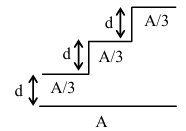
A capacitor is made of a flat plate of area A and a second plate having a stair-like structure as shown in figure. If the area of each stair is and the height is d, the capacitance of the arrangement is:
- Option A:
- Option B:
- Option C:
- Option D:
Answer: AStep-by-step solution → - Question 38Physics· Newton's Laws of Motion
A light unstretchable string passing over a smooth light pulley connects two blocks of masses and . If the acceleration of the system is , then the ratio of the masses is:
- Option A:
- Option B:
- Option C:
- Option D:
Answer: AStep-by-step solution → - Question 39Physics· Units, Dimensions & Error Analysis
The dimensional formula of latent heat is:
- Option A:
- Option B:
- Option C:
- Option D:
Answer: CStep-by-step solution → - Question 40Physics· Thermodynamics
The volume of an ideal gas is changed adiabatically from 5 litres to 4 litres. The ratio of initial pressure to final pressure is:
- Option A:
- Option B:
- Option C:
- Option D:
Answer: CStep-by-step solution → - Question 41Physics· Nuclear Physics
The energy equivalent of 1 g of substance is:
- Option A:
- Option B:
- Option C:
5.6 eV
- Option D:
Answer: DStep-by-step solution → - Question 42Physics· Gravitation
An astronaut takes a ball of mass from earth to space. He throws the ball into a circular orbit about earth at an altitude of 318.5 km . From earth's surface to the orbit, the change in total mechanical energy of the ball is . The value of is (take ):
- Option A:
11
- Option B:
9
- Option C:
12
- Option D:
10
Answer: AStep-by-step solution → - Question 43Physics· Moving Charges and Magnetic Field
Given below are two statements:
Statement (I) : When currents vary with time, Newton's third law is valid only if momentum carried by the electromagnetic field is taken into account.
Statement (II) : Ampere's circuital law does not depend on Biot-Savart's law. In the light of the above statements, choose the correct answer from the options given below:
- Option A:
Both Statement I and Statement II are false.
- Option B:
Statement I is true but Statement II is false.
- Option C:
Statement I is false but Statement II is true.
- Option D:
Both Statement I and Statement II are true.
Answer: BStep-by-step solution → - Question 44Physics· Work, Power & Energy
A particle of mass moves on a straight line with its velocity increasing with distance according to the equation , where is a constant. The total work done by all the forces applied on the particle during its displacement from to , will be:
- Option A:
- Option B:
- Option C:
- Option D:
Answer: CStep-by-step solution → - Question 45Physics· Current Electricity
A galvanmeter has a coil of resistance with a full scale deflection at . The value of resistance to be added to use it as an ammeter of range is:
- Option A:
- Option B:
- Option C:
- Option D:
Answer: BStep-by-step solution → - Question 46Physics· Rotational Dynamics
A heavy iron bar, of weight W is having its one end on the ground and the other on the shoulder of a person. The bar makes an angle with the horizontal. The weight experienced by the person is:
- Option A:
- Option B:
W
- Option C:
- Option D:
Answer: AStep-by-step solution → - Question 47Physics· Units, Dimensions & Error Analysis
One main scale division of a vernier caliper is equal to units. If division of main scale coincides with division of vernier scale, the least count of the vernier caliper is:
- Option A:
- Option B:
- Option C:
- Option D:
Answer: BStep-by-step solution → - Question 48Physics· Capacitors and R-C Circuits
A bulb and a capacitor are connected in series across an ac supply. A dielectric is then placed between the plates of the capacitor. The glow of the bulb:
- Option A:
increases
- Option B:
remains same
- Option C:
becomes zero
- Option D:
decreases
Answer: AStep-by-step solution → - Question 49Physics· Thermodynamics
A sample of 1 mole gas at temperature is adiabatically expanded to double its volume. If adiabatic constant for the gas is , then the work done by the gas in the process is:
- Option A:
- Option B:
- Option C:
- Option D:
Answer: AStep-by-step solution → - Question 50Physics· Vectors and Scalars
If and makes an angle with each other, then for The integer value of is
Answer: 3Step-by-step solution → - Question 51Physics· Electrostatics
At the centre of a half ring of radius and linear charge density , the potential is . The value of is .
Answer: 36Step-by-step solution → - Question 52Physics· Nuclear Physics
A star has helium composition. It starts to convert three into one via triple alpha process as
. The mass of the star is and it generates energy at the rate of
. The rate of converting these to is ,
where n is . [Take, mass of , mass of ]
Answer: 15Step-by-step solution → - Question 53Physics· Wave Optics
In a Young's double slit experiment, the intensity at a point is of the maximum intensity, the minimum distance
of the point from the central maximum is . (Given: )
Answer: 200Step-by-step solution → - Question 54Physics· Rotational Dynamics
A string is wrapped around the rim of a wheel of moment of inertia and radius 10 cm . The wheel is free to rotate about its axis. Initially the wheel is at rest. The string is now pulled by a force of 40 N . The angular velocity of the wheel after 10 s is , where x is .
Answer: 100Step-by-step solution → - Question 55Physics· Moving Charges and Magnetic Field
A square loop of edge length 2 m carrying current of 2 A is placed with its edges parallel to the axis. A magnetic field is passing through the plane and expressed as , where . The net magnetic force experienced by the loop is N .
Answer: 160Step-by-step solution → - Question 56Physics· Mechanical Properties of Matter
Two persons pull a wire towards themselves. Each person exerts a force of 200 N on the wire. Young's modulus of the material of wire is . Original length of the wire is 2 m and the area of cross section is . The wire will extend in length by .
Answer: 20Step-by-step solution → - Question 57Physics· Electromagnetic Induction
When a coil is connected across a 20 V dc supply, it draws a current of 5 A . When it is connected across ac supply, it draws a current of 4 A . The self inductance of the coil is mH . (Take )
Answer: 10Step-by-step solution → - Question 58Physics· Simple Harmonic Motion
The position, velocity and acceleration of a particle executing simple harmonic motion are found to have magnitudes of and at a certain instant. The amplitude of the motion is where x is .
Answer: 17Step-by-step solution → - Question 59Physics· Current Electricity
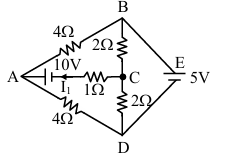
The current flowing through the resistor is A. The value of is .
 Answer: 25Step-by-step solution →
 - Question 60Chemistry· Electrochemistry
The molar conductivity for electrolytes A and B are plotted against as shown below. Electrolytes A and B respectively are :

- Option A:
(A) Weak electrolyte (B) Weak electrolyte
- Option B:
(A) Strong electrolyte (B) Strong electrolyte
- Option C:
(A) Weak electrolyte (B) Strong electrolyte
- Option D:
(A) Strong electrolyte (B) Weak electrolyte
Answer: DStep-by-step solution → - Question 61Chemistry· Solid State
Methods used for purification of organic compounds are based on :
- Option A:
neither on nature of compound nor on the impurity present.
- Option B:
nature of compound only.
- Option C:
nature of compound and presence of impurity.
- Option D:
presence of impurity only.
Answer: CStep-by-step solution → - Question 62Chemistry· General Organic Chemistry
Correct order of basic strength of Pyrrole


- Option A:
Piperidine Pyridine Pyrrole
- Option B:
Pyrrole Pyridine Piperidine
- Option C:
Pyridine Piperidine Pyrrole
- Option D:
Pyrrole Piperidine Pyridine
Answer: AStep-by-step solution → - Question 63Chemistry· Chemical Bonding
In which one of the following pairs the central atoms exhibit hybridization?
- Option A:
and
- Option B:
and
- Option C:
and
- Option D:
and
Answer: AStep-by-step solution → - Question 64Chemistry· Metallurgy
The ions make the enamel on teeth much harder by converting hydroxyapatite (the enamel on the surface of teeth) into much harder fluoroapatite having the formula.
- Option A:
- Option B:
- Option C:
- Option D:
Answer: AStep-by-step solution → - Question 65Chemistry· General Organic Chemistry
Relative stability of the contributing structures is :

- Option A:
(I) (III) (II)
- Option B:
(I) (II) (III)
- Option C:
(II) (I) (III)
- Option D:
(III) (II) (I)
Answer: BStep-by-step solution → - Question 66Chemistry· Periodicity of Elements and Periodic Properties
Given below are two statements, one is labelled as Statement I and the other is labelled as Statement II.
Statement (I) : The oxidation state of an element in a particular compound is the charge acquired by its atom on the basis of electron gain enthalpy consideration from other atoms in the molecule.
Statement (II) : - bond formation is more prevalent in second period elements over other periods.
In the light of the above statements, choose the most appropriate answer from the options given below :
- Option A:
Both Statement I and Statement II are incorrect
- Option B:
Statement I is correct but Statement II is incorrect
- Option C:
Both Statement I and Statement II are correct
- Option D:
Statement I is incorrect but Statement II is correct
Answer: DStep-by-step solution → - Question 67Chemistry· Alkyl and Aryl Halides
Given below are two statements, one is labelled as Assertion (A) and the other is labelled asReason (R).
Assertion (A) : reaction of occurs more readily than the reaction of .
Reason (R) : The partially bonded unhybridised p-orbital that develops in the trigonal bipyramidal transition state is stabilised by conjugation with the phenyl ring.
In the light of the above statements, choose the most appropriate answer from the options given below :
- Option A:
Both (A) and (R) are correct and (R) is the correct explanation of (A)
- Option B:
Both (A) and (R) are correct but (R) is not the correct explanation of (A)
- Option C:
(A) is correct but (R) is not correct
- Option D:
(A) is not correct but (R) is correct
Answer: AStep-by-step solution → - Question 68Chemistry· p-Block Elements (Group 15-18)
Given below are two statements : one is labelled as Assertion (A) : and the other is labelled as Reason (R).
Assertion (A) : Both rhombic and monoclinic sulphur exist as while oxygen exists as .
Reason (R) : Oxygen forms - multiple bonds with itself and other elements having small size and high electronegativity like , which is not possible for sulphur.
In the light of the above statements, choose the most appropriate answer from the options given below :
- Option A:
Both (A) and (R) are correct and (R) is the correct explanation of
- Option B:
Both (A) and (R) are correct but (R) is not the correct explanation of .
- Option C:
(A) is correct but (R) is not correct.
- Option D:
(A) is not correct but (R) is correct.
Answer: CStep-by-step solution → - Question 69Chemistry· Coordination Compounds
Given below are two statements : one is labelled as Assertion (A) and the other is labelled as Reason (R).
Assertion (A): The total number of geometrical isomers shown by complex ion is three
Reason (R): complex ion has an octahedral geometry.
In the light of the above statements, choose the most appropriate answer from the options given below :
- Option A:
Both (A) and (R) are correct and (R) is the correct explanation of (A).
- Option B:
(A) is correct but (R) is not correct.
- Option C:
(A) is not correct but ( ) is correct.
- Option D:
Both (A) and (R) are correct but (R) is not the correct explanation of .
Answer: CStep-by-step solution → - Question 70Chemistry· d and f Block Elements
The electronic configuration of Cu (II) is whereas that of is . Which of the following is correct?
- Option A:
is less stable
- Option B:
Stability of and Cu (II) depends on nature of copper salts
- Option C:
is more stable
- Option D:
and are equally stable
Answer: CStep-by-step solution → - Question 71Chemistry· Structure of Atom
Compare the energies of following sets of quantum numbers for a multielectron system.
(A)
(B)
(C)
(D)
(E)
Choose the correct answer from the options given below :
- Option A:
(B) > (A) > (C) > (E) > (D)
- Option B:
(E) > (C) < (D) < (A) < (B)
- Option C:
(E) > (C) > (A) > (D) > (B)
- Option D:
(C) < (E) < (D) < (A) < (B)
Answer: DStep-by-step solution → - Question 72Chemistry· Aldehydes and Ketones
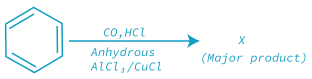
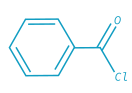
Identify major product " X " formed in the following reaction :
- Option A:
- Option B:
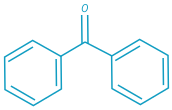
- Option C:

- Option D:
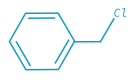
Answer: CStep-by-step solution → - Question 73Chemistry· Alcohols, Ethers and Phenols
Identify the product A and product B in the following set of reactions.

- Option A:
- Option B:
- Option C:
- Option D:
Answer: CStep-by-step solution → - Question 74Chemistry· Practical Inorganic chemistry (Qualitative Analysis)
On reaction of Lead Sulphide with dilute nitric acid which of the following is not formed?
- Option A:
Lead nitrate
- Option B:
Sulphur
- Option C:
Nitric oxide
- Option D:
Nitrous oxide
Answer: DStep-by-step solution → - Question 75Chemistry· Practical Inorganic chemistry (Qualitative Analysis)
Identify the incorrect statements regarding primary standard of titrimetric analysis
(A) It should be purely available in dry form.
(B) It should not undergo chemical change in air.
(C) It should be hygroscopic and should react with another chemical instantaneously and stoichiometrically.
(D) It should be readily soluble in water.
(E) can be used as primary standard.
Choose the correct answer from the options given below :
- Option A:
(C) and (D) only
- Option B:
(B) and (E) only
- Option C:
(A) and (B) only
- Option D:
(C) and (E) only
Answer: DStep-by-step solution → - Question 76Chemistry· Thermodynamics & Thermochemistry
The heat of solution of anhydrous and are and respectively.
The heat of hydration of to is . The value of is .
Answer: 82Step-by-step solution → - Question 77Chemistry· General Organic Chemistry
How many compounds among the following compounds show inductive, mesomeric as well as hyperconjugation effects ?
 Answer: 4Step-by-step solution →
 - Question 78Chemistry· Electrochemistry
The standard reduction potentials at 298 K for the following half cells are given below :
Consider the given electrochemical reactions, The number of metal(s) which will be oxidized be , in aqueous
solution is
Answer: 3Step-by-step solution → - Question 79Chemistry· Some Basic Concepts of Chemistry (Mole Concept) + Stoichiometry
When equal volume of and are separately neutralised by excess volume of solution. and kJ of heat is liberated respectively. The value of is .
Answer: 2Step-by-step solution → - Question 80Chemistry· Some Basic Concepts of Chemistry (Mole Concept) + Stoichiometry
Molarity of an aqueous solution containing of anhydrous in solution at is . Its molality will be (nearest integer).
[Given: density of solution ]
Answer: 164Step-by-step solution → - Question 81Chemistry· Chemical Bonding
The total number of species from the following in which one unpaired electron is present, is .
Answer: 4Step-by-step solution → - Question 82Chemistry· Coordination Compounds
Number of ambidentate ligands among the following is .
Answer: 3Step-by-step solution → - Question 83Chemistry· Biomolecules
Total number of essential amino acid among the given list of amino acids is .
Arginine, Phenylalanine, Aspartic acid, Cysteine, Histidine, Valine, Proline
Answer: 4Step-by-step solution → - Question 84Chemistry· d and f Block Elements
Number of colourless lanthanoid ions among the following is .
Answer: 2Step-by-step solution →
Stuck on one of these?
Practise questions like them — free, with a tutor that explains every step.