NEET (UG) 2025 · previous year paper
NEET (UG) 2025
170 questions with the verified answer key. Open any question for its step-by-step solution.
- Question 1Physics· Mechanical Properties of Matter
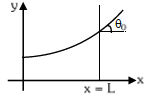
Consider a water tank shown in the figure. It has one wall at and can be taken to be very wide in the direction. When filled with a liquid of surface tension S and density , the liquid surface makes angle with the -axis at . If is the height of the surface then the equation for is: (take is the acceleration due to gravity)
- Option A:
- Option B:
- Option C:
- Option D:
Answer: BStep-by-step solution → - Question 2Physics· Geometrical Optics
A microscope has an objective of focal length 2 cm , eyepiece of focal length 4 cm and the tube length of 40 cm . If the distance of distinct vision of eye is 25 cm , the magnification in the microscope is :
- Option A:
100
- Option B:
125
- Option C:
150
- Option D:
250
Answer: BStep-by-step solution → - Question 3Physics· Moving Charges and Magnetic Field
An electron (mass and charge ) moving with speed ( = speed of light) is injected into a magnetic field of magnitude perpendicular to its direction of motion. We wish to apply a uniform electric field together with the magnetic field so that the electron does not deflect from its path. Then (speed of light )
- Option A:
is perpendicular to and its magnitude is
- Option B:
is perpendicular to and its magnitude is
- Option C:
is parallel to and its magnitude is
- Option D:
is parallel to and its magnitude is
Answer: BStep-by-step solution → - Question 4Physics· Friction
There are two inclined surface of equal length (L) and same angle of inclination with the horizontal. One of them is rough and the other is perfectly smooth. A given body takes 2 times as much time to slide down on rough surface than on the smooth surface. The coefficient of kinetic friction between the object and the rough surface is close to:
- Option A:
0.25
- Option B:
0.4
- Option C:
0.5
- Option D:
0.75
Answer: DStep-by-step solution → - Question 5Physics· Work, Power & Energy
The kinetic energies of two similar cars and are 100 J and 225 J respectively. On applying breaks, car A stops after 1000 m and car B stops after 1500 m . If and are the forces applied by the breaks on cars A and B , respectively, then the ratio is :
- Option A:
- Option B:
- Option C:
- Option D:
Answer: BStep-by-step solution → - Question 6Physics· Horizontal Circular Motion
A bob of heavy mass is suspended by a light string of length . The bob is given a horizontal velocity as shown in figure. If the string gets slack at some point P making an angle from the horizontal, the ratio of the speed v of the bob at point P to its initial speed is :

- Option A:
- Option B:
- Option C:
- Option D:
Answer: DStep-by-step solution → - Question 7Physics· Semiconductor and Electronic Devices
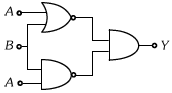
The output (Y) of the given logic implementation is similar to the output of an/a gate.
- Option A:
AND
- Option B:
NAND
- Option C:
OR
- Option D:
NOR
Answer: DStep-by-step solution → - Question 8Physics· Electrostatics
The electric field in a plane electromagnetic wave is given by . Then
expression for the corresponding magnetic field is (here subscripts denote the direction of the field) :
- Option A:
- Option B:
- Option C:
- Option D:
Answer: AStep-by-step solution → - Question 9Physics· Newton's Laws of Motion
A ball of mass 0.5 kg is dropped from a height of 40 m . The ball hits the ground and rises to a height of 10 m . The impulse imparted to the ball during its collision with the ground is (Take )
- Option A:
21 Ns
- Option B:
7 Ns
- Option C:
0
- Option D:
84 Ns
Answer: AStep-by-step solution → - Question 10Physics· Electromagnetic Induction
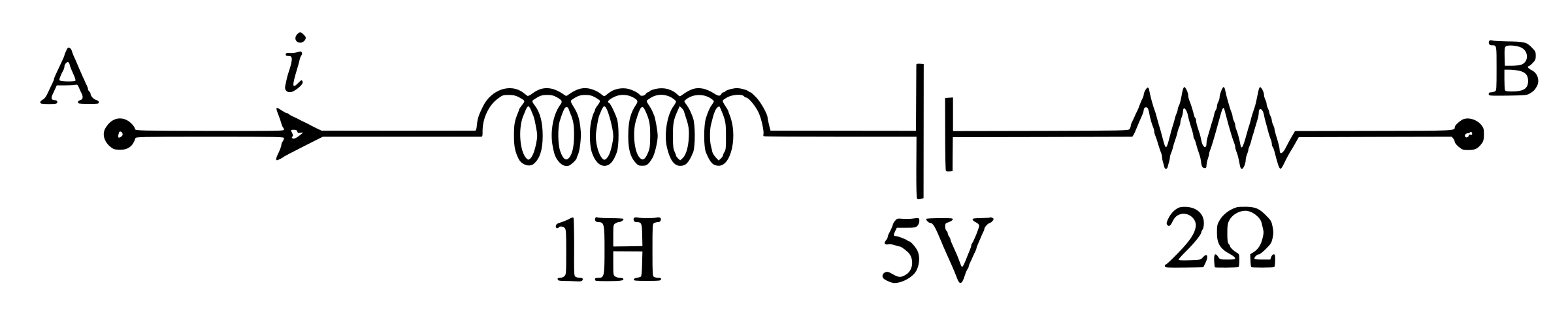
AB is a part of an electrical circuit (see figure). The potential difference " ", at the instant when current and is increasing at a rate of second is :
- Option A:
5 volt
- Option B:
6 volt
- Option C:
9 volt
- Option D:
10 volt
Answer: DStep-by-step solution → - Question 11Physics· Moving Charges and Magnetic Field
A 2 amp current is flowing through two different small circular copper coils having radii ratio . The ratio of their respective magnetic moments will be
- Option A:
- Option B:
- Option C:
- Option D:
Answer: AStep-by-step solution → - Question 12Physics· Geometrical Optics
In a certain camera, a combination of four similar thin convex lenses are arranged axially in contact. Then the power of the combination and the total magnification in comparison to the power (P) and magnification ( ) for each lens will be, respectively
- Option A:
and
- Option B:
and
- Option C:
and
- Option D:
and
Answer: CStep-by-step solution → - Question 13Physics· Kinetic Theory of Gases
An oxygen cylinder of volume 30 litre has 18.20 moles of oxygen. After some oxygen is withdrawn from the cylinder, its gauge pressure drops to 11 atmospheric pressure at temperature . The mass of the oxygen withdrawn from the cylinder is nearly equal to
- Option A:
0.125 kg
- Option B:
0.144 kg
- Option C:
0.116 kg
- Option D:
0.156 kg
Answer: CStep-by-step solution → - Question 14Physics· Motion in one Dimension
In some appropriate units, time ( ) and position (x) relation of a moving particle is given by . The acceleration of the particle is
- Option A:
- Option B:
- Option C:
- Option D:
Answer: BStep-by-step solution → - Question 15Physics· Alternating Current
To an ac power supply of 220 V at 50 Hz, a resistor of , a capacitor of reactance and an inductor of reactance are connected in series. The corresponding current in the circuit and the phase angle between the current and the voltage is, respectively-
- Option A:
7.8 A and
- Option B:
7.8 A and
- Option C:
15.6 A and
- Option D:
15.6 A and
Answer: BStep-by-step solution → - Question 16Physics· Rotational Dynamics
The Sun rotates around its centre once in 27 days. What will be the period of revolution if the Sun were to expand to twice its present radius without any external influence? Assume the Sun to be a sphere of uniform density.
- Option A:
100 days
- Option B:
105 days
- Option C:
115 days
- Option D:
108 days
Answer: DStep-by-step solution → - Question 17Physics· Atomic Physics
A model for quantized motion of an electron in a uniform magnetic field states that the flux passing through the orbit of the electron is where is an integer, is Planck's constant and is the magnitude of electron's charge. According to the model, the magnetic moment of an electron in its lowest energy state will be ( is the mass of the electron)
- Option A:
- Option B:
- Option C:
- Option D:
Answer: BStep-by-step solution → - Question 18Physics· Heat Transfer
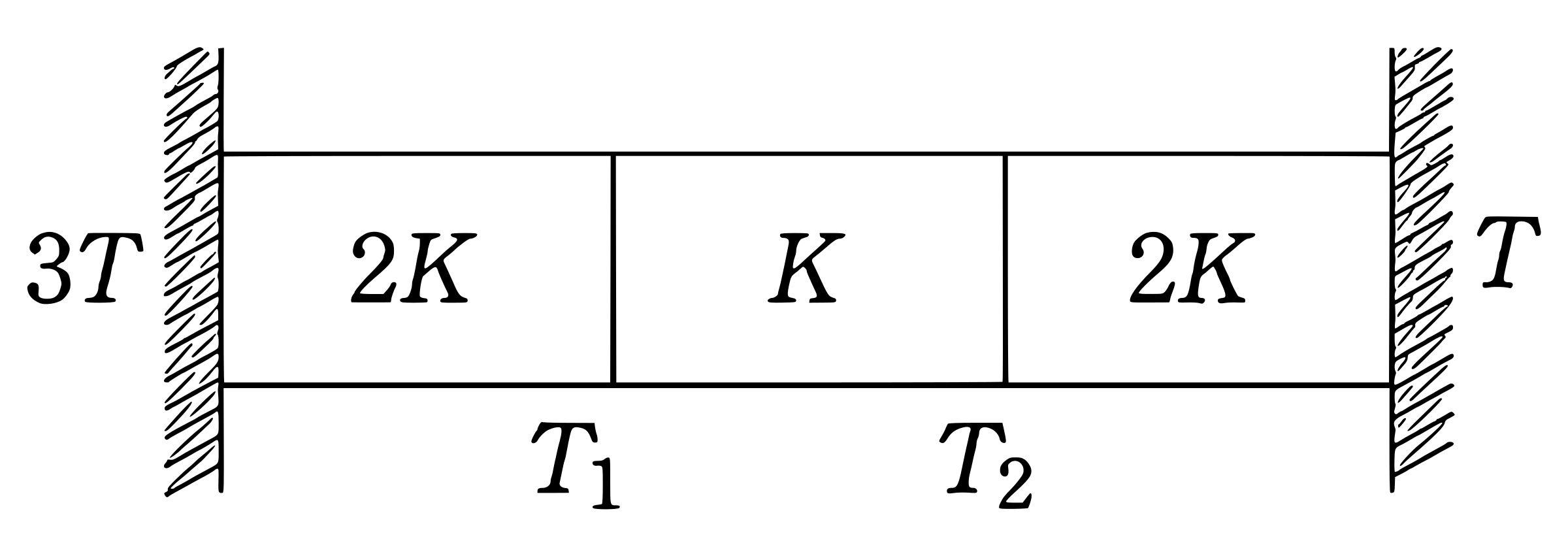
Three identical heat conducting rods are connected in series as shown in the figure. The rods on the sides have thermal conductivity 2 K while that in the middle has thermal conductivity . The left end of the combination is maintained at temperature and the right end at . The rods are thermally insulated from outside. In steady state, temperature at the left junction is and that at the right junction is . The ratio is
- Option A:
- Option B:
- Option C:
- Option D:
Answer: CStep-by-step solution → - Question 19Physics· Capacitors and R-C Circuits
The plates of a parallel plate capacitor are separated by d. Two slabs of different dielectric constant and with thickness and , respectively are inserted in the capacitor. Due to this, the capacitance becomes two times larger than when there is nothing between the plates. (If , the value of is :
- Option A:
2.66
- Option B:
2.33
- Option C:
1.6
- Option D:
1.33
Answer: AStep-by-step solution → - Question 20Physics· Motion in Plane
Two cities and are connected by a regular bus service with a bus leaving in either direction every min. A girl is driving scooty with a speed of 60 in the direction X to Y notices that a bus goes past her every 30 minutes in the direction of her motion, and every 10 minutes in the opposite direction. Choose the correct option for the period T of the bus service and the speed (assumed constant) of the buses.
- Option A:
- Option B:
- Option C:
- Option D:
Answer: DStep-by-step solution → - Question 21Physics· Friction
A uniform rod of mass 20 kg and length 5 m leans against a smooth vertical wall making an angle of with it. The other end rests on a rough horizontal floor. The friction force that the floor exerts on the rod is (take )
- Option A:
100 N
- Option B:
- Option C:
200 N
- Option D:
Answer: BStep-by-step solution → - Question 22Physics· Electrostatics
A balloon is made of a material of surface tension and its inflation outlet (from where gas is filled in it) has small area . It is filled with a gas of density and takes a spherical shape of radius . When the gas is allowed to flow freely out of it, its radius changes from to 0 (zero) in time . If the speed of gas coming out of the balloon depends on as and then
- Option A:
- Option B:
- Option C:
- Option D:
Answer: CStep-by-step solution → - Question 23Physics· Units, Dimensions & Error Analysis
Consider the diameter of a spherical object being measured with the help of a Vernier callipers. Suppose its 10 Vernier Scale Divisions (V.S.D.) are equal to its 9 Main Scale Divisions (M.S.D.) The least division in the M.S. is 0.1 cm and the zero of V.S. is at when the jaws of Vernier callipers are closed. If the main scale reading for the diameter is and the number of coinciding vernier division is 8, the measured diameter after zero error correction, is
- Option A:
5.18 cm
- Option B:
5.08 cm
- Option C:
4.98 cm
- Option D:
5.00 cm
Answer: CStep-by-step solution → - Question 24Physics· Electromagnetic Waves
A parallel plate capacitor made of circular plates is being charged such that the surface charge density on its plates is increasing at a constant rate with time. The magnetic field arising due to displacement current is :
- Option A:
zero at all places
- Option B:
constant between the plates and zero outside the plates
- Option C:
non-zero everywhere with maximum at the imaginary cylindrical surface connecting peripheries of the plates
- Option D:
zero between the plates and non-zero outside
Answer: CStep-by-step solution → - Question 25Physics· Wave Optics
An unpolarized light beam travelling in air is incident on a medium of refractive index 1.73 at Brewster's angle. Then -
- Option A:
reflected light is completely polarized and the angle of reflection is close to
- Option B:
reflected light is partially polarized and the angle of reflection is close to
- Option C:
both reflected and transmitted light are perfectly polarized with angles of reflection and refraction close to and , respectively
- Option D:
transmitted light is completely polarized with angle of refraction close to
Answer: AStep-by-step solution → - Question 26Physics· Electrostatics
Two identical charged conducting spheres and have their centres separated by a certain distance. Charge on each sphere is q and the force of repulsion between them is F. A third identical uncharged conducting sphere is brought in contact with sphere A first and then with B and finally removed from both. New force of repulsion between spheres A and B (Radii of A and B are negligible compared to the distance of separation so that for calculating force between them they can be considered as point charges) is best given as :
- Option A:
- Option B:
- Option C:
- Option D:
Answer: DStep-by-step solution → - Question 27Physics· Kinetic Theory of Gases
A container has two chambers of volumes litres and litres separated by a partition made of a thermal insulator. The chambers contains and moles of ideal gas at pressures and , respectively. When the partition is removed, the mixture attains an equilibrium pressure of :
- Option A:
1.3 atm
- Option B:
1.6 atm
- Option C:
1.4 atm
- Option D:
1.8 atm
Answer: BStep-by-step solution → - Question 28Physics· Atomic Physics
A particle of mass is moving around the origin with a constant force pulling it towards the origin. If Bohr model is used to describe its motion, the radius of the orbit and the particle's speed in the orbit depend on as
- Option A:
- Option B:
- Option C:
- Option D:
Answer: CStep-by-step solution → - Question 29Physics· Gravitation
The radius of Martian orbit around the Sun is about 4 times the radius of the orbit of Mercury. The Martian year is 687 Earth days. Then which of the following is the length of 1 year on Mercury ?
- Option A:
88 earth days
- Option B:
225 earth days
- Option C:
172 earth days
- Option D:
124 earth days
Answer: AStep-by-step solution → - Question 30Physics· Gravitation
A body weighs 48 N on the surface of the earth. The gravitational force experienced by the body due to the earth at a height equal to one-third the radius of the earth from its surface is :
- Option A:
16 N
- Option B:
27 N
- Option C:
32 N
- Option D:
36 N
Answer: BStep-by-step solution → - Question 31Physics· Current Electricity
A wire of resistance is cut into 8 equal pieces. From these pieces two equivalent resistances are made by adding four of these together in parallel. Then these two sets are added in series. The net effective resistance of the combination is :
- Option A:
- Option B:
- Option C:
- Option D:
Answer: CStep-by-step solution → - Question 32Physics· Atomic Physics
De-Broglie wavelength of an electron orbiting in the state of hydrogen atom is close to (Given Bohr radius )
- Option A:
0.067 nm
- Option B:
0.67 nm
- Option C:
1.67 nm
- Option D:
2.67 nm
Answer: BStep-by-step solution → - Question 33Physics· Electrostatics
An electric dipole with dipole moment is aligned with the direction of a uniform electric field of magnitude The dipole is then rotated through an angle of with respect to the electric field. The change in the potential energy of the dipole is :
- Option A:
0.8 J
- Option B:
1.0 J
- Option C:
1.2 J
- Option D:
1.5 J
Answer: BStep-by-step solution → - Question 34Physics· Current Electricity
A constant voltage of 50 V is maintained between the points A and B of the circuit shown in the figure. The current through the branch CD of the circuit is :-

- Option A:
1.5 A
- Option B:
2.0 A
- Option C:
2.5 A
- Option D:
3.0 A
Answer: BStep-by-step solution → - Question 35Physics· Atomic Physics
A photon and an electron (mass ) have the same energy . The ratio ( ) of their de Broglie wavelengths is: (c is the speed of light)
- Option A:
- Option B:
- Option C:
- Option D:
Answer: CStep-by-step solution → - Question 36Physics· Rotational Dynamics
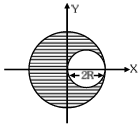
A sphere of radius is cut from a larger solid sphere of radius as shown in the figure. The ratio of the moment of inertia of the smaller sphere to that of the rest part of the sphere about the Y-axis is:
- Option A:
- Option B:
- Option C:
- Option D:
Answer: CStep-by-step solution → - Question 37Physics· Semiconductor and Electronic Devices
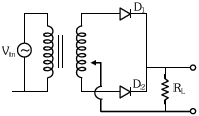
A full wave rectifier circuit with diodes and is shown in the figure. If input supply voltage volt, then at
- Option A:
is forward biased, is reverse biased
- Option B:
is reverse biased, is forward biased
- Option C:
and both are forward biased
- Option D:
and both are reverse biased
Answer: BStep-by-step solution → - Question 38Physics· Thermodynamics
Two gases and are filled at the same pressure in separate cylinders with movable pistons of radius and , respectively. On supplying an equal amount of heat to both the systems reversibly under constant pressure, the pistons of gas and are displaced by 16 cm and 9 cm , respectively. If the change in their internal energy is the same, then the ratio is equal to
- Option A:
- Option B:
- Option C:
- Option D:
Answer: BStep-by-step solution → - Question 39Physics· Units, Dimensions & Error Analysis
A physical quantity is related to four observations and as follows :
The percentage errors of measurement in and are and respectively. The percentage error in the quantity is
- Option A:
- Option B:
- Option C:
- Option D:
Answer: CStep-by-step solution → - Question 40Physics· Wave Optics
The intensity of transmitted light when a polaroid sheet, placed between two crossed polaroids at from the polarization axis of one of the polaroid, is ( is the intensity of polarised light after passing through the first polaroid):
- Option A:
- Option B:
- Option C:
- Option D:
Answer: CStep-by-step solution → - Question 41Physics· Simple Harmonic Motion
Two identical point masses and , suspended from two separate massless springs of spring constants and , respectively, oscillate vertically. If their maximum speeds are the same, the ratio ( ) of the amplitude of mass to the amplitude of mass is :
- Option A:
- Option B:
- Option C:
- Option D:
Answer: DStep-by-step solution → - Question 42Physics· Sound Waves
A pipe open at both ends has a fundamental frequency in air. The pipe is now dipped vertically in a water drum to half of its length. The fundamental frequency of the air column is now equal to :
- Option A:
- Option B:
- Option C:
- Option D:
Answer: BStep-by-step solution → - Question 43Chemistry· Structure of Atom
The ratio of the wavelengths of the light absorbed by a Hydrogen atom when it undergoes and transitions, respectively, is
- Option A:
- Option B:
- Option C:
- Option D:
Answer: DStep-by-step solution → - Question 44Chemistry· Periodicity of Elements and Periodic Properties
Which of the following statements are true?
A. Unlike Ga that has a very high melting point, Cs has a very low melting point.
B. On Pauling scale, the electronegativity values of N and Cl are not the same.
C. , and are all isoelectronic species.
D. The correct order of the first ionization enthalpies of , and Si is .
E. The atomic radius of Cs is greater than that of Li and Rb.
Choose the correct answer from the options given below
- Option A:
A, B and E only
- Option B:
C and E only
- Option C:
C and D only
- Option D:
A, C and E only
Answer: BStep-by-step solution → - Question 45Chemistry· Practical Inorganic chemistry (Qualitative Analysis)
Match List I with List II \begin{center}
List I (Ion) List II (Group Number in Cation Analysis) A. I. Group-I B. II. Group-III C. III. Group-IV D. IV. Group-VI Choose the correct answer from the option given below:
- Option A:
A-III, B-IV, C-II, D-I
- Option B:
A-III, B-IV, C-I, D-II
- Option C:
A-III, B-II, C-IV, D-I
- Option D:
A-III, B-II, C-I, D-IV
Answer: BStep-by-step solution → - Question 46Chemistry· Structure of Atom
Energy and radius of first Bohr orbit of and are
[Given ]
- Option A:
;r_{\mathrm{n}}\left(\mathrm{Li}^{2+}\right)=17.6 \mathrm{pm}$$\mathrm{E}_{\mathrm{n}}\left(\mathrm{He}^{+}\right)=-8.72 \times 10^{-18} \mathrm{~J};
- Option B:
;r_{n}\left(\mathrm{Li}^{2+}\right)=26.4 \mathrm{pm}$$\mathrm{E}_{\mathrm{n}}\left(\mathrm{He}^{+}\right)=-19.62 \times 10^{-18} \mathrm{~J};
- Option C:
;r_{n}\left(\mathrm{Li}^{2+}\right)=17.6 \mathrm{pm}$$\mathrm{E}_{\mathrm{n}}\left(\mathrm{He}^{+}\right)=-8.72 \times 10^{-16} \mathrm{~J} ;$$\mathrm{r}_{\mathrm{n}}\left(\mathrm{He}^{+}\right)=26.4 \mathrm{pm}
- Option D:
;r_{n}\left(\mathrm{Li}^{2+}\right)=17.6 \mathrm{pm}$$\mathrm{E}_{\mathrm{n}}\left(\mathrm{He}^{+}\right)=-19.62 \times 10^{-16} \mathrm{~J};
Answer: AStep-by-step solution → - Question 47Chemistry· Coordination Compounds
Which of the following are paramagnetic?
A.
B.
C.
D.
E.
Choose the correct answer from the options given below:
- Option A:
A and C only
- Option B:
B and E only
- Option C:
A and D only
- Option D:
A, D and E only
Answer: CStep-by-step solution → - Question 48Chemistry· p-Block Elements (Group 15-18)
Given below are two statements:
Statement I : Like nitrogen that can form ammonia, arsenic can form arsine.
Statement II : Antimony cannot form antimony pentoxide.
In the light of the above statements, choose the most appropriate answer from the options given below:
- Option A:
Both Statement I and Statement II are correct
- Option B:
Both Statement I and Statement II are incorrect
- Option C:
Statement I is correct but Statement II is incorrect
- Option D:
Statement I is incorrect but Statement II is correct.
Answer: CStep-by-step solution → - Question 49Chemistry· Periodicity of Elements and Periodic Properties
Which among the following electronic configurations belong to main group elements?
A.
B.
C.
D.
E.
Choose the correct answer from the option given below:
- Option A:
B and E only
- Option B:
A and C only
- Option C:
D and E only
- Option D:
A, C and D only
Answer: BStep-by-step solution → - Question 50Chemistry· Some Basic Concepts of Chemistry (Mole Concept) + Stoichiometry
Dalton's Atomic theory could not explain which of the following ?
- Option A:
Law of conservation of mass
- Option B:
Law of constant proportion
- Option C:
Law of multiple proportion
- Option D:
Law of gaseous volume
Answer: DStep-by-step solution → - Question 51Chemistry· Redox Reactions
Consider the following compounds:
and .
The oxidation states of the underlined elements in them are, respectively,
- Option A:
, and +6
- Option B:
, and +6
- Option C:
, and +4
- Option D:
, and +6
Answer: AStep-by-step solution → - Question 52Chemistry· Chemical Kinetics
If the half-life ( ) for a first order reaction is 1 minutes, then the time required for completion of the reaction is closest to:
- Option A:
2 minutes
- Option B:
4 minutes
- Option C:
5 minutes
- Option D:
10 minutes
Answer: DStep-by-step solution → - Question 53Chemistry· Coordination Compounds
The correct order of the wavelength of light absorbed by the following complexes is,
A.
B.
C.
D.
Choose the correct answer from the options given below:
- Option A:
B D A C
- Option B:
B A D C
- Option C:
C D A B
- Option D:
C A D B
Answer: BStep-by-step solution → - Question 54Chemistry· Isomerism
Which one of the following compounds can exist as cis-trans isomers ?
- Option A:
Pent-1-ene
- Option B:
2-Methylhex-2-ene
- Option C:
1, 1-Dimethylcyclopropane
- Option D:
1, 2-Dimethylcyclohexane
Answer: DStep-by-step solution → - Question 55Chemistry· Ionic Equilibrium
Phosphoric acid ionizes in three steps with their ionization constant values and , respectively,
While K is the overall ionization constant. Which of the following statements are true ?
A.
B. is a stronger acid than and
C.
D.
Choose the correct answer from the options given below:
- Option A:
A and B only
- Option B:
A and C only
- Option C:
B, C and D only
- Option D:
A, B and C only
Answer: DStep-by-step solution → - Question 56Chemistry· Electrochemistry
If the molar conductivity ( ) of a solution of a monobasic weak acid is , its extent (degree) of dissociation will be [Assume and .]
- Option A:
0.115
- Option B:
0.125
- Option C:
0.225
- Option D:
0.215
Answer: CStep-by-step solution → - Question 57Chemistry· Chemical Bonding
Given below are two statements: one is labelled as Statement I and the other is labelled as Statement II: Statement I: A hypothetical diatomic molecule with bond order zero is quite stable. Statement II: As bond order increases, the bond length increases. In the light of the above statements, choose the most appropriate answer from the options given below:
- Option A:
Both Statement I and Statement II are true
- Option B:
Both Statement I and Statement II are false
- Option C:
Statement I is true but Statement II is false
- Option D:
Statement I is false but Statement II are true
Answer: BStep-by-step solution → - Question 58Chemistry· Coordination Compounds
Out of the following complex compounds, which of the compound will be having the minimum conductance in solution?
- Option A:
- Option B:
- Option C:
- Option D:
Answer: AStep-by-step solution → - Question 59Chemistry· Chemical Bonding
Match List - I with List - II
List-I List-II A. I. , linear B. II. ; pyramidal C. III. ; distorted octahedral D. IV. ; square pyramidal Choose the correct answer from the options given below:
- Option A:
A-II, B-I, C-IV, D-III
- Option B:
A-II, B-I, C-III, D-IV
- Option C:
A-IV, B-II, C-III, D-I
- Option D:
A-IV, B-II, C-I, D-III
Answer: AStep-by-step solution → - Question 60Chemistry· Thermodynamics & Thermochemistry
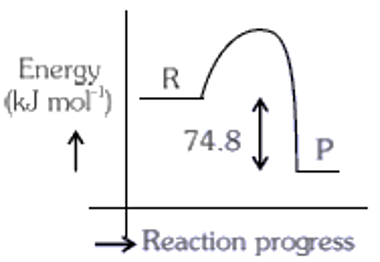
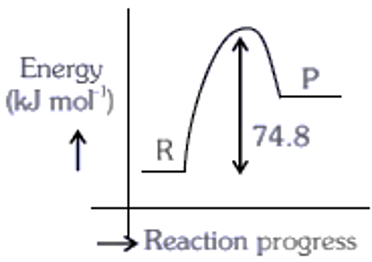
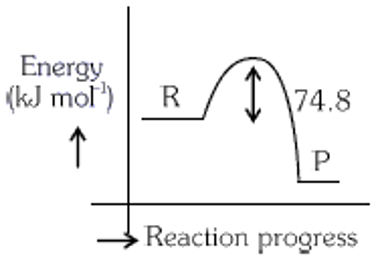
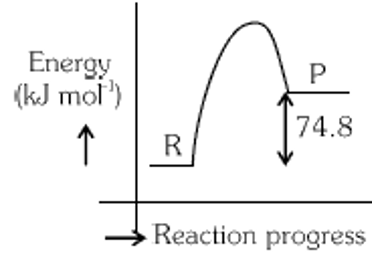
Which of the following diagrams gives an accurate representation of the above reaction?
reactants; products]
- Option A:
- Option B:
- Option C:
- Option D:
Answer: AStep-by-step solution → - Question 61Chemistry· Solutions and Colligative Properties
Match List - I with List - II
List-I (Example) List-II (Type of Solution) A. Humidity I. Solid in solid B. Alloys II. Liquid in gas C. Amalgams III. Solid in gas D. Smoke IV. Liquid in solid Choose the correct answer from the options given below:
- Option A:
A-II, B-IV, C-I, D-III
- Option B:
A-II, B-I, C-IV, D-III
- Option C:
A-III, B-I, C-IV, D-II
- Option D:
A-III, B-II, C-I, D-IV
Answer: BStep-by-step solution → - Question 62Chemistry· Nitrogen Containing Organic Compounds
The correct order of decreasing basic strength of the given amines is :
- Option A:
N-methylaniline > benzenamine > ethanamine > N-ethylethanamine
- Option B:
N- ethylethanamine > ethanamine > benzenamine > N- methylanili
- Option C:
N- ethylethanamine > ethanamine >N - methylaniline > benzenamine
- Option D:
benzenamine ethanamine N-methylaniline > N-ethylethanamine
Answer: CStep-by-step solution → - Question 63Chemistry· Some Basic Concepts of Chemistry (Mole Concept) + Stoichiometry
Among the following choose the ones with equal number of atoms.
A. 212 g of [molar mass ]
B. 248 g of [molar mass ]
C. 240 g of [molar mass ]
D. 12 g of [molar mass ]
E. 220 g of [molar mass ]
Choose the correct answer from the options given below:
- Option A:
A, B and C only
- Option B:
A, B and D only
- Option C:
B, C and D only
- Option D:
B, D and E only
Answer: BStep-by-step solution → - Question 64Chemistry· Biomolecules
Match List - I with List - II
List-I (Name of the Vitamin) List-II (Deficiency disease) A. Vitamin I. Cheilosis B. Vitamin D II. Convulsions C. Vitamin III. Rickets D. Vitamin IV. Pernicious anaemia Choose the correct answer from the options given below:
- Option A:
A-I, B-III, C-II, D-IV
- Option B:
A-IV, B-III, C-I, D-II
- Option C:
A-II, B-III, C-I, D-IV
- Option D:
A-IV, B-III, C-II, D-I
Answer: BStep-by-step solution → - Question 65Chemistry· Carboxylic Acids and Derivatives
The correct order of decreasing acidity of the following aliphatic acids is :-
- Option A:
- Option B:
- Option C:
- Option D:
Answer: CStep-by-step solution → - Question 66Chemistry· d and f Block Elements
Given below are two statements : one is labelled as Statement I and the other is labelled as Statement II:
Statement I: Ferromagnetism is considered as an extreme form of paramagnetism.
Statement II: The number of unpaired electrons in a ion is the same as that of a ion ( ).
In the light of the above statements, choose the correct answer from the options given below :
- Option A:
Both Statements I and Statement II are true
- Option B:
Both Statement I and Statements II are false
- Option C:
Statement I is true but Statement II is false
- Option D:
Statement I is false but Statement II is true
Answer: CStep-by-step solution → - Question 67Chemistry· Solid State
Match List-I with List-II
List-I (Mixture) List-II (Method of Separation) A. I. Distillation under reduced pressure B. Crude oil in petroleum industry II. Steam distillation C. Glycerol from spent-lye III. Fractional distillation D. Aniline-water IV. Simple distillation Choose the correct answer from the options given below :-
- Option A:
A-IV, B-III, C-I, D-II
- Option B:
A-IV, B-III, C-II, D-I
- Option C:
A-III, B-IV, C-I, D-II
- Option D:
A-III, B-IV, C-II, D-I
Answer: AStep-by-step solution → - Question 68Chemistry· Chemical Equilibrium
For the reaction , the backward reaction rate constant is higher than the forward reaction rate
constant by a factor of 2500 , at 1000 K . [Given : ] for the reaction
at 1000 K is
- Option A:
83.1
- Option B:
- Option C:
0.033
- Option D:
0.021
Answer: CStep-by-step solution → - Question 69Chemistry· Nitrogen Containing Organic Compounds
Given below are two statements : one is labelled as Statement I and the other is labelled as Statement II:
Statement I: Benzenediazonium salt is prepared by the reaction of aniline with nitrous acid at . It decomposes easily in the dry state.
Statement II: Insertion of iodine into the benzene ring is difficult and hence iodobenzene is prepared through the reaction of benzenediazonium salt with KI.
In the light of the above statements, choose the correct answer from the options given below :
- Option A:
Both Statement I and Statement II are correct
- Option B:
Both Statement I and Statement II are incorrect
- Option C:
Statement I is correct but Statement II is incorrect
- Option D:
Statement I is incorrect but Statement II is correct
Answer: AStep-by-step solution → - Question 70Chemistry· Alkyl and Aryl Halides
How many products (including stereoisomers) are expected from monochlorination of the following compound?
- Option A:
2
- Option B:
3
- Option C:
5
- Option D:
6
Answer: CStep-by-step solution → - Question 71Chemistry· General Organic Chemistry
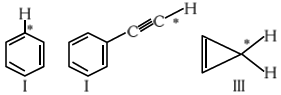
Among the given compound I-III, the correct order of bond dissociation energy of bond marked with * is :-
- Option A:
II I III
- Option B:
I II III
- Option C:
III II I
- Option D:
II III I
Answer: AStep-by-step solution → - Question 72Chemistry· Aromatic Compounds
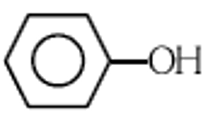
Which one of the following compounds does not decolourize bromine water?
- Option A:

- Option B:
- Option C:
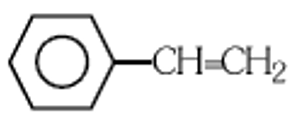
- Option D:
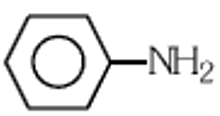
Answer: AStep-by-step solution → - Question 73Chemistry· Solutions and Colligative Properties
Which of the following aqueous solution will exhibit highest boiling point?
- Option A:
0.01 M Urea
- Option B:
- Option C:
- Option D:
Answer: CStep-by-step solution → - Question 74Chemistry· Coordination Compounds
Match List-I with List-II
List-I List-II A. Haber process I. Fe catalyst B. Wacker oxidation II. C. Wilkinson catalyst III. D. Ziegler catalyst IV. with Choose the correct answer from the options given below:
- Option A:
A-I, B-II, C-IV, D-III
- Option B:
A-II, B-III, C-I, D-IV
- Option C:
A-I, B-II, C-III, D-IV
- Option D:
A-I, B-IV, C-III, D-II
Answer: CStep-by-step solution → - Question 75Chemistry· Solutions and Colligative Properties
5 moles of liquid X and 10 moles of liquid Y make a solution having a vapour pressure of 70 torr. The vapour pressures of pure X and Y are 63 torr and 78 torr respectively. Which of the following is true regarding the described solution ?
- Option A:
The solution shows positive deviation.
- Option B:
The solution shows negative deviation.
- Option C:
The solution is ideal.
- Option D:
The solution has volume greater than the sum of individual volumes.
Answer: BStep-by-step solution → - Question 76Chemistry· Biomolecules
Sugar 'X' A. is found in honey. B. is a keto sugar. C. exists in and - anomeric forms. D. is laevorotatory. 'X' is :
- Option A:
D-Glucose
- Option B:
D-Fructose
- Option C:
Maltose
- Option D:
Sucrose
Answer: BStep-by-step solution → - Question 77Chemistry· Alkyl and Aryl Halides
Given below are two statements: One is labelled as Assertion (A) and the other is labelled as Reason (R)
Assertion (A):

undergoes S2 reaction faster than

Reason (R): Iodine is a better leaving group because of its large size.
In light of the above statements, choose the most appropriate answer from the options given below.
- Option A:
Both and are true and is the correct explanation of .
- Option B:
Both and are true but is not the correct explanation of .
- Option C:
is true but is false
- Option D:
is false but is true
Answer: AStep-by-step solution → - Question 78Chemistry· Thermodynamics & Thermochemistry
The standard heat of formation, in of is
[Given : standard heat of formation of ion (aq) , Standard heat of crystallisation of
, standard heat of formation of
- Option A:
- Option B:
- Option C:
- Option D:
Answer: AStep-by-step solution → - Question 79Chemistry· Isomerism
Total number of possible isomers (both structural and stereoisomers) of cyclic ethers of molecular formula is:
- Option A:
6
- Option B:
8
- Option C:
10
- Option D:
11
Answer: CStep-by-step solution → - Question 80Chemistry· Chemical Bonding
Identify the correct orders against the property mentioned
(A) - dipole moment
(B) number of lone pairs on central atom
(C) bond length
(D) bond enthalpy
Choose the correct answer from the options given below:
- Option A:
A, D only
- Option B:
B, D only
- Option C:
A, C only
- Option D:
B, C only
Answer: AStep-by-step solution → - Question 81Chemistry· Chemical Equilibrium
Higher yield of NO in
can be obtained at
of the reaction
I. higher temperature
II. lower temperature
III. higher concentration of
IV. higher concentration of
Choose the correct answer from the options given below:
- Option A:
I, IV only
- Option B:
II, IIIonly
- Option C:
II, III, IV only
- Option D:
I, III, IV only
Answer: DStep-by-step solution → - Question 82Chemistry· Chemical Kinetics
If the rate constant of a reaction is , how much time does it take for concentration of the reactant to get reduced to ? (Given: )
- Option A:
69.3 s
- Option B:
23.1 s
- Option C:
210 s
- Option D:
21.0 s
Answer: AStep-by-step solution → - Question 83Chemistry· Practical Organic Chemistry
Which one of the following reactions does NOT belong to "Lassaigne's test" ?
- Option A:
- Option B:
- Option C:
- Option D:
Answer: DStep-by-step solution → - Question 84Botany· Respiration in Plants
The complex II of mitochondrial electron transport chain is also known as
- Option A:
Cytochrome
- Option B:
Succinate dehydrogenase
- Option C:
Cytochrome c oxidase
- Option D:
NADH dehydrogenase
Answer: BStep-by-step solution → - Question 85Zoology· Biotechnology: Principles and Processes
Polymerase chain reaction (PCR) amplifies DNA following the equation:
- Option A:
- Option B:
- Option C:
- Option D:
Answer: BStep-by-step solution → - Question 86Zoology· Reproductive Health
What are the potential drawbacks of adopting the IVF method?
A. High fatality risk to mother
B. Expensive instruments and reagents
C. Husband/wife necessary for being donors
D. Less adoption of orphans
E. Not available in India
F. Possibility that the early embryo does not survive
Choose the correct answer from the options given below:
- Option A:
B, D, F only
- Option B:
A, C, D, F only
- Option C:
A, B, C, D only
- Option D:
A, B, C, E, F only
Answer: AStep-by-step solution → - Question 87Zoology· Structural Organisation in Animals
What is the name of the blood vessel that carries deoxygenated blood from the body to the heart in a frog?
- Option A:
Aorta
- Option B:
Pulmonary artery
- Option C:
Pulmonary vein
- Option D:
Vena cava
Answer: DStep-by-step solution → - Question 88Botany· The Living World
Which one of the following statements refers to Reductionist Biology?
- Option A:
Physico-chemical approach to study and understand living organisms.
- Option B:
Physiological approach to study and understand living organisms.
- Option C:
Chemical approach to study and understand living organisms.
- Option D:
Behavioural approach to study and understand living organisms.
Answer: AStep-by-step solution → - Question 89Zoology· Evolution
Given below are two statements : one is labelled as Statement I and the other is labelled as Statement II:
Statement I: In the RNA world, RNA is considered the first genetic material evolved to carry out essential life processes. RNA acts as a genetic material and also as a catalyst for some important biochemical reactions in living systems. Being reactive, RNA is unstable.
Statement II: DNA evolved from RNA and is a more stable genetic material. Its double helical strands being complementary, resist changes by evolving repairing mechanism.
In the light of the above statements, choose the correct answer from the options given below :
- Option A:
Both statement I and statement II are correct.
- Option B:
Both statement I and statement II are incorrect.
- Option C:
Statement I is correct but statement II is incorrect.
- Option D:
Statement I is incorrect but statement II is correct.
Answer: AStep-by-step solution → - Question 90Botany· Organisms and Populations
Epiphytes that are growing on a mango branch is an example of which of the following?
- Option A:
Commensalism
- Option B:
Mutualism
- Option C:
Predation
- Option D:
Amensalism
Answer: AStep-by-step solution → - Question 91Botany· Cell: The Unit of Life
From the statements given below choose the correct option :
A. The eukaryotic ribosomes are 80 S and prokaryotic ribosomes are 70S.
B. Each ribosome has two sub-units.
C. The two sub-units of 80 S ribosome are 60 S and 40 S while that of 70 S are 50 S and 30 S .
D. The two sub-units of 80 S ribosome are 60 S and 20 S and that of 70 S are 50 S and 20 S .
E. The two sub-units of 80 S ribosome are 60 S and 30 S and that of 70 S are 50 S and 30 S .
- Option A:
A, B, C are true
- Option B:
A, B, D are true
- Option C:
A, B, E are true
- Option D:
B, D, E are true
Answer: AStep-by-step solution → - Question 92Botany· Biodiversity and Conservation
Which one of the following is an example of ex-situ conservation?
- Option A:
National park
- Option B:
Wildlife Sanctuary
- Option C:
Zoos and botanical gardens
- Option D:
Protected areas
Answer: CStep-by-step solution → - Question 93Botany· Ecosystem
Given below are two statements : one is labelled as Statement I and the other is labelled as Statement II:
Statement I: The primary source of energy in an ecosystem is solar energy.
Statement II: The rate of production of organic matter during photosynthesis in an ecosystem is called net primary productivity (NPP).
In the light of the above statements, choose the correct answer from the options given below :
- Option A:
Both statement I and statement II are correct.
- Option B:
Both statement I and statement II are incorrect
- Option C:
Statement I is correct but statement II is incorrect.
- Option D:
Statement I is incorrect but statement II is correct.
Answer: CStep-by-step solution → - Question 94Zoology· Breathing and Exchange of Gases
Match List-I with List-II. List-I
List-I List-II A. Emphysema I. Rapid spasms in muscle due to low in body fluid. B. Angina Pectoris II. Damaged alveolar walls and decreased respiratory surface C. Glomerulonephritis III. Acute chest pain when not enough oxygen is reaching to heart muscle D. Tetany IV. Inflammation of glomeruli of kidney Choose the correct answer from the options given below:
- Option A:
A-III, B-I, C-IV, D-II
- Option B:
A-III, B-I, C-II, D-IV
- Option C:
A-II, B-IV, C-III, D-I
- Option D:
A-II, B-III, C-IV, D-I
Answer: DStep-by-step solution → - Question 95Botany· Sexual Reproduction in Flowering Plants
Given below are two statements: One is labelled as Assertion (A) and the other is labelled as Reason (R)
Assertion (A): Both wind and water pollinated flowers are not very colourful and do not produce nectar.
Reason (R): The flowers produce enormous amount of pollen grains in wind and water pollinated flowers.
In light of the above statements, choose the most appropriate answer from the options given below.
- Option A:
Both A and R are true and R is the correct explanation of A.
- Option B:
Both A and R are true and R is NOT the correct explanation of A.
- Option C:
A is true but R is false.
- Option D:
A is false but R is true.
Answer: BStep-by-step solution → - Question 96Botany· Microbes in Human Welfare
Which of the following is an example of non-distilled alcoholic beverage produced by yeast?
- Option A:
Whisky
- Option B:
Brandy
- Option C:
Beer
- Option D:
Rum
Answer: CStep-by-step solution → - Question 97Botany· Morphology of Flowering Plants
Given below are two statements : one is labelled as Statement I and the other is labelled as Statement II:
Statement I: In a floral formula ⊕ stands for zygomorphic nature of the flower, and G stands for inferior ovary.
Statement II: In a floral formula ⊕ stands for actinomorphic nature of the flower and G stands for superior ovary.
In the light of the above statements, choose the correct answer from the options given below :
- Option A:
Both Statement I and Statement II are correct.
- Option B:
Both Statement I and Statement II are incorrect.
- Option C:
Statement I is correct but Statement II is incorrect.
- Option D:
Statement I is incorrect but Statement II is correct.
Answer: BStep-by-step solution → - Question 98Zoology· Biotechnology and its Applications
Streptokinase produced by bacterium Streptococcus is used for
- Option A:
Curd production
- Option B:
Ethanol production
- Option C:
Liver disease treatment
- Option D:
Removing clots from blood vessels
Answer: DStep-by-step solution → - Question 99Botany· Molecular basis of Inheritance
Which chromosome in the human genome has the highest number of genes?
- Option A:
Chromosome X
- Option B:
Chromosome Y
- Option C:
Chromosome 1
- Option D:
Chromosome 10
Answer: CStep-by-step solution → - Question 100Zoology· Animal Kingdom
Which of the following statement is correct about location of the male frog copulatory pad?
- Option A:
First and Second digit of fore limb
- Option B:
First digit of hind limb
- Option C:
Second digit of fore limb
- Option D:
First digit of the fore limb
Answer: DStep-by-step solution → - Question 101Botany· Plant Growth and Development
Which one of the following phytohormones promotes nutrient mobilization which helps in the delay of leaf senescence in plants?
- Option A:
Ethylene
- Option B:
Abscisic acid
- Option C:
Gibberellin
- Option D:
Cytokinin
Answer: DStep-by-step solution → - Question 102Zoology· Animal Kingdom
While trying to find out the characteristic of a newly found animal, a researcher performed a histological examination of the adult animal and observed a cavity with presence of mesodermal tissue towards the body wall, but no mesodermal tissue was observed towards the alimentary canal. What could be the possible coelom of that animal?
- Option A:
Acoelomate
- Option B:
Pseudocoelomate
- Option C:
Schizocoelomate
- Option D:
Spongocoelomate
Answer: BStep-by-step solution → - Question 103Zoology· Human Reproduction
Match List-I with List-II
List-I List-II A. Head I. Enzymes B. Middle piece II. Sperm motility C. Acrosome III. Energy D. Tail IV. Genetic material Choose the correct answer from the options given below:
- Option A:
A-IV, B-III, C-I, D-II
- Option B:
A-IV, B-III, C-II, D-I
- Option C:
A-III, B-IV, C-II, D-I
- Option D:
A-III, B-II, C-I, D-IV
Answer: AStep-by-step solution → - Question 104Botany· Plant Kingdom
Given below are the stages in the life cycle of pteridophytes. Arrange the following stages in the correct sequence.
A. Prothallus stage
B. Meiosis in spore mother cells
C. Fertilisation
D. Formation of archegonia and antheridia in gametophyte.
E. Transfer of antherozoids to the archegonia in presence of water.
Choose the correct answer from the options given below:
- Option A:
B, A, D, E, C
- Option B:
B, A, E, C, D
- Option C:
D, E, C, A, B
- Option D:
E,D,C,B,A
Answer: AStep-by-step solution → - Question 105Zoology· Body Fluids and Circulation
Cardiac activities of the heart are regulated by:
A. Nodal tissue
B. A special neural centre in the medulla oblongata
C. Adrenal medullary hormones
D. Adrenal cortical hormones
Choose the correct answer from the options given below:
- Option A:
A, B and C Only
- Option B:
A, B, C and D
- Option C:
A, C and D Only
- Option D:
A, B and D Only
Answer: AStep-by-step solution → - Question 106Botany· Biological Classification
Which of following organisms cannot fix nitrogen?
A. Azotobacter
B. Oscillatoria
C. Anabaena
D. Volvox
E. Nostoc
Choose the correct answer from the options given below:
- Option A:
A only
- Option B:
D only
- Option C:
B only
- Option D:
E only
Answer: BStep-by-step solution → - Question 107Zoology· Biotechnology: Principles and Processes
In the plasmid represented above, a foreign piece of DNA is inserted at the EcoRI site. Which of the following strategies will be chosen to select the recombinant colonies?
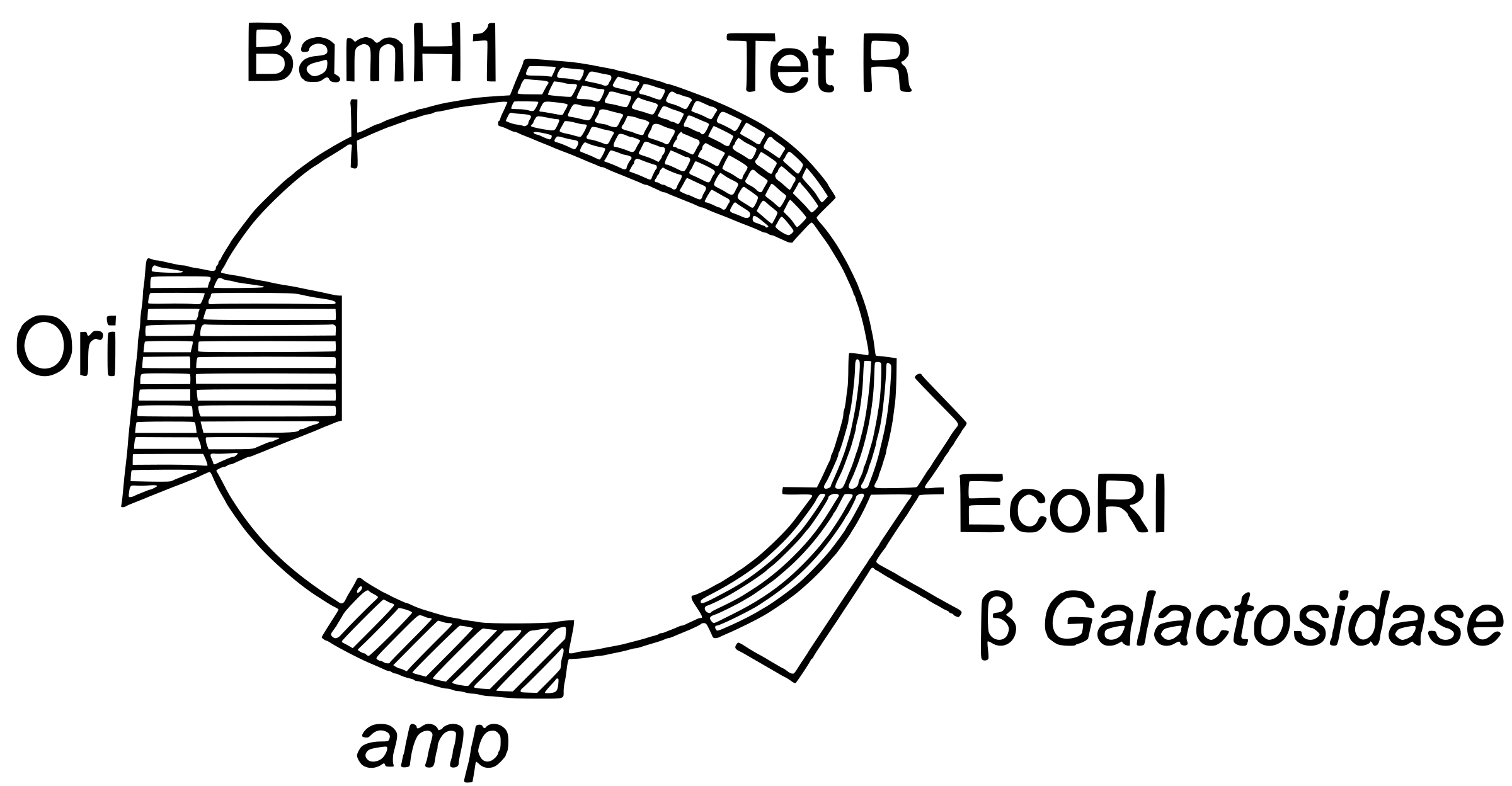
- Option A:
Using a medium plate containing ampicillin and tetracycline.
- Option B:
Blue color colonies will be selected
- Option C:
White color colonies will be selected.
- Option D:
Blue color colonies grown on ampicillin plates can be selected.
Answer: CStep-by-step solution → - Question 108Zoology· Biotechnology and its Applications
Which of the following genetically engineered organisms was used by Eli Lilly to prepare human insulin?
- Option A:
Bacterium
- Option B:
Yeast
- Option C:
Virus
- Option D:
Phage
Answer: AStep-by-step solution → - Question 109Zoology· Biomolecules
Name the class of enzyme that usually catalyze the following reaction : Where,
- Option A:
Hydrolase
- Option B:
Lyase
- Option C:
Transferase
- Option D:
Ligase
Answer: CStep-by-step solution → - Question 110Botany· Anatomy of Flowering Plants
Find the statement that is NOT correct with regard to the structure of monocot stem.
- Option A:
Hypodermis is parenchymatous
- Option B:
Vascular bundles are scattered.
- Option C:
Vascular bundles are conjoint and closed.
- Option D:
Phloem parenchyma is absent.
Answer: AStep-by-step solution → - Question 111Botany· Plant Kingdom
The correct sequence of events in the life cycle of bryophytes is
A. Fusion of antherozoid with egg.
B. Attachment of gametophyte to substratum.
C. Reduction division to produce haploid spores.
D. Formation of sporophyte.
E. Release of antherozoids into water.
Choose the correct answer from the options given below:
- Option A:
D, E, A, C, B
- Option B:
B, E, A, C, D
- Option C:
B, E, A, D, C
- Option D:
D, E, A, B, C
Answer: CStep-by-step solution → - Question 112Zoology· Human Health and Diseases
Which are correct: A. Computed tomography and magnetic resonance imaging detect cancers of internal organs. B. Chemotherapeutic drugs are used to kill non-cancerous cells. C. α-interferon activates the cancer patients' immune system and helps in destroying the tumour. D. Chemotherapeutic drugs are biological response modifiers. E. In the case of leukaemia blood cell counts are decreased. Choose the correct answer from the options given below:
- Option A:
B and D only
- Option B:
D and E only
- Option C:
C and D only
- Option D:
A and C only
Answer: DStep-by-step solution → - Question 113Botany· Cell: The Unit of Life
Match List - I with List - II.
List - I List - II A. Centromere I. Mitochondrion B. Cilium II. Cell division C. Cristae III. Cell movement D. Cell membrane IV. Phospholipid Bilayer Choose the correct answer from the options given below:
- Option A:
A-I, B-II, C-III, D-IV
- Option B:
A-II, B-I, C-IV, D-III
- Option C:
A-IV, B-II, C-III, D-I
- Option D:
A-II, B-III, C-I, D-IV
Answer: DStep-by-step solution → - Question 114Botany· Photosynthesis in Higher Plants
Match List I with List II.
List I List II A. Chlorophyll a I. Yellow-green B. Chlorophyll b II. Yellow C. Xanthophylls III. Blue-green D. Carotenoids IV. Yellow to Yellow-orange Choose the option with all correct matches.
- Option A:
A-III, B-IV, C-II, D-I
- Option B:
A-III, B-I, C-II, D-IV
- Option C:
A-I, B-II, C-IV, D-III
- Option D:
A-I, B-IV, C-III, D-II
Answer: BStep-by-step solution → - Question 115Zoology· Human Reproduction
Find the correct statements :
A. In human pregnancy, the major organ systems are formed at the end of 12 weeks.
B. In human pregnancy the major organ systems are formed at the end of 8 weeks.
C. In human pregnancy heart is formed after one month of gestation.
D. In human pregnancy, limbs and digits develop by the end of second month.
E. In human pregnancy the appearance of hair is usually observed in the fifth month.
Choose the correct answer from the options given below:
- Option A:
A and E Only
- Option B:
B and C Only
- Option C:
B, C, D and E Only
- Option D:
A, C, D and E Only
Answer: DStep-by-step solution → - Question 116Botany· Morphology of Flowering Plants
In the seeds of cereals, the outer covering of endosperm separates the embryo by a protein-rich layer called :
- Option A:
Coleoptile
- Option B:
Coleorhiza
- Option C:
Integument
- Option D:
Aleurone Layer
Answer: DStep-by-step solution → - Question 117Zoology· Biotechnology: Principles and Processes
Identify the part of a bioreactor which is used as a foam breaker from the given figure.
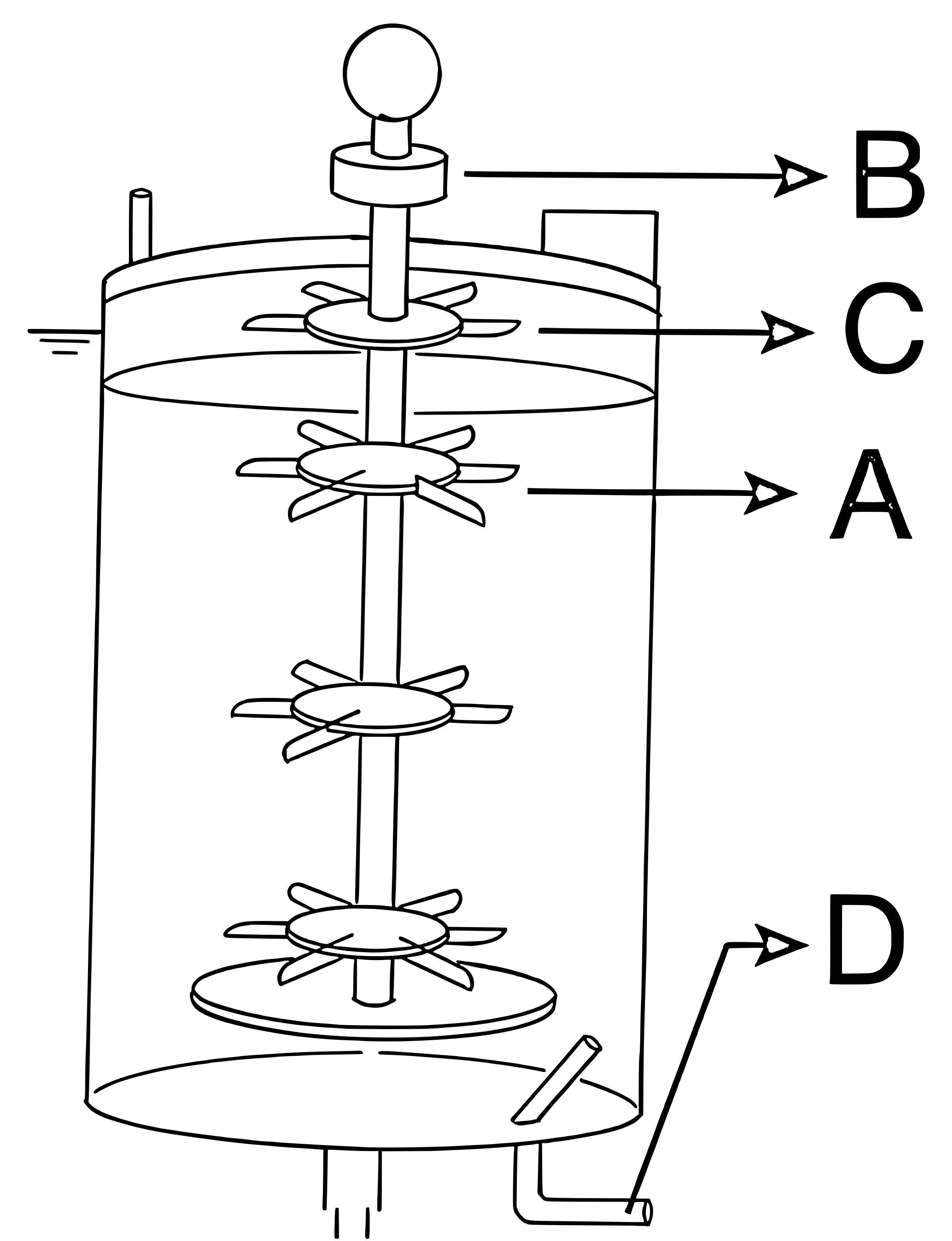
- Option A:
A
- Option B:
B
- Option C:
C
- Option D:
D
Answer: AStep-by-step solution → - Question 118Botany· Sexual Reproduction in Flowering Plants
Given below are two statements: One is labelled as Assertion (A) and the other is labelled as Reason (R)
Assertion (A): A typical unfertilised, angiosperm embryo sac at maturity is 8 nucleate and 7-celled.
Reason (R): The egg apparatus has 2 polar nuclei.
In light of the above statements, choose the most appropriate answer from the options given below.
- Option A:
Both A and R are true and R is the correct explanation of A.
- Option B:
Both A and R are true but R is NOT the correct explanation of A.
- Option C:
A is true but R is false.
- Option D:
A is false but R is true
Answer: CStep-by-step solution → - Question 119Botany· Biological Classification
A specialised membranous structure in a prokaryotic cell which helps in cell wall formation, DNA replication and respiration is :
- Option A:
Mesosome
- Option B:
Chromatophores
- Option C:
Cristae
- Option D:
Endoplasmic Reticulum
Answer: AStep-by-step solution → - Question 120Botany· Molecular basis of Inheritance
Which of the following are the post-transcriptional events in an eukaryotic cell?
A. Transport of pre-mRNA to cytoplasm prior to splicing.
B. Removal of introns and joining of exons.
C. Addition of methyl group 5' end of hnRNA.
D. Addition of adenine residues at 3 ' end of hnRNA.
E. Base pairing of two complementary RNAs.
Choose the correct answer from the options given below:
- Option A:
A, B, C only
- Option B:
B, C, D only
- Option C:
B, C, E only
- Option D:
C, D, E only
Answer: BStep-by-step solution → - Question 121Botany· Principles of Inheritance and Variation
What is the pattern of inheritance for polygenic trait?
- Option A:
Mendelian inheritance pattern
- Option B:
Non-mendelian inheritance pattern
- Option C:
Autosomal dominant pattern
- Option D:
X-linked recessive inheritance pattern
Answer: BStep-by-step solution → - Question 122Zoology· Biomolecules
Which one of the following enzymes contains 'Haem' as the prosthetic group?
- Option A:
RuBisCo
- Option B:
Carbonic anhydrase
- Option C:
Succinate dehydrogenase
- Option D:
Catalase
Answer: DStep-by-step solution → - Question 123Botany· Biological Classification
Each of the following characteristics represent a Kingdom proposed by Whittaker. Arrange the following in increasing order of complexity of body organization.
A. Multicellular heterotrophs with cell wall made of chitin.
B. Heterotrophs with tissue/organ/organ system level of body organization.
C. Prokaryotes with cell wall made of polysaccharides and amino acids.
D. Eukaryotic autotrophs with tissue/organ level of body organization.
E. Eukaryotes with cellular body organization.
Choose the correct answer from the options given below:
- Option A:
A, C, E, B, D
- Option B:
C, E, A, D, B
- Option C:
A, C, E, D, B
- Option D:
C, E, A, B, D
Answer: BStep-by-step solution → - Question 124Botany· Biodiversity and Conservation
Who is known as the father of Ecology in India?
- Option A:
S.R. Kashyap
- Option B:
Ramdeo Misra
- Option C:
Ram Udar
- Option D:
Birbal Sahni
Answer: BStep-by-step solution → - Question 125Botany· Molecular basis of Inheritance
Match List-I with List-II.
List-I List-II A. Alfred Hershey and Martha Chase I. Streptococcus pneumoniae B. Euchromatin II. Densely packed and dark-stained C. Frederick Griffith III. Loosely packed and light-stained D. Heterochromatin IV. DNA as genetic material confirmation Choose the correct answer from the options given below:
- Option A:
A-II, B-IV, C-I, D-III
- Option B:
A-IV, B-II, C-I, D-III
- Option C:
A-IV, B-III, C-I, D-II
- Option D:
A-III, B-II, C-IV, D-I
Answer: CStep-by-step solution → - Question 126Zoology· Human Health and Diseases
Neoplastic characteristics of cells refer to: A. A mass of proliferating cells B. Rapid growth of cells C. Invasion and damage to the surrounding tissue D. Those confined to the original location
Choose the correct answer from the options given below:
- Option A:
A, B only
- Option B:
A, B, C only
- Option C:
A, B, D only
- Option D:
B, C, D only
Answer: BStep-by-step solution → - Question 127Zoology· Biotechnology: Principles and Processes
Given below are two statements : one is labelled as Statement I and the other is labelled as Statement II:
Statement I: The DNA fragments extracted from gel electrophoresis can be used in construction of recombinant DNA.
Statement II: Smaller size DNA fragments are observed near anode while larger fragments are found near the wells in an agarose gel.
In the light of the above statements, choose the correct answer from the options given below :
- Option A:
Both statement I and statement II are correct
- Option B:
Both statement I and statement II are incorrect
- Option C:
Statement I is correct but statement II is incorrect
- Option D:
Statement I is incorrect but statement II is correct
Answer: AStep-by-step solution → - Question 128Zoology· Biomolecules
Match List-I with List-II.
List-I List-II A. Adenosine I. Nitrogen base B. Adenylic acid II. Nucleotide C. Adenine III. Nucleoside D. Alanine IV. Amino acid Choose the option with all correct matches:
- Option A:
A-III, B-IV, C-II, D-I
- Option B:
A-III, B-II, C-IV, D-I
- Option C:
A-III, B-II, C-I, D-IV
- Option D:
A-II, B-III, C-I, D-IV
Answer: CStep-by-step solution → - Question 129Zoology· Human Reproduction
Consider the following:
A. The reductive division for the human female gametogenesis starts earlier than that of the male gametogenesis.
B. The gap between the first meiotic division and the second meiotic division is much shorter for males compared to females.
C. The first polar body is associated with the formation of the primary oocyte.
D. Luteinizing Hormone (LH) surge leads to disintegration of the endometrium and onset of menstrual bleeding.
Choose the correct answer from the options given below:
- Option A:
A and B are true
- Option B:
A and C are true
- Option C:
B and D are true
- Option D:
B and C are true
Answer: DStep-by-step solution → - Question 130Zoology· Animal Kingdom
All living members of the class Cyclostomata are:
- Option A:
Free living
- Option B:
Endoparasite
- Option C:
Symbiotic
- Option D:
Ectoparasite
Answer: DStep-by-step solution → - Question 131Botany· Cell: The Unit of Life
Given below are two statements: one is labelled as Assertion (A) and the other is labelled as Reason (R).
Assertion (A): The primary function of the Golgi apparatus is to package the materials made by the endoplasmic reticulum and deliver it to intracellular targets and outside the cell.
Reason (R): Vesicles containing materials made by the endoplasmic reticulum fuse with the cis face of the Golgi apparatus, and they are modified and released from the trans face of the Golgi apparatus.
In the light of the above statements, choose the correct answer from the options given below:
- Option A:
Both A and R are true and R is the correct explanation of A
- Option B:
Both A and R are true but R is not the correct explanation of A
- Option C:
A is true but R is false
- Option D:
A is false but R is true
Answer: AStep-by-step solution → - Question 132Botany· Morphology of Flowering Plants
Match List-I with List-II.
List-I List-II A. Scutellum I. Persistent nucellus B. Non-albuminous seed II. Cotyledon of Monocot seed C. Epiblast III. Groundnut D. Perisperm IV. Rudimentary cotyledon Choose the option with all correct matches.
- Option A:
A-II, B-III, C-IV, D-I
- Option B:
A-IV, B-III, C-II, D-I
- Option C:
A-IV, B-III, C-I, D-II
- Option D:
A-II, B-IV, C-III, D-I
Answer: AStep-by-step solution → - Question 133Zoology· Animal Kingdom
Given below are two statements: One is labelled as Assertion (A) and the other is labelled as Reason (R)
Assertion (A): All vertebrates are chordates but all chordates are not vertebrate.
Reason (R): The members of subphylum vertebrata possess notochord during the embryonic period, the notochord is replaced by a cartilaginous or bony vertebral column in adults.
In the light of the above statements, choose the correct answer from the options given below:
- Option A:
Both A and R are true and R is the correct explanation of A
- Option B:
Both A and R are true but R is not the correct explanation of A
- Option C:
A is true but R is false
- Option D:
A is false but R is true
Answer: AStep-by-step solution → - Question 134Zoology· Human Health and Diseases
Identify the statement that is NOT correct.
- Option A:
Each antibody has two light and two heavy chains.
- Option B:
The heavy and light chains are held together by disulfide bonds
- Option C:
Antigen binding site is located at C-terminal region of antibody molecules.
- Option D:
Constant region of heavy and light chains are located at C-terminus of antibody molecules.
Answer: CStep-by-step solution → - Question 135Botany· Molecular basis of Inheritance
Silencing of specific mRNA is possible via RNAi because of -
- Option A:
Complementary dsRNA
- Option B:
Inhibitory ssRNA
- Option C:
Complementary tRNA
- Option D:
Non-complementary ssRNA
Answer: AStep-by-step solution → - Question 136Botany· Principles of Inheritance and Variation
Genes R and Y follow independent assortment. If RRYY produce round yellow seeds and rryy produce wrinkled green seeds, what will be the phenotypic ratio of the F2 generation?
- Option A:
Phenotypic ratio - 1:2:1
- Option B:
Phenotypic ratio - 3:1
- Option C:
Phenotypic ratio-9:3:3:1
- Option D:
Phenotypic ratio - 9:7
Answer: CStep-by-step solution → - Question 137Botany· Cell: The Unit of Life
Histones are enriched with -
- Option A:
Lysine & Arginine
- Option B:
Leucine & Lysine
- Option C:
Phenylalanine & Leucine
- Option D:
Phenylalanine & Arginine
Answer: AStep-by-step solution → - Question 138Zoology· Human Reproduction
The first menstruation is called:
- Option A:
Menopause
- Option B:
Menarche
- Option C:
Diapause
- Option D:
Ovulation
Answer: BStep-by-step solution → - Question 139Zoology· Chemical Control and Coordination
Match List - I with List - II.
List-I List-II A. Heart I. Erythropoietin B. Kidney II. Aldosterone C. Gastro-intestinal tract III. Atrial natriuretic factor D. Adrenal Cortex IV. Secretin Choose the correct answer from the options given below:
- Option A:
A-II, B-I, C-III, D-IV
- Option B:
A-IV, B-III, C-II, D-I
- Option C:
A-I, B-III, C-IV, D-II
- Option D:
A-III, B-I, C-IV, D-II
Answer: DStep-by-step solution → - Question 140Zoology· Biomolecules
The protein portion of an enzyme is called:
- Option A:
Cofactor
- Option B:
Coenzyme
- Option C:
Apoenzyme
- Option D:
Prosthetic group
Answer: CStep-by-step solution → - Question 141Botany· Ecosystem
Which of the following is the unit of productivity of an ecosystem?
- Option A:
gm
- Option B:
KCalm
- Option C:
KCalm
- Option D:
(KCalm
Answer: DStep-by-step solution → - Question 142Zoology· Evolution
Sweet potato and potato represent a certain type of evolution. Select the correct combination of terms to explain the evolution.
- Option A:
Analogy, convergent
- Option B:
Homology, divergent
- Option C:
Homology, convergent
- Option D:
Analogy, divergent
Answer: AStep-by-step solution → - Question 143Botany· Principles of Inheritance and Variation
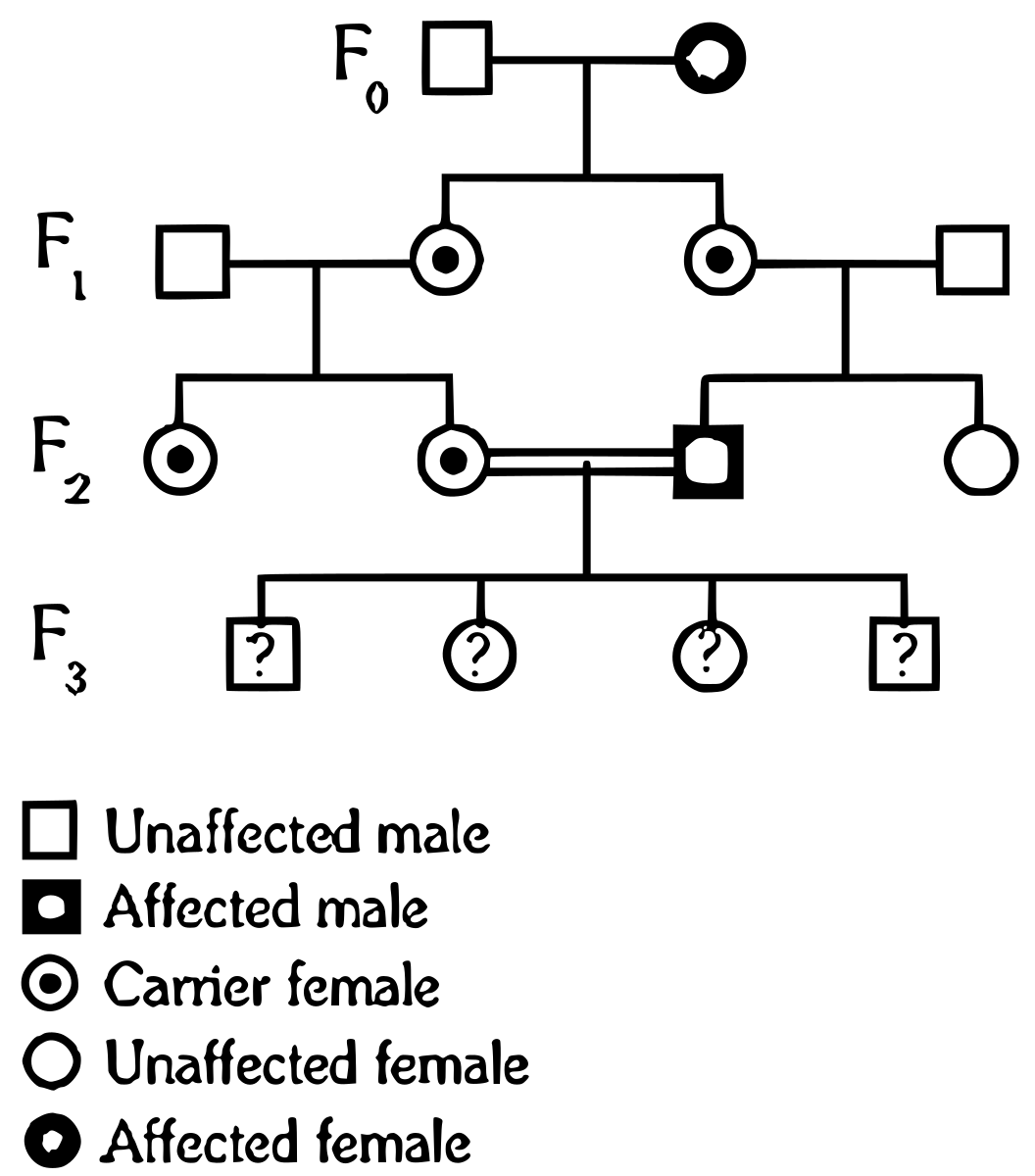
With the help of given pedigree, find out the probability for the birth of a child having no disease and being a carrier (has the disease mutation in one allele of the gene) in generation.
- Option A:
- Option B:
- Option C:
- Option D:
Zero
Answer: BStep-by-step solution → - Question 144Botany· Sexual Reproduction in Flowering Plants
Given below are two statements: One is labelled as Assertion (A) and the other is labelled as Reason (R)
Assertion (A): Cells of the tapetum possess dense cytoplasm and generally have more than one nucleus.
Reason (R): Presence of more than one nucleus in the tapetum increase the efficiency of nourishing the developing microspore mother cells
In light of the above statements, choose the most appropriate answer from the options given below:
- Option A:
Both A and R are true and R is the correct explanation of A.
- Option B:
Both A and R are true and R is NOT the correct explanation of A.
- Option C:
A is true but R is false.
- Option D:
A is false but R is true.
Answer: CStep-by-step solution → - Question 145Botany· Sexual Reproduction in Flowering Plants
How many meiotic and mitotic divisions need to occur for the development of a mature female gametophyte from the megaspore mother cell in an angiosperm plant?
- Option A:
2 Meiosis and 3 Mitosis
- Option B:
1 Meiosis and 2 Mitosis
- Option C:
1 Meiosis and 3 Mitosis
- Option D:
No Meiosis and 3 Mitosis
Answer: CStep-by-step solution → - Question 146Botany· Morphology of Flowering Plants
Which of the following is an example of a zygomorphic flower?
- Option A:
Petunia
- Option B:
Datura
- Option C:
Pea
- Option D:
Chilli
Answer: CStep-by-step solution → - Question 147Zoology· Human Health and Diseases
After maturation, in primary lymphoid organs, the lymphocytes migrate for interaction with antigens to secondary lymphoid organ(s) / tissue(s) like:
A. thymus
B. bone marrow
C. spleen
D. lymph nodes
E. Peyer's patches
Choose the correct answer from the options given below:
- Option A:
B, C, D only
- Option B:
A, B, C only
- Option C:
E, A, B only
- Option D:
C, D, E only
Answer: DStep-by-step solution → - Question 148Botany· Sexual Reproduction in Flowering Plants
Given below are two statements: one is labelled as Statement I and the other is labelled as Statement II.
Statement I: Fig fruit is a non-vegetarian fruit as it has enclosed fig wasps in it.
Statement II: Fig wasp and fig tree exhibit a mutualistic relationship as the fig wasp completes its life cycle in the fig fruit and the fig fruit gets pollinated by the fig wasp.
In the light of the above statements, choose the correct answer from the options given below:
- Option A:
Both Statement I and Statement II are correct
- Option B:
Both statement I and statement II are incorrect
- Option C:
Statement I is correct but Statement II is incorrect
- Option D:
Statement I is incorrect but Statement II is correct
Answer: DStep-by-step solution → - Question 149Botany· Cell Cycle and Cell Division
What is the main function of the spindle fibers during mitosis?
- Option A:
To separate the chromosomes
- Option B:
To synthesize new DNA
- Option C:
To repair damaged DNA
- Option D:
To regulate cell growth
Answer: AStep-by-step solution → - Question 150Botany· Plant Kingdom
Which one of the following is the characteristic feature of gymnosperms?
- Option A:
Seeds are enclosed in fruits.
- Option B:
Seeds are naked.
- Option C:
Seeds are absent.
- Option D:
Gymnosperms have flowers for reproduction.
Answer: BStep-by-step solution → - Question 151Zoology· Chemical Control and Coordination
Consider the following statements regarding function of adrenal medullary hormones :
A. It causes pupilary constriction
B. It is a hyperglycemic hormone
C. It causes piloerection
D. It increases strength of heart contraction
Choose the correct answer from the options/ given below:
- Option A:
C and D Only
- Option B:
B, C and D Only
- Option C:
A, C and D Only
- Option D:
D Only
Answer: BStep-by-step solution → - Question 152Zoology· Human Health and Diseases
Why can't insulin be given orally to diabetic patients?
- Option A:
Human body will elicit strong immune response
- Option B:
It will be digested in Gastro-Intestinal (GI) tract
- Option C:
Because of structural variation
- Option D:
Its bioavailability will be increased
Answer: BStep-by-step solution → - Question 153Botany· Plant Kingdom
Match List-I with List-II
List-I List-II A. Pteridophyte I. Salvia B. Bryophyte II. Ginkgo C. Angiosperm III. Polytrichum D. Gymnosperm IV. Salvinia Choose the option with all correct matches:
- Option A:
A-III, B-IV, C-II, D-I
- Option B:
A-IV, B-III, C-I, D-II
- Option C:
A-III, B-IV, C-I, D-II
- Option D:
A-IV, B-III, C-II, D-I
Answer: BStep-by-step solution → - Question 154Botany· Molecular basis of Inheritance
Who proposed that the genetic code for amino acids should be made up of three nucleotides ?
- Option A:
George Gamow
- Option B:
Francis Crick
- Option C:
Jacque Monod
- Option D:
Franklin Stahl
Answer: AStep-by-step solution → - Question 155Botany· Biodiversity and Conservation
Match List-I with List-II :
List-I List-II A. The Evil Quartet I. Cryopreservation B. Ex situ conservation II. Alien species invasion C. Lantana camara III. Causes of biodiversity losses D. Dodo IV. Extinction Choose the option with all correct matches:
- Option A:
A-III, B-II, C-I, D-IV
- Option B:
A-III, B-I, C-II, D-IV
- Option C:
A-III, B-IV, C-II, D-I
- Option D:
A-III, B-II, C-IV, D-I
Answer: BStep-by-step solution → - Question 156Zoology· Chemical Control and Coordination
Which of the following hormones released from the pituitary is actually synthesized in the hypothalamus?
- Option A:
Luteinizing hormone (LH)
- Option B:
Anti-diuretic hormone (ADH)
- Option C:
Follicle-stimulating hormone (FSH)
- Option D:
Adenocorticotrophic hormone (ACTH)
Answer: BStep-by-step solution → - Question 157Zoology· Animal Kingdom
Role of the water vascular system in Echinoderms is:
A. Respiration and Locomotion
B. Excretion and Locomotion
C. Capture and transport of food
D. Digestion and Respiration
E. Digestion and Excretion
Choose the correct answer from the options given below:
- Option A:
A and B only
- Option B:
A and C only
- Option C:
B and C only
- Option D:
B, D and E only
Answer: BStep-by-step solution → - Question 158Zoology· Human Health and Diseases
Which of the following type of immunity is present at the time of birth and is a non-specific type of defence in the human body ?
- Option A:
Acquired Immunity
- Option B:
Innate Immunity
- Option C:
Cell-mediated Immunity
- Option D:
Humoral Immunity
Answer: BStep-by-step solution → - Question 159Botany· Plant Kingdom
In bryophytes, the gemmae help in which one of the following ?
- Option A:
Sexual reproduction
- Option B:
Asexual reproduction
- Option C:
Nutrient absorption
- Option D:
Gaseous exchange
Answer: BStep-by-step solution → - Question 160Zoology· Structural Organisation in Animals
In frog, the Renal portal system is a special venous connection that acts to link :
- Option A:
Liver and intestine
- Option B:
Liver and kidney
- Option C:
Kidney and intestine
- Option D:
Kidney and lower part of body
Answer: DStep-by-step solution → - Question 161Botany· Ecosystem
Given below are two statements : one is labelled as Statement I and the other is labelled as Statement II:
Statement I: In ecosystem, there is unidirectional flow of energy of sun from producers of consumers.
Statement II: Ecosystems are exempted from law of thermodynamics.
In the light of the above statements, choose the correct answer from the options given below :
- Option A:
Both statement-I and statement II are correct
- Option B:
Both statement-I and statement II are incorrect
- Option C:
Statement-I is correct but statement II is incorrect
- Option D:
Statement-I is incorrect but statement II is correct
Answer: CStep-by-step solution → - Question 162Botany· Photosynthesis in Higher Plants
Which of the following statements about RuBisCO is true?
- Option A:
It is active only in the dark.
- Option B:
It has higher affinity of oxygen than carbon dioxide.
- Option C:
It is an enzyme involved in the photolysis of water.
- Option D:
It catalyzes the carboxylation of RuBP
Answer: DStep-by-step solution → - Question 163Zoology· Biotechnology: Principles and Processes
Which of the following enzyme(s) are NOT essential for gene cloning?
A. Restriction enzymes
B. DNA ligase
C. DNA mutase
D. DNA recombinase
E. DNA polymerase
Choose the correct answer from the options given below:
- Option A:
C and D only
- Option B:
A and B only
- Option C:
D and E only
- Option D:
B and C only
Answer: AStep-by-step solution → - Question 164Botany· Plant Growth and Development
Read the following statements on plant growth and development.
A. Parthenocarpy can be induced by auxins.
B. Plant growth regulators can be involved in promotion as well as inhibition of growth.
C. Dedifferentiation is a pre-requisite for differentiation.
D. Abscisic acid is a plant growth promoter.
E. Apical dominance promotes the growth of lateral buds.
Choose the option with all correct statements.
- Option A:
A, B, C only
- Option B:
A, C, E only
- Option C:
A, D, E only
- Option D:
B, D, E only
Answer: AStep-by-step solution → - Question 165Botany· Molecular basis of Inheritance
Which factor is important for termination of transcription?
- Option A:
α (alpha)
- Option B:
σ (sigma)
- Option C:
ρ (rho)
- Option D:
γ (gamma)
Answer: CStep-by-step solution → - Question 166Zoology· Human Reproduction
Twins are born to a family that lives next door to you. The twins are a boy and a girl. Which of the following must be true?
- Option A:
They are monozygotic twins.
- Option B:
They are fraternal twins.
- Option C:
They were conceived through in vitro fertilisation.
- Option D:
They have 75% identical genetic content.
Answer: BStep-by-step solution → - Question 167Botany· Microbes in Human Welfare
Which of the following microbes is NOT involved in the preparation of household products?
A. Aspergillus niger
B. Lactobacillus
C. Trichoderma pulysporum
D. Saccharomyces cerevisiae
E. Propionibacterium sharmanii
Choose the correct answer from the options given below:
- Option A:
A and B only
- Option B:
A and C only
- Option C:
C and D only
- Option D:
C and E only
Answer: DStep-by-step solution → - Question 168Zoology· Chemical Control and Coordination
Match List-I with List-II List-I
List-I List-II A. Progesterone I. Pars intermedia B. Relaxin II. Ovary C. Melanocyte stimulating hormone III Adrenal Medulla D Catecholamines IV. Corpus luteum Choose the correct answer from the options given below:
- Option A:
A-IV, B-II, C-I, D-III
- Option B:
A-IV, B-II, C-III, D-I
- Option C:
A-II, B-IV, C-I, D-III
- Option D:
A-III, B-II, C-IV, D-I
Answer: AStep-by-step solution → - Question 169Zoology· Biotechnology: Principles and Processes
Given below are two statements : one is labelled as Statement I and the other is labelled as Statement II:
The blue and white selectable markers have been developed which differentiate recombinant colonies from non-recombinant colonies on the basis of their ability to produce colour in the presence of a chromogenic substrate. Given below are two statements about this method:
Statement I: The blue coloured colonies have DNA insert in the plasmid and they are identified as recombinant colonies.
Statement II: The colonies without blue colour have DNA insert in the plasmid and are identified as recombinant colonies.
In the light of the above statements, choose the correct answer from the options given below :
- Option A:
Both Statement I and Statement II are correct
- Option B:
Both Statement I and Statement II is incorrect
- Option C:
Statement I is correct but Statement II is incorrect
- Option D:
Statement I is incorrect but Statement II is correct
Answer: DStep-by-step solution → - Question 170Botany· Organisms and Populations
Which one of the following equations represents the Verhulst-Pearl Logistic Growth of population?
- Option A:
- Option B:
- Option C:
- Option D:
Answer: BStep-by-step solution →
Stuck on one of these?
Practise questions like them — free, with a tutor that explains every step.