Physics · Mechanical Properties of Matter

NEET (UG) 2025 — Question 1

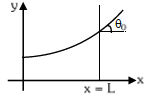
Consider a water tank shown in the figure. It has one wall at x=Lx=L and can be taken to be very wide in the zz direction. When filled with a liquid of surface tension S and density ρ\rho, the liquid surface makes angle θ0(θ0≪1)\theta_{0}\left(\theta_{0} \ll 1\right) with the xx-axis at x=Lx=L. If y(x)y(x) is the height of the surface then the equation for y(x)\mathrm{y}(\mathrm{x}) is: (take θ(x)=sin⁡θ(x)=tan⁡θ(x)=dydx,g\theta(x)=\sin \theta(x)=\tan \theta(x)=\frac{d y}{d x}, g is the acceleration due to gravity)

Question figure
  1. Option A:

    d2ydx2=ρgSx\frac{\mathrm{d}^{2} \mathrm{y}}{\mathrm{dx}^{2}}=\frac{\rho \mathrm{g}}{\mathrm{S}} \mathrm{x}

  2. Option B:

    d2ydx2=ρgSy\frac{d^{2} y}{d x^{2}}=\frac{\rho g}{S} y

    Correct
  3. Option C:

    d2ydx2=ρgS\frac{d^{2} y}{d x^{2}}=\sqrt{\frac{\rho g}{S}}

  4. Option D:

    dydx=ρgSx\frac{d y}{d x}=\sqrt{\frac{\rho g}{S}} x

Answer: B

Step-by-step solution

figure

For the given element, (consider length dd in ZZ direction) Net force in upward direction == Weight

(Ssin⁡(θ+dθ)−Ssin⁡θ)d=mg(\mathrm{S} \sin (\theta+\mathrm{d} \theta)-\mathrm{S} \sin \theta) \mathrm{d}=\mathrm{mg}

Angle is small ∴sin⁡θ≈θ\therefore \sin \theta \approx \theta

⇒dθydx=ρgS…(1)\Rightarrow \frac{\mathrm{d} \theta}{\mathrm{ydx}}=\frac{\rho \mathrm{g}}{\mathrm{S}} …(1)

tan⁡θ=dydx⇒\tan \theta=\frac{\mathrm{dy}}{\mathrm{dx}} \Rightarrow Differentiating wrt x sec⁡2θdθdx=d2ydx2…(2)\sec ^{2} \theta \frac{d \theta}{d x}=\frac{d^{2} y}{d x^{2}} …(2)

Put dθd \theta from (2) in (1) dd take cos⁡θ≈1\cos \theta \approx 1, we get d2ydx2=ρgyS\frac{d^{2} y}{d x^{2}}=\frac{\rho g y}{S}

Alternative Solution

figure

PA=PB=P0\mathrm{P}_{\mathrm{A}}=\mathrm{P}_{\mathrm{B}}=\mathrm{P}_{0}

PC=P0−ρgyP_{C}=P_{0}-\rho g y

PC=P0−SRP_{C}=P_{0}-\frac{S}{R}

R={1+(dydx)2}3/2d2ydx2R=\frac{\left\{1+\left(\frac{d y}{d x}\right)^{2}\right\}^{3 / 2}}{\frac{d^{2} y}{d x^{2}}}

ρgy=SR\rho g y=\frac{S}{R}

ρgy=Sd2ydx2\rho g y=S \frac{d^{2} y}{d x^{2}} dy/dx is very small d2ydx2=ρgyS\frac{d^{2} y}{d x^{2}}=\frac{\rho g y}{S}

R=1 d2y/dx2 d2ydx2=1R\begin{aligned} & \mathrm{R}=\frac{1}{\mathrm{~d}^{2} \mathrm{y} / \mathrm{dx}^{2}} \\& \frac{\mathrm{~d}^{2} \mathrm{y}}{\mathrm{dx}^{2}}=\frac{1}{\mathrm{R}} \end{aligned}

Answer key and solution verified before publishing.

Practise Mechanical Properties of Matter

Start with this question, then two more from the same chapter — with a tutor that explains every step. Free.

Exam
NEET (UG) 2025
Subject
Physics
Chapter
Mechanical Properties of Matter
Topic
Surface Tension and Surface Energy