JEE Advanced 2019 · previous year paper
JEE Advanced 2019 — Paper 1
46 questions with the verified answer key. Open any question for its step-by-step solution.
- Question 1Physics· Gravitation
Consider a spherical gaseous cloud of mass density in free space where is the radial distance from its center. The gaseous cloud is made of particles of equal mass moving in circular orbits about the common center with the same kinetic energy K. The force acting on the particles is their mutual gravitational force. If is constant in time, the particle number density is[0pt] [ is universal gravitational constant]
- Option A:
- Option B:
- Option C:
- Option D:
Answer: BStep-by-step solution → - Question 2Physics· Electrostatics
A thin spherical insulating shell of radius R carries a uniformly distributed charge such that the potential at its surface is . A hole with a small area is made on the shell without affecting the rest of the shell. Which one of the following statements is correct?
- Option A:
The magnitude of electric field at a point, located on a line passing through the hole and shell's center, on a distance from the center of the spherical shell will be reduced by
- Option B:
The magnitude of electric field at the center of the shell is reduced by
- Option C:
The ratio of the potential at the center of the shell to that of the point at from center towards the hole will be
- Option D:
The potential at the center of the shell is reduced by
Answer: CStep-by-step solution → - Question 3Physics· Thermodynamics
A current carrying wire heats a metal rod. The wire provides a constant power ( P ) to the rod. The metal rod is enclosed in an insulated container. It is observed that the temperature in the metal rod changes with time ( t ) as where is a constant with appropriate dimension while is a constant with dimension of temperature. The heat capacity of the metal is
- Option A:
- Option B:
- Option C:
- Option D:
Answer: DStep-by-step solution → - Question 4Physics· Nuclear Physics
In a radioactive sample nuclei either decay into stable nuclei with decay constant per year or into stable nuclei with decay constant per year. Given that in this sample all the stable and nuclei are produced by the nuclei only. In time years, if the ratio of the sum of stable and nuclei to the radioactive nuclei is 99 , the value of t will be [Given ]
- Option A:
1.15
- Option B:
4.6
- Option C:
9.2
- Option D:
2.3
Answer: CStep-by-step solution → - Question 5Physics· Electromagnetic Induction
A conducting wire of parabolic shape, initially , is moving with velocity in a non uniform magnetic field , as shown in figure. If , and are positive constants and is the potential difference developed between the ends of the wire, then the correct statement(s) is/are:
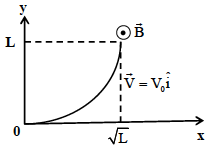
- Option A:
is proportional to the length of the wire projected on the -axis.
- Option B:
remains the same if the parabolic wire is replaced by a straight wire, initially, of length
- Option C:
for
- Option D:
for
Answer: A, B, DStep-by-step solution → - Question 6Physics· Geometrical Optics
A thin convex lens is made of two materials with refractive indices and , as shown in figure. The radius of curvature of the left and right spherical surfaces are equal. is the focal length of the lens when . The focal length is when and . Assuming and . The correct statement(s) is/are.
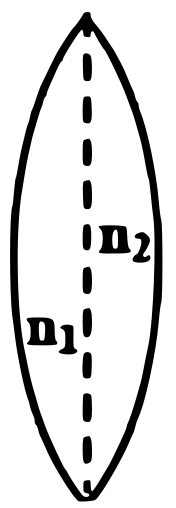
- Option A:
- Option B:
If then
- Option C:
For and , the value of will be 0.02 cm (round off to decimal place).
- Option D:
The relation between and remains unchanged if both the convex surfaces are replaced by concave surfaces of the same radius of curvature.
Answer: B, CStep-by-step solution → - Question 7Physics· Mechanical Properties of Matter
A cylindrical capillary tube of 0.2 mm radius is made by joining two capillaries and of different materials having water contact angles of and , respectively. The capillary tube is dipped vertically in water in two different configurations, case I and II as shown in figure. Which of the following option(s) is (are) correct?[0pt] [Surface tension of a water , density of water , take ]
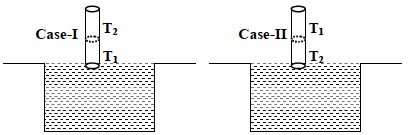
- Option A:
For case , if the joint is kept at 8 cm above the water surface, the height of water column in the tube will be 7.5 cm . (Neglect the weight of the water in the meniscus)
- Option B:
For case I, if the capillary joint is 5 cm above the water surface, the height of water column raised in the tube will be more than 8.75 cm . (Neglect the weight of the water in the meniscus)
- Option C:
For case II, if the capillary joint is 5 cm above the water surface, the height of water column raised in the tube will be 3.75 cm . (Neglect the weight of the water in the meniscus)
- Option D:
The correction in the height of water column raised in the tube, due to weight of water contained in the meniscus, will be different for both cases.
Answer: A, C, DStep-by-step solution → - Question 8Physics· Units, Dimensions & Error Analysis
Let us consider a system of units in which mass and angular momentum are dimensionless. If length has dimension of L , which of the following statement(s) is/are correct?
- Option A:
The dimension of energy is
- Option B:
The dimension of force is
- Option C:
The dimension of power is
- Option D:
The dimension of linear momentum is
Answer: A, B, DStep-by-step solution → - Question 9Physics· Capacitors and R-C Circuits
In the circuit shown, initially there is no charge on capacitors and keys and are open. The values of the
capacitors are and . Which of the statement(s) is/are
correct?
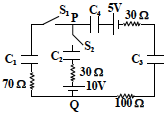
- Option A:
The key is kept closed for long time such that capacitors are fully charged. Now key is closed, at this time, the instantaneous current across resistor (between points P and Q ) will be 0.2 A (round off to decimal place).
- Option B:
If key is kept closed for long time such that capacitors are fully charged, the voltage across the capacitor will be 4 V .
- Option C:
At time , the key is closed, the instantaneous current in the closed circuit will be 25 mA
- Option D:
If key is kept closed for long time such that capacitors are fully charged, the voltage difference between points P and Q will be 10 V .
Answer: B, CStep-by-step solution → - Question 10Physics· Thermodynamics
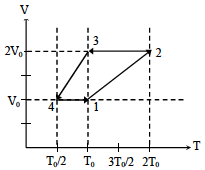
One mole of a monatomic ideal gas goes through a thermodynamic cycle, as shown in the volume versus temperature diagram. The correct statement(s) is/are:
[ R is the gas constant]
- Option A:
Work done in this thermodynamic cycle is
- Option B:
The ratio of heat transfer during processes and is
- Option C:
The above thermodynamic cycle exhibits only isochoric and adiabatic processes.
- Option D:
The ratio of heat transfer during processes and is
Answer: A, BStep-by-step solution → - Question 11Physics· Current Electricity
Two identical moving coil galvanometers have resistance and full scale deflection at current. One of them is converted into a voltmeter of 100 mV full scale reading and the other into an Ammeter of 1 mA full scale current using appropriate resistors. These are then used to measure the voltage and current in the Ohm's law experiment with resistor by using an ideal cell. Which of the following statement(s) is/are correct?
- Option A:
The measured value of R will be
- Option B:
The resistance of the Voltmeter will be
- Option C:
If the ideal cell is replaced by a cell having internal resistance of then the measured value of R will be more than
- Option D:
The resistance of the Ammeter will be (round off to decimal place)
Answer: A, DStep-by-step solution → - Question 12Physics· Mechanical Properties of Matter
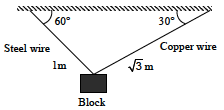
A block of weight 100 N is suspended by copper and steel wires of same cross sectional area and, length and 1 m , respectively. Their other ends are fixed on a ceiling as shown in figure. The angles subtended by copper and steel wires with ceiling are and , respectively. If elongation in copper wire is and elongation in steel wire is , then the ratio is
[Young's modulus for copper and steel are and , respectively.]
 Answer: 2Step-by-step solution →
 - Question 13Physics· Work, Power & Energy
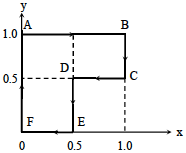
A particle is moved along a path AB-BC-CD-DE-EF-FA, as shown in figure, in presence of a force , where x and y are in meter and . The work done on the particle by this force will be Joule.
 Answer: 0.75Step-by-step solution →
 - Question 14Physics· Sound Waves
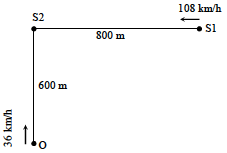
A train S1, moving with a uniform velocity of 108 , approaches another train S2 standing on a platform. An observer O moves with a uniform velocity of towards S 2 , as shown in figure. Both the trains are blowing whistles of same frequency 120 Hz . When O is 600 m away from S2 and distance between S 1 and S 2 is 800 m , the number of beats heard by O is . [Speed of the sound ]
 Answer: 8.13Step-by-step solution →
 - Question 15Physics· Thermal Properties of Matter
A liquid at is poured very slowly into a Calorimeter that is at temperature of . The boiling temperature of the liquid is . It is found that the first 5 gm of the liquid completely evaporates. After pouring another 80 gm of the liquid the equilibrium temperature is found to be . The ratio of the Latent heat of the liquid to its specific heat will be . [Neglect the heat exchange with surrounding]
Answer: 270Step-by-step solution → - Question 16Physics· Geometrical Optics
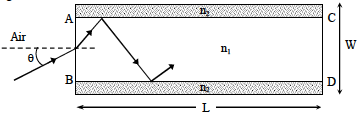
A planar structure of length L and width W is made of two different optical media of refractive indices and as shown in figure. If , a ray entering from end AB will emerge from end CD only if the total internal reflection condition is met inside the structure. For , if the incident angle is varied, the maximum time taken by a ray to exit the plane CD is , where t is . [Speed of light ]
 Answer: 50Step-by-step solution →
 - Question 17Physics· Capacitors and R-C Circuits
A parallel plate capacitor of capacitance has spacing between two plates having area A. The region between the plates is filled with N dielectric layers, parallel to its plates, each with thickness . The dielectric constant of the layer is . For a very large , the capacitance is . The value of will be . [ is the permittivity of free space]
Answer: 1Step-by-step solution → - Question 18Chemistry· Practical Inorganic chemistry (Qualitative Analysis)
The green colour produced in the borax bead test of a chromium(III) salt is due to
- Option A:
CrB
- Option B:
- Option C:
- Option D:
Answer: DStep-by-step solution → - Question 19Chemistry· Metallurgy
Calamine, malachite, magnetite and cryolite, respectively, are
- Option A:
- Option B:
- Option C:
- Option D:
Answer: BStep-by-step solution → - Question 20Chemistry· Biomolecules
Which of the following statements(s) is (are) true ?
- Option A:
Oxidation of glucose with bromine water gives glutamic acid
- Option B:
The two six-membered cyclic hemiacetal forms of D-(+)-glucose are called anomers
- Option C:
Monosaccharides cannot be hydrolysed to give polyhydroxy aldehydes and ketones
- Option D:
Hydrolysis of sucrose gives dextrorotatory glucose and laevorotatory fructose
Answer: B, C, DStep-by-step solution → - Question 21Chemistry· Thermodynamics & Thermochemistry
Choose the reaction(s) from the following options, for which the standard enthalpy of reaction is equal to the standard enthalpy of formation.
- Option A:
- Option B:
- Option C:
- Option D:
Answer: B, DStep-by-step solution → - Question 22Chemistry· Chemical Bonding
Fusion of with KOH in presence of produces a salt W . Alkaline solution of W upon electrolytic oxidation yields another salt X . The manganese containing ions present in W and X , respectively, are Y and Z. Correct statement(s) is(are)
- Option A:
In aqueous acidic solution, Y undergoes disproportionation reaction to give Z and
- Option B:
In both Y and -bonding occurs between p-orbitals of oxygen and d-orbitals of manganese
- Option C:
Y is diamagnetic in nature while Z is paramagnetic
- Option D:
Both Y and Z are coloured and have tetrahedral shape
Answer: A, B, DStep-by-step solution → - Question 23Chemistry· States of Matter - Gaseous State
Which of the following statement(s) is(are) correct regarding the root mean square speed ( ) and average translational kinetic energy ( ) of a molecule in a gas at equilibrium?
- Option A:
at a given temperature does not depend on its molecular mass
- Option B:
is doubled when its temperature is increased four times
- Option C:
is doubled when its temperature is increased four times
- Option D:
is inversely proportional to the square root of its molecular mass
Answer: A, B, DStep-by-step solution → - Question 24Chemistry· Structure of Atom
In the decay sequence,
and are particles /radiation emitted by the respective isotopes. The correct option(s) is(are)
- Option A:
is -ray
- Option B:
Z is an isotope of uranium
- Option C:
is
- Option D:
will deflect towards negatively charged plate
Answer: B, C, DStep-by-step solution → - Question 25Chemistry· Solutions and Colligative Properties
On dissolving 0.5 g of a non-volatile non-ionic solute to 39 g of benzene, its vapour pressure decreases from 650 mm Hg to 640 mm Hg . The depression of freezing point of benzene (in K ) upon addition of the solute is (Given data: Molar mass and the molal freezing point depression constant of benzene are and , respectively)
Answer: 1.02Step-by-step solution → - Question 26Chemistry· Chemical EquilibriumAnswer: 8.93Step-by-step solution →
- Question 27Chemistry· Chemical Kinetics
Experiment No. Rate of reaction 1 0.2 0.1 0.1 2 0.2 0.2 0.1 3 0.2 0.1 0.2 4 0.3 0.1 0.1 The rate of the reaction for and
is found to be . The value of Y is
Answer: 6.75Step-by-step solution → - Question 28Chemistry· p-Block Elements (Group 15-18)
At 143 K , the reaction of with produces xenon compound Y. The total number of lone Pair(s) of electrons present on the whole molecule of Y is
Answer: 19Step-by-step solution → - Question 29Mathematics· Matrices
Let , where and are
real numbers, and 1 is the identity matrix. If is the minimum of the set and
is the minimum of the set , then the value of is
- Option A:
- Option B:
- Option C:
- Option D:
Answer: DStep-by-step solution → - Question 30Mathematics· Area under the Curves
The area of the region is
- Option A:
- Option B:
- Option C:
- Option D:
Answer: CStep-by-step solution → - Question 31Mathematics· Complex Numbers
Let be the set of all complex numbers satisfying . If the complex number is such that is the maximum of the set , then the principal argument of is
- Option A:
- Option B:
- Option C:
- Option D:
Answer: CStep-by-step solution → - Question 32Mathematics· Circles
A line intersects the circle at the points and . If the midpoint
of the line segment PQ has x -coordinate , then which one of the following options is correct?
- Option A:
- Option B:
- Option C:
- Option D:
Answer: CStep-by-step solution → - Question 33Mathematics· Sequence and Series
Let and be the roots of , with . For all positive integers , define
and . Then which of the following
options is/are correct?
- Option A:
- Option B:
for all
- Option C:
for all
- Option D:
Answer: B, C, DStep-by-step solution → - Question 34Mathematics· properties of traingles
In a non-right-angled triangle , let denote the lengths of the sides opposite to the angles at P , respectively. The median from R meets the side PQ at S , the perpendicular from P meets the side QR at , and RS and PE intersect at . If , and the radius of the circumcircle of the equals 1 , then which of the following options is/are correct?
- Option A:
length of
- Option B:
Radius of incircle of
- Option C:
Length of
- Option D:
Are of
Answer: A, B, CStep-by-step solution → - Question 35Mathematics· Differential Equations
Let denote a curve which is in the first quadrant and let the point lie on it. Let the tangent to at a point intersect the -axis at . If has length 1 for each point on , then which of the following option is/are correct?
- Option A:
- Option B:
- Option C:
- Option D:
Answer: A, BStep-by-step solution → - Question 36Mathematics· Matrices
Let and adj where and area real numbers. Which of the following options is/are correct?
- Option A:
- Option B:
If , then
- Option C:
- Option D:
Answer: A, B, DStep-by-step solution → - Question 37Mathematics· Ellipse
Define the collections of ellipses and of rectangles as follows:
;
: rectangle of largest area, with sides parallel to the axes, inscribed in ;
: ellipse of largest area inscribed in ;
: rectangle of largest area, with sides parallel to the axes, inscribed in .
Then which of the following options is/are correct?
- Option A:
area of , for each positive integer
- Option B:
The distance of a focus from the centre in is
- Option C:
The eccentricities of and are NOT equal
- Option D:
The length of latus rectum of is
Answer: A, DStep-by-step solution → - Question 38Mathematics· Application of Derivatives
Let by given by
Then which of the following options is/are correct?
- Option A:
has a local maximum at
- Option B:
is NOT differentiable at
- Option C:
f is onto
- Option D:
is increasing on
Answer: A, B, CStep-by-step solution → - Question 39Mathematics· 3D Geometry
Let and denote the lines and
respectively. If is a line which is perpendicular to both and and cuts both of them, then which of the
following options describe (s) ?
- Option A:
- Option B:
- Option C:
- Option D:
Answer: A, B, CStep-by-step solution → - Question 40Mathematics· Probability
There are three bags and . The bag contains 5 red and 5 green balls, contains 3 red and 5 green balls and contains 5 red and 3 green balls. Bags and have probabilities and respectively of being chosen. A bag is selected at random and a ball is chosen at random from the bag. Then which of the following options is/are correct?
- Option A:
Probability that the chosen ball is green equals
- Option B:
Probability that the chosen ball is green, given that the selected bag is , equals
- Option C:
Probability that the selected bag is and the chosen ball is green equals
- Option D:
Probability that the selected bag is , given that the chosen ball is green, equals
Answer: A, BStep-by-step solution → - Question 41Mathematics· Complex Numbers
Let be a cube root of unity. Then the minimum of the set distinct non-zero integers equals
Answer: 3Step-by-step solution → - Question 42Mathematics· Definite Integration
If then equals
Answer: 4Step-by-step solution → - Question 43Mathematics· Probability
Let be the sample space of all matrices with entries from the set . Let the events and be given by If a matrix is chosen at random from , then the conditional probability equals
Answer: 0.5Step-by-step solution → - Question 44Mathematics· Circles
Let the point be the reflection of the point with respect to line . Let and be circles of radii 2 and 1 with centres A and B respectively. Let be a common tangent to the circles and such that both the circles are on the same side of T . If C is the point of intersection of T and the line passing through and , then the length of the line segment is -
Answer: 10Step-by-step solution → - Question 45Mathematics· Sequence and Series
Let denote the set of all the terms of an infinite arithmetic progression with first term a and common
difference . If then equals
Answer: 157Step-by-step solution → - Question 46Mathematics· 3D Geometry
Three lines are given by and . Let the
lines cut the plane at the points and respectively. If the area of the triangle is
then the value of equals
Answer: 0.75Step-by-step solution →
Stuck on one of these?
Practise questions like them — free, with a tutor that explains every step.