Physics · Geometrical Optics

JEE Advanced 2019 — Paper 1 — Question 6

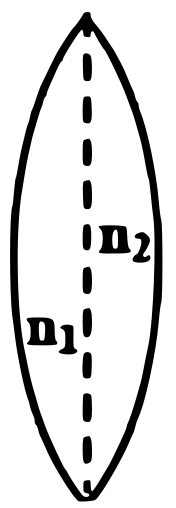
A thin convex lens is made of two materials with refractive indices n1n_{1} and n2n_{2}, as shown in figure. The radius of curvature of the left and right spherical surfaces are equal. ff is the focal length of the lens when n1=n2=n\mathrm{n}_{1}=\mathrm{n}_{2}=\mathrm{n}. The focal length is f+f+ Δf\Delta f when n1=n\mathrm{n}_{1}=\mathrm{n} and n2=n+Δn\mathrm{n}_{2}=\mathrm{n}+\Delta \mathrm{n}. Assuming Δn≪(n−1)\Delta \mathrm{n} \ll(\mathrm{n}-1) and 1<n<21<\mathrm{n}<2. The correct statement(s) is/are.

Question figure
  1. Option A:

    ∣Δff∣<∣Δnn∣\left|\frac{\Delta f}{f}\right|<\left|\frac{\Delta \mathrm{n}}{\mathrm{n}}\right|

  2. Option B:

    If Δnn<0\frac{\Delta \mathrm{n}}{\mathrm{n}}<0 then Δff>0\frac{\Delta \mathrm{f}}{\mathrm{f}}>0

    Correct
  3. Option C:

    For n=1.5,Δn=10−3\mathrm{n}=1.5, \Delta \mathrm{n}=10^{-3} and f=20 cm\mathrm{f}=20 \mathrm{~cm}, the value of ∣Δf∣|\Delta \mathrm{f}| will be 0.02 cm (round off to 2nd 2^{\text {nd }} decimal place).

    Correct
  4. Option D:

    The relation between Δff\frac{\Delta \mathrm{f}}{\mathrm{f}} and Δnn\frac{\Delta \mathrm{n}}{\mathrm{n}} remains unchanged if both the convex surfaces are replaced by concave surfaces of the same radius of curvature.

Answer: B, C

Step-by-step solution

When n1=n2=n\mathrm{n}_{1}=\mathrm{n}_{2}=\mathrm{n}

1f=(n−1)(2R)…(i)\begin{gathered} \frac{1}{\mathrm{f}}=(\mathrm{n}-1)\left(\frac{2}{\mathrm{R}}\right) …(i)\end{gathered}

When, n1=n\mathrm{n}_{1}=\mathrm{n} and n2=n+Δn\mathrm{n}_{2}=\mathrm{n}+\Delta \mathrm{n}

1f+Δf=(n−1)(1R)+(n+Δn−1)(1R)…(ii)\begin{gathered} \frac{1}{\mathrm{f}+\Delta \mathrm{f}}=(\mathrm{n}-1)\left(\frac{1}{\mathrm{R}}\right)+(\mathrm{n}+\Delta \mathrm{n}-1)\left(\frac{1}{\mathrm{R}}\right) …(ii) \end{gathered}

So from equation (i) and (ii)

1f−1f+Δf=−(Δn)(1R)\frac{1}{f}-\frac{1}{f+\Delta f}=-(\Delta n)\left(\frac{1}{R}\right)

⇒Δff2=−(Δn)(1R)\Rightarrow \frac{\Delta \mathrm{f}}{\mathrm{f}^{2}}=-(\Delta \mathrm{n})\left(\frac{1}{\mathrm{R}}\right)

So Δff=−Δn2(n−1)≈−Δn2n\frac{\Delta \mathrm{f}}{\mathrm{f}}=-\frac{\Delta \mathrm{n}}{2(\mathrm{n}-1)} \approx-\frac{\Delta \mathrm{n}}{2 \mathrm{n}}

Answer key and solution verified before publishing.

Practise Geometrical Optics

Start with this question, then two more from the same chapter — with a tutor that explains every step. Free.

Exam
JEE Advanced 2019
Paper
Paper 1
Subject
Physics
Chapter
Geometrical Optics
Topic
Lenses and Their Combinations, Silvering of Lens
A thin convex lens is made of two materials with refractive indices n… | JEE Advanced 2019 PYQ with Solution · DhiX AI