Mathematics · Differential Equations

JEE Advanced 2019 — Paper 1 — Question 35

Let Γ\Gamma denote a curve y=y(x)\mathrm{y}=\mathrm{y}(\mathrm{x}) which is in the first quadrant and let the point (1,0)(1,0) lie on it. Let the tangent to Γ\Gamma at a point PP intersect the yy-axis at YPY_{P}. If PYPP Y_{P} has length 1 for each point PP on Γ\Gamma, then which of the following option is/are correct?

  1. Option A:

    y=log⁡e(1+1−x2x)−1−x2\mathrm{y}=\log _{\mathrm{e}}\left(\frac{1+\sqrt{1-\mathrm{x}^{2}}}{\mathrm{x}}\right)-\sqrt{1-\mathrm{x}^{2}}

    Correct
  2. Option B:

    xy′+1−x2=0x y^{\prime}+\sqrt{1-x^{2}}=0

    Correct
  3. Option C:

    y=−log⁡e(1+1−x2x)+1−x2y=-\log _{e}\left(\frac{1+\sqrt{1-x^{2}}}{x}\right)+\sqrt{1-x^{2}}

  4. Option D:

    xy′−1−x2=0x y^{\prime}-\sqrt{1-x^{2}}=0

Answer: A, B

Step-by-step solution

Let P=(x,y)P=(x,y) on Γ\Gamma. The tangent at PP is Y−y=y′(X−x)Y - y = y'(X-x). Its yy-intercept is YP=(0,y−xy′)Y_P = (0, y - x y'). Distance PYP=(x−0)2+(y−(y−xy′))2=x2+(xy′)2=1PY_P = \sqrt{(x-0)^2 + (y-(y-xy'))^2} = \sqrt{x^2 + (xy')^2} = 1. Thus x2(1+(y′)2)=1⇒(y′)2=1−x2x2⇒y′=±1−x2xx^2(1+(y')^2)=1 \Rightarrow (y')^2 = \frac{1-x^2}{x^2} \Rightarrow y' = \pm \frac{\sqrt{1-x^2}}{x}. The curve lies in the first quadrant and passes through (1,0)(1,0).

For the positive sign, y′(x)y'(x) is positive for 0<x<10<x<1, so yy decreases as xx moves left from 1, giving negative yy values; this contradicts the quadrant condition.

Hence we take the negative sign: y′=−1−x2xy' = -\frac{\sqrt{1-x^2}}{x} which gives xy′+1−x2=0x y' + \sqrt{1-x^2} = 0 (option B). Separate variables: dy=−1−x2xdxdy = -\frac{\sqrt{1-x^2}}{x}dx. Let t=1−x2t = \sqrt{1-x^2}. Then xdx=−tdtx dx = -t dt and 1−x2xdx=−t21−t2dt\frac{\sqrt{1-x^2}}{x}dx = -\frac{t^2}{1-t^2}dt. Integrate: ∫1−x2xdx=∫−t21−t2dt=∫(1+1t2−1)dt=t+12ln⁡∣t−1t+1∣+C\int \frac{\sqrt{1-x^2}}{x} dx = \int -\frac{t^2}{1-t^2} dt = \int \left(1+\frac{1}{t^2-1}\right) dt = t + \frac12 \ln\left|\frac{t-1}{t+1}\right| + C. For 0≤t<10\le t<1, ∣t−1t+1∣=1−t1+t\left|\frac{t-1}{t+1}\right| = \frac{1-t}{1+t}.

Hence 12ln⁡1−t1+t=−ln⁡1+t1−t2=−ln⁡1+1−x2x\frac12 \ln\frac{1-t}{1+t} = - \ln\frac{1+t}{\sqrt{1-t^2}} = -\ln\frac{1+\sqrt{1-x^2}}{x}. Thus ∫1−x2xdx=1−x2−ln⁡1+1−x2x+C\int \frac{\sqrt{1-x^2}}{x} dx = \sqrt{1-x^2} - \ln\frac{1+\sqrt{1-x^2}}{x} + C. Therefore y=−(1−x2−ln⁡1+1−x2x+C)=ln⁡1+1−x2x−1−x2−Cy = -\left(\sqrt{1-x^2} - \ln\frac{1+\sqrt{1-x^2}}{x} + C\right) = \ln\frac{1+\sqrt{1-x^2}}{x} - \sqrt{1-x^2} - C. Condition y(1)=0y(1)=0 gives 0=ln⁡1+01−0−C⇒C=00 = \ln\frac{1+0}{1} - 0 - C \Rightarrow C=0. Hence y=ln⁡1+1−x2x−1−x2y = \ln\frac{1+\sqrt{1-x^2}}{x} - \sqrt{1-x^2} (option A). So options A and B are correct.
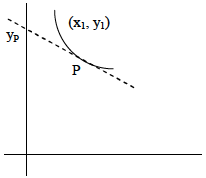
Solution figure

Answer key and solution verified before publishing.

Practise Differential Equations

Start with this question, then two more from the same chapter — with a tutor that explains every step. Free.

Exam
JEE Advanced 2019
Paper
Paper 1
Subject
Mathematics
Chapter
Differential Equations
Topic
Formation Of D.E