Mathematics · 3D Geometry
JEE Advanced 2019 — Paper 1 — Question 39
Let and denote the lines and
respectively. If is a line which is perpendicular to both and and cuts both of them, then which of the
following options describe (s) ?
- Option A:Correct
- Option B:Correct
- Option C:Correct
- Option D:
Answer: A, B, C
Step-by-step solution
Equation of Equation of
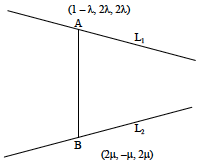
& are skew lines The direction ratios of line AB which is perpendicular to and will be
\mathbf{i} & \mathbf{j} & \mathbf{k} \\ -1 & 2 & 2 \\ 2 & -1 & 2 \end{vmatrix} = (4 - (-2))\mathbf{i} - (-2 - 4)\mathbf{j} + (1 - 4)\mathbf{k} = 6\mathbf{i} + 6\mathbf{j} - 3\mathbf{k}$$ Hence direction ratios of AB will be $(2, 2, -1)$ direction ratios of AB proportional to $ (2, 2, -1)$1 - \lambda - 2\mu = 2k \quad \ldots (i)
2\lambda + \mu = 2k \quad \ldots (ii)
2\lambda - 2\mu = -k \quad \ldots (iii)
\text{solving } (i) \text{ & } (ii) \text{ & } (iii)
\text{we get } \lambda = 1/9
\mu = 2/9
A\left(1 - \frac{1}{9}, 0 + 2 \times \frac{1}{9}, 0 + 2 \times \frac{1}{9}\right) = A\left(\frac{8}{9}, \frac{2}{9}, \frac{2}{9}\right)
B\left(2 \times \frac{2}{9}, -1 \times \frac{2}{9}, 2 \times \frac{2}{9}\right) = B\left(\frac{4}{9}, -\frac{2}{9}, \frac{4}{9}\right)
Equation of line $ L_3 (A, B)$ passing through $ A$\mathbf{r} = \left(\frac{8}{9}\mathbf{i} + \frac{2}{9}\mathbf{j} + \frac{2}{9}\mathbf{k}\right) + t(2\mathbf{i} + 2\mathbf{j} - \mathbf{k}), t \in \mathbb{R}
option (A) correct. Equation of line $ L_3$ passing through $B$\mathbf{r} = \left(\frac{4}{9}\mathbf{i} - \frac{2}{9}\mathbf{j} + \frac{4}{9}\mathbf{k}\right) + t(2\mathbf{i} + 2\mathbf{j} - \mathbf{k}), t \in \mathbb{R}
Answer key and solution verified before publishing.
Practise 3D Geometry
Start with this question, then two more from the same chapter — with a tutor that explains every step. Free.
- Exam
- JEE Advanced 2019
- Paper
- Paper 1
- Subject
- Mathematics
- Chapter
- 3D Geometry
- Topic
- Skew lines & shortest distance between them