Physics · Nuclear Physics
JEE Advanced 2019 — Paper 1 — Question 4
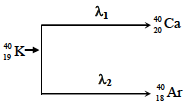
In a radioactive sample nuclei either decay into stable nuclei with decay constant per year or into stable nuclei with decay constant per year. Given that in this sample all the stable and nuclei are produced by the nuclei only. In time years, if the ratio of the sum of stable and nuclei to the radioactive nuclei is 99 , the value of t will be [Given ]
- Option A:
1.15
- Option B:
4.6
- Option C:Correct
9.2
- Option D:
2.3
Answer: C
Step-by-step solution
So equivalent decay constant per year
and given that
So year
Answer key and solution verified before publishing.
Practise Nuclear Physics
Start with this question, then two more from the same chapter — with a tutor that explains every step. Free.
- Exam
- JEE Advanced 2019
- Paper
- Paper 1
- Subject
- Physics
- Chapter
- Nuclear Physics
- Topic
- Laws of Radioactive Decay