Mathematics · Ellipse

JEE Advanced 2019 — Paper 1 — Question 37

Define the collections {E1,E2,E3,……}\left\{E_{1}, E_{2}, E_{3}, \ldots \ldots\right\} of ellipses and {R1,R2,R3,…}\left\{R_{1}, R_{2}, R_{3}, \ldots\right\} of rectangles as follows:

E1:x29+y24=1E_{1}: \frac{x^{2}}{9}+\frac{y^{2}}{4}=1;

R1R_{1} : rectangle of largest area, with sides parallel to the axes, inscribed in E1E_{1};

EnE_{n} : ellipse x2an2+y2bn2=1\frac{x^{2}}{a_{n}^{2}}+\frac{y^{2}}{b_{n}^{2}}=1 of largest area inscribed in Rn−1,n>1R_{n-1}, n>1;

Rn\mathrm{R}_{\mathrm{n}} : rectangle of largest area, with sides parallel to the axes, inscribed in En,n>1\mathrm{E}_{\mathrm{n}}, \mathrm{n}>1.

Then which of the following options is/are correct?

  1. Option A:

    ∑n=1N(\quad \sum_{n=1}^{N}\left(\right. area of Rn)<24\left.R_{n}\right)<24, for each positive integer NN

    Correct
  2. Option B:

    The distance of a focus from the centre in E9\mathrm{E}_{9} is 532\frac{\sqrt{5}}{32}

  3. Option C:

    The eccentricities of E18\mathrm{E}_{18} and E19\mathrm{E}_{19} are NOT equal

  4. Option D:

    The length of latus rectum of E9E_{9} is 16\frac{1}{6}

    Correct

Answer: A, D

Step-by-step solution

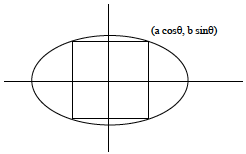
Area of Rn=2acos⁡θ×2bsin⁡θ=2absin⁡2θ R_n = 2a \cos\theta \times 2b \sin\theta = 2ab \sin 2\theta which will be maximum when θ=45∘.\theta = 45^\circ.

∴Rn max=2ab\therefore R_{n \text{ max}} = 2ab abE132E23222E33(2)22(2)2⋮⋮⋮En3(2)n−12(2)n−1\begin{array}{|c|c|c|} \hline & a & b \\ \hline E_1 & 3 & 2 \\ \hline E_2 & \frac{3}{\sqrt{2}} & \frac{2}{\sqrt{2}} \\ \hline E_3 & \frac{3}{(\sqrt{2})^2} & \frac{2}{(\sqrt{2})^2} \\ \hline \vdots & \vdots & \vdots \\ \hline E_n & \frac{3}{(\sqrt{2})^{n-1}} & \frac{2}{(\sqrt{2})^{n-1}} \\ \hline \end{array} (A) Area of Rn=2×3(2)n−1×2(2)n−1=122n−1\text{(A) Area of } R_n = 2 \times \frac{3}{(\sqrt{2})^{n-1}} \times \frac{2}{(\sqrt{2})^{n-1}} = \frac{12}{2^{n-1}} Area of R1+Area of R2+… Area of Rn…∞\text{Area of } R_1 + \text{Area of } R_2 + \ldots \text{ Area of } R_n \ldots \infty =12+122+124+…= 12 + \frac{12}{2} + \frac{12}{4} + \ldots =12(1+12+14+…)= 12 \left( 1 + \frac{1}{2} + \frac{1}{4} + \ldots \right) =12×11−12=12×112=24= 12 \times \frac{1}{1 - \frac{1}{2}} = 12 \times \frac{1}{\frac{1}{2}} = 24

(B) b2=a2(1−e2) b^2 = a^2(1 - e^2) for ellipse

(2(2)8)2=(3(2)8)2(1−e92)\left( \frac{2}{(\sqrt{2})^8} \right)^2 = \left( \frac{3}{(\sqrt{2})^8} \right)^2 (1 - e_9^2) 4216=9216(1−e92)\frac{4}{2^{16}} = \frac{9}{2^{16}} (1 - e_9^2) 1−e92=491 - e_9^2 = \frac{4}{9} e92=1−49=59e_9^2 = 1 - \frac{4}{9} = \frac{5}{9} e9=53e_9 = \frac{\sqrt{5}}{3}

Distance between centre and focus =ae= ae

=3(2)8×53=524=516= \frac{3}{(\sqrt{2})^8} \times \frac{\sqrt{5}}{3} = \frac{\sqrt{5}}{2^4} = \frac{\sqrt{5}}{16} (C) e18=e19\text{(C) } e_{18} = e_{19}

(D) Latus rectum (length) =2b2a=2×(2(2)8)23(2)8=16= \frac{2b^2}{a} = \frac{2 \times \left( \frac{2}{(\sqrt{2})^8} \right)^2}{\frac{3}{(\sqrt{2})^8}} = \frac{1}{6}

Solution figure

Answer key and solution verified before publishing.

Practise Ellipse

Start with this question, then two more from the same chapter — with a tutor that explains every step. Free.

Exam
JEE Advanced 2019
Paper
Paper 1
Subject
Mathematics
Chapter
Ellipse
Topic
Introduction to Ellipse
Define the collections \ E 1 , E 2 , E 3 , ldots ldots \ of ellipses… | JEE Advanced 2019 PYQ with Solution · DhiX AI