JEE Advanced 2019 · previous year paper
JEE Advanced 2019 — Paper 2
39 questions with the verified answer key. Open any question for its step-by-step solution.
- Question 1Physics· Wave Optics
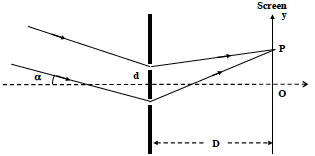
In a Young's double slit experiment, the slit separation d is 0.3 mm and the screen distance D is 1 m . A parallel beam of light of wavelength 600 nm is incident on the slits at angle as shown in figure. On the screen, the point O is equidistant from the slits and distance PO is 11.0 mm . Which of the following statements(s) is/are correct?
- Option A:
For degree, there will be destructive interference at point .
- Option B:
Fringe spacing depends on .
- Option C:
For degree, there will be destructive interference at point .
- Option D:
For , there will be constructive interference at point .
Answer: CStep-by-step solution → - Question 2Physics· Newton's Laws of Motion
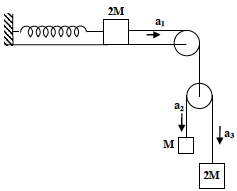
A block of mass 2M is attached to a massless spring with spring-constant k . This block is connected to two other blocks of masses M and 2 M using two massless pulleys and strings. The accelerations of the blocks are and as shown in the figure. the system is released from rest with the spring in its unstretched state. The maximum extension of the spring is . Which of the following option(s) is/are correct? [ is the acceleration due to gravity. neglect friction]
- Option A:
- Option B:
At an extension of of the spring, the magnitude of acceleration of the block connected to the spring is
- Option C:
- Option D:
When spring achieves an extension of for the first time, the speed of the block connected to the spring is .
Answer: AStep-by-step solution → - Question 3Physics· Rotational Dynamics
A thin and uniform rod of mass and length is held vertical on a floor with large friction. The rod is released from rest so that it falls by rotating about its contact-point with the floor without slipping. Which of the following statement(s) is/are correct, when the rod makes an angle with vertical ? [ is the acceleration due to gravity]
- Option A:
The radial acceleration of the rod's center of mass will be
- Option B:
The angular speed of the rod will be
- Option C:
The angular acceleration of the rod will be
- Option D:
The normal reaction force from the floor on the rod will be
Answer: A, B, DStep-by-step solution → - Question 4Physics· System Of Particles
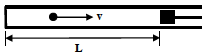
A small particle of mass m moving inside a heavy, hollow and straight tube along the tube axis undergoes elastic collision at two ends. The tube has no friction and it is closed at one end by a flat surface while the other end is fitted with a heavy movable flat piston as shown in figure. When the distance of the piston from closed end is the particle speed is . The piston is moved inward at a very low speed V such that , where dL is the infinitesimal displacement of the piston. which of the following statement(s) is/are correct ?
- Option A:
The particle's kinetic energy increases by a factor of 4 when the piston is moved inward from to .
- Option B:
After each collision with the piston, the particle speed increases by 2 V .
- Option C:
If the piston moves inward by dL , the particle speed increases by
- Option D:
The rate at which the particle strikes the piston is
Answer: A, BStep-by-step solution → - Question 5Physics· Geometrical Optics
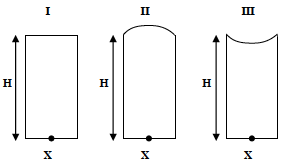
Three glass cylinders of equal height and same refractive index are placed on a horizontal surface as shown in figure. Cylinder I has a flat top, cylinder II has a convex top and cylinder III has a concave top. The radii of curvature of the two curved tops are same . If and are the apparent depths of a point X on the bottom of the three cylinders, respectively, the correct statement(s) is/are:
- Option A:
- Option B:
- Option C:
- Option D:
Answer: A, BStep-by-step solution → - Question 6Physics· Electrostatics
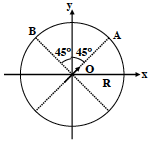
An electric dipole with dipole moment is held fixed at the origin O in the presence of an uniform electric field of magnitude . If the potential is constant on a circle of radius R centered at the origin as shown in figure, then the correct statement(s) is/are : ( is permittivity of free space. dipole size)
- Option A:
Total electric field at point is
- Option B:
Total electric field at point is
- Option C:
- Option D:
The magnitude of total electric field on any two points of the circle will be same.
Answer: B, CStep-by-step solution → - Question 7Physics· Atomic Physics
A free hydrogen atom after absorbing a photon of wavelength gets excited from the state to the state
. Immediately after that the electron jumps to state by emitting a photon of wavelength . Let
the change in momentum of atom due to the absorption and the emission are and . respectively. If
, which of the option(s) is /are correct ? [Use hc , h and c are
Planck's constant and speed of light, respectively]
- Option A:
- Option B:
The ratio of kinetic energy of the electron in the state to the state is
- Option C:
- Option D:
Answer: B, DStep-by-step solution → - Question 8Physics· Thermodynamics
A mixture of ideal gas contains 5 moles of monatomic gas and 1 mole of rigid diatomic gas is initially at pressure
, volume , and temperature . If the gas mixture is adiabatically compressed to a volume , then the
correct statement(s) is /are, (Given is gas constant)
- Option A:
Adiabatic constant of the gas mixture is 1.6
- Option B:
The final pressure of the gas mixture after compression is in between and
- Option C:
The work done during the process is
- Option D:
The average kinetic energy of the gas mixture after compression is in between and
Answer: A, BStep-by-step solution → - Question 9Physics· Nuclear Physics
Suppose a nucleus at rest and in ground state undergoes -decay to a nucleus in its excited
state. The kinetic energy of the emitted particle is found to be nucleus then goes to its
ground state by -decay. The energy of the emitted photon is keV. [Given: atomic mass of
, atomic mass of , atomic mass of particle
is speed of the light]
Answer: 135Step-by-step solution → - Question 10Physics· Motion in Plane
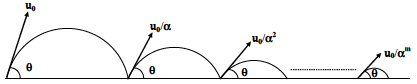
A ball is thrown from ground at an angle with horizontal and with an initial speed . For the resulting projectile motion, the magnitude of average velocity of the ball up to the point when it hits the ground for the first time is . After hitting the ground, the ball rebounds at the same angle but with a reduced speed of . Its motion continues for a long time as shown in figure. If the magnitude of average velocity of the ball for entire duration of motion is , the value of is —.
 Answer: 4Step-by-step solution →
 - Question 11Physics· Electromagnetic Induction
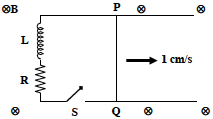
A 10 cm long perfectly conducting wire PQ is moving with a velocity on a pair of horizontal rails of zero resistance. One side of the rails is connected to an inductor and a resistance as shown in the figure. The horizontal rails, L and R lie in the same plane with a uniform magnetic field perpendicular to the plane. If the key S is closed at certain instant, the current in the circuit after 1 millisecond is , where the value of x is -. [Assume the velocity of wire PQ remains constant ( ) after key S is closed. Given: , where e is base of the natural logarithm]
 Answer: 0.63Step-by-step solution →
 - Question 12Physics· Atomic Physics
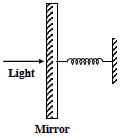
A perfectly reflecting mirror of mass mounted on a spring constitutes a spring-mass system of angular frequency such that with h as Planck's constant. N photons of wavelength strike the mirror simultaneously at normal incidence such that the mirror gets displaced by . If the value of N is , then the value of x is -. [Consider the spring as massless]
 Answer: 1Step-by-step solution →
 - Question 13Physics· Geometrical Optics
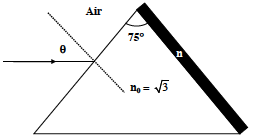
A monochromatic light is incident from air on a refracting surface of prism of angle and refractive index . The other refracting surface of the prism is coated by a thin film of material of refractive index as shown in figure. The light suffers total internal reflection at the coated prism surface for an incidence angle of . The value of is —.
 Answer: 1.5Step-by-step solution →
 - Question 14Physics· Units, Dimensions & Error Analysis
An optical bench has 1.5 m long scale having four equal divisions in each cm . While measuring the focal length of a convex lens, the lens is kept at 75 cm mark of the scale and the object pin is kept at 45 cm mark. The image of the object pin on the other side of the lens overlaps with image pin that is kept at 135 cm mark. In this experiment, the percentage error in the measurement of the focal length of the lens is —.
Answer: 1.39Step-by-step solution → - Question 15Chemistry· d and f Block Elements
Consider the following reactions (unbalanced)
Choose the correct option(s)
- Option A:
The oxidation state of Zn in T is +1
- Option B:
R is a V -shaped molecule
- Option C:
Z is dirty white in colour
- Option D:
Bond order of Q is 1 in its ground state
Answer: B, C, DStep-by-step solution → - Question 16Chemistry· Structure of Atom
The ground state energy of hydrogen atom is -13.6 eV . Consider an electronic state of whose energy, azumuthal quantum number and magnetic quantum number are and 0 , respectively. Which of the following statement(s) is(are) true for the state ?
- Option A:
It is a 4d state
- Option B:
It has 2 angular nodes
- Option C:
It has 3 radial nodes
- Option D:
The nuclear charge experienced by the electron in this state is less than 2 e , where e is the magnitude of the electronic charge
Answer: A, BStep-by-step solution → - Question 17Chemistry· p-Block Elements (Group 15-18)
With reference to aqua regia, choose the correct option(s)
- Option A:
The yellow colour of aqua regia is due to the presence of NOCl and
- Option B:
Aqua regia is prepared by mixing conc. HCl and conc. in ratio
- Option C:
Reaction of gold with aqua regia produces an anion having Au in +3 oxidation state
- Option D:
Reaction of gold with aqua regia produces in the absence of air
Answer: A, B, CStep-by-step solution → - Question 18Chemistry· Some Basic Concepts of Chemistry (Mole Concept) + Stoichiometry
The mole fraction of urea in an aqueous solution containing of water is . If the density of the solution is , the molarity of urea solution is .
[Given: molar mass of urea , water ]
Answer: 2.98Step-by-step solution → - Question 19Chemistry· p-Block Elements (Group 15-18)
The amount of water produced (in g) in the oxidation of 1 mole of rhombic sulphur by conc. to a compound with the highest oxidation state of sulphur is Given data : Molar mass of water
Answer: 288Step-by-step solution → - Question 20Chemistry· Chemical Kinetics
The decomposition reaction is started in a closed cylinder
under isothermal isochoric condition at an initial pressure of 1 atm . After , the pressure inside the
cylinder is found to be 1.45 atm . If the rate constant of the reaction is , assuming ideal gas
behaviour, the value of is -
Answer: 2.3Step-by-step solution → - Question 21Mathematics· 3D Geometry
A line passing through the point , is perpendicular to both the lines and .
If the position vector of point on is such that , then ( ) can be:
- Option A:
16
- Option B:
15
- Option C:
2
- Option D:
1
Answer: B, DStep-by-step solution → - Question 22Mathematics· Matrices
Let and let Then which of the following options is/are correct?
- Option A:
- Option B:
- Option C:
- Option D:
There exists a real number x such that
Answer: A, CStep-by-step solution → - Question 23Mathematics· Limits, Continuity and Differentiability
For non-negative integers n , let
Assuming takes values in , which of the following options is/are correct?
- Option A:
- Option B:
If , then
- Option C:
- Option D:
Answer: A, B, CStep-by-step solution → - Question 24Mathematics· Limits, Continuity and Differentiability
For , let
Then the possible value(s) of a is/are
- Option A:
8
- Option B:
- Option C:
7
- Option D:
Answer: A, DStep-by-step solution → - Question 25Mathematics· Application of Derivatives
The function has no maxima or minima if
- Option A:
- Option B:
- Option C:
- Option D:
none of these
Answer: A, B, CStep-by-step solution → - Question 26Mathematics· Matrices
where denotes the transpose of the matrix . Then which of the following options is/are correct?
- Option A:
is an invertible matrix
- Option B:
X is a symmetric matrix
- Option C:
The sum of diagonal entries of X is 18
- Option D:
Answer: B, C, DStep-by-step solution → - Question 27Mathematics· Limits, Continuity and Differentiability
Let be a function. We say that f has
PROPERTY 1 if exists and is finite, and
PROPERTY 2 if exists and if finite.
Then, which of the following options is/are correct?
- Option A:
has PROPERTY 2
- Option B:
has PROPERTY 2
- Option C:
has PROPERTY 1
- Option D:
has PROPERTY 1
Answer: C, DStep-by-step solution → - Question 28Mathematics· Definite Integration
The value of the integral
Answer: 0.5Step-by-step solution → - Question 29Mathematics· Vector Algebra
Let and be two vectors.Consider a vector .If the projection of on the vector is ,then the minimum value of equals
Answer: 18Step-by-step solution → - Question 30Mathematics· Permutations and Combinations
Five persons A,B,C,D and E are seated in a circular arrangement.If each of them is given a hat of one of the three colours red,blue and green,then the number of ways of distributing the hats such that the persons seated in adjacent seats get different coloured hats is
Answer: 30Step-by-step solution → - Question 31Mathematics· Binomial TheoremAnswer: 6.2Step-by-step solution →
- Question 32Mathematics· Probability
Let denote the number of elements in a set X . Let be a sample space, where each element is equally likely to occur. If and are independent events associated with , then the number of ordered pairs (A, B) such that , equals
Answer: 422Step-by-step solution → - Question 33Mathematics· Trigonometry Ratios and IdentitiesAnswer: 0Step-by-step solution →
- Question 34Physics· Transverse waves
A musical instrument is made using four different metal strings, and 4 with mass per unit length , and respectively. The instrument is played by vibrating the strings by varying the free length in between the range and . It is found that in string- at free length and tension the fundamental mode frequency is . List -I gives the above four strings while list -II lists the magnitude of some quantity.
List-I List-II (I) String-1 ( ) (P) (II) String-2 ( ) (Q) (III) String-3 ( ) (R) (IV) String-4 ( ) (S) (T) (U) If the tension in each string is , the correct match for the highest fundamental frequency in units will be,
- Option A:
- Option B:
- Option C:
- Option D:
Answer: AStep-by-step solution → - Question 35Physics· Transverse waves
A musical instrument is made using four different metal strings, and 4 with mass per unit length , and respectively. The instrument is played by vibrating the strings by varying the free length in between the range and . It is found that in string- at free length and tension the fundamental mode frequency is . List -I gives the above four strings while list -II lists the magnitude of some quantity.
List-I List-II (I) String-1 ( ) (P) (II) String-2 ( ) (Q) (III) String-3 ( ) (R) (IV) String-4 ( ) (S) (T) (U) - Option A:
- Option B:
- Option C:
- Option D:
Answer: AStep-by-step solution → - Question 36Chemistry· Structure of Atom
Consider the Bohr's model of a one-electron atom where the electron moves around the nucleus. In the following, List-I contains some quantities for the orbit of the atom and List-II contains options showing how they depend on .
LIST-I LIST-II (I) Radius of the orbit (P) (II) Angular momentum of the electron in the orbit (Q) (III) Kinetic energy of the electron in the orbit (R) (IV) Potential energy of the electron in the orbit (S) (T) (U) Which of the following options has the correct combination considering List-I and List-II?
- Option A:
(III), (P)
- Option B:
(IV), (U)
- Option C:
(III), (S)
- Option D:
(IV), (Q)
Answer: AStep-by-step solution → - Question 37Chemistry· Structure of Atom
Consider the Bohr's model of a one-electron atom where the electron moves around the nucleus. In the following, List-I contains some quantities for the orbit of the atom and List-II contains options showing how they depend on .
LIST-I LIST-II (I) Radius of the orbit (P) (II) Angular momentum of the electron in the orbit (Q) (III) Kinetic energy of the electron in the orbit (R) (IV) Potential energy of the electron in the orbit (S) (T) (U) Which of the following options has the correct combination considering List-I and List-II?
- Option A:
(I), (T)
- Option B:
(II), (R)
- Option C:
(I), (P)
- Option D:
(II), (Q)
Answer: AStep-by-step solution → - Question 38Mathematics· Trigonometry Ratios and Identities
Let and be two functions defined for . Define the
following sets whose elements are written in the increasing order:
List - I contains the set X, Y, Z and W. List - II contains some information regarding these sets.
List - I List - II (I) X (P) (II) Y (Q) an arithmetic progression (III) Z (R) NOT an arithmetic progression (IV) W (S) (T) (U) Which of the following is the only CORRECT combination?
- Option A:
(II), (R), (S)
- Option B:
(I), (Q), (U)
- Option C:
(II), (Q), (T)
- Option D:
(I), (P), (R)
Answer: CStep-by-step solution → - Question 39Mathematics· Trigonometry Ratios and Identities
Let and be two functions defined for . Define the
following sets whose elements are written in the increasing order:
List - I contains the set X, Y, Z and W. List - II contains some information regarding these sets.
List - I List - II (I) X (P) (II) Y (Q) an arithmetic progression (III) Z (R) NOT an arithmetic progression (IV) W (S) (T) (U) Which of the following is the only CORRECT combination?
- Option A:
(IV), (P), (R), (S)
- Option B:
(III), (P), (Q), (U)
- Option C:
(IV), (Q), (T)
- Option D:
(III), (R), (U)
Answer: AStep-by-step solution →
Stuck on one of these?
Practise questions like them — free, with a tutor that explains every step.