JEE Advanced 2025 · previous year paper
JEE Advanced 2025 — Paper 1
45 questions with the verified answer key. Open any question for its step-by-step solution.
- Question 1Physics· Simple Harmonic Motion
The center of a disk of radius and mass is attached to a spring of spring constant , inside a ring of radius as shown in the figure. The other end of the spring is attached on the periphery of the ring. Both the ring and the disk are in the same vertical plane. The disk can only roll along the inside periphery of the ring, without slipping. The spring can only be stretched or compressed along the periphery of the ring, following the Hooke's law. In equilibrium, the disk is at the bottom of the ring. Assuming small displacement of the disc, the time period of oscillation of center of mass of the disk is written as . The correct expression for is ( is the acceleration due to gravity)

- Option A:
- Option B:
- Option C:
- Option D:
Answer: AStep-by-step solution → - Question 2Physics· System Of Particles
In a scattering experiment, a particle of mass collides with another particle of mass , which is initially at rest. Assuming the collision to be perfectly elastic, the maximum angular deviation of the heavier particle, as shown in the figure, in radians is

- Option A:
- Option B:
- Option C:
- Option D:
Answer: DStep-by-step solution → - Question 3Physics· Electromagnetic Induction
A conducting square loop of side , mass and resistance is moving in the plane with its edges parallel to the and axes. The region has a uniform magnetic
field, . The magnetic field is zero everywhere else. At time , the loop starts to enter the magnetic field with an initial velocity , as shown in the figure.
Considering the quantity in appropriate units, ignoring self-inductance of the loop and gravity, which of the following statements is/are correct
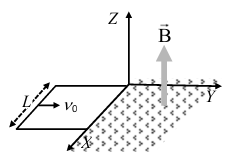
- Option A:
If , the loop will stop before it enters completely inside the region of magnetic field
- Option B:
When the complete loop is inside the region of magnetic field, the net force acting on the loop is zero.
- Option C:
If , the loop comes to rest at .
- Option D:
If , the complete loop enters inside the region of magnetic field at time .
Answer: B, DStep-by-step solution → - Question 4Physics· Units, Dimensions & Error Analysis
Length, breadth and thickness of a strip having a uniform cross section are measured to be 10.5 cm , 0.05 mm , and , respectively. Which of the following
option(s) give(s) the volume of the strip in with correct significant figures
- Option A:
- Option B:
- Option C:
- Option D:
Answer: DStep-by-step solution → - Question 5Physics· Transverse waves
Consider a system of three connected strings, and with uniform linear mass densities , and , respectively, as shown in the figure.
and are connected at the point , whereas and are connected at the point , and the other end of is connected to a wall. A wave generator O is connected to the free end of .
The wave from the generator is represented by , where and are constants of appropriate dimensions. Which of the following statements is/are correct

- Option A:
) When the wave reflects from for the first time, the reflected wave is represented by , where is a positive constant
- Option B:
When the wave transmits through for the first time, the transmitted wave is represented by , where is a positive constant
- Option C:
When the wave reflects from for the first time, the reflected wave is represented by , where is a positive constant
- Option D:
When the wave transmits through for the first time, the transmitted wave is represented by , where is a positive constant.
Answer: A, DStep-by-step solution → - Question 6Physics· Simple Harmonic Motion
A person sitting inside an elevator performs a weighing experiment with an object of mass 50 kg . Suppose that the variation of the height (in m ) of the elevator, from the
ground, with time (in s) is given by , where . Taking acceleration due to gravity, , the maximum variation of the object's weight (in N ) as observed in the experiment is
Answer: 2Step-by-step solution → - Question 7Physics· Electromagnetic Waves
A cube of unit volume contains photons of frequency . If the energy of all the photons is viewed as the average energy being contained
in the electromagnetic waves within the same volume, then the amplitude of the magnetic field is . Taking permeability of free space
, Planck's constant and , the value of is
Answer: 22.98Step-by-step solution → - Question 8Physics· Heat Transfer
Two identical plates P and Q , radiating as perfect black bodies, are kept in vacuum at constant absolute temperatures and , respectively, with , as shown in Fig. 1. The radiated power transferred per unit area from P to Q is . Subsequently, two more plates, identical to P and Q , are introduced between P and Q , as shown in Fig. 2. Assume that heat transfer takes place only between adjacent plates. If the power transferred per unit area in the direction from to (Fig. 2) in the steady state is , then the ratio is Fig. 1 Fig. 2
 Answer: 3Step-by-step solution →
 - Question 9Physics· Wave Optics
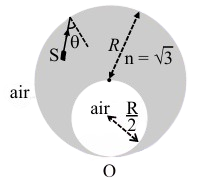
A solid glass sphere of refractive index and radius contains a spherical air cavity of radius , as shown in the figure. A very thin glass layer is present at the point O
so that the air cavity (refractive index ) remains inside the glass sphere. An unpolarized, unidirectional and monochromatic light source emits a light ray from a point inside
the glass sphere towards the periphery of the glass sphere. If the light is reflected from the point O and is fully polarized, then the angle of incidence at the inner surface of the glass sphere is . The value of is
 Answer: 0.75Step-by-step solution →
 - Question 10Physics· Wave Optics
A single slit diffraction experiment is performed to determine the slit width using the equation, , where is the slit width, the shortest distance between the slit and the screen, the distance between the diffraction maximum and the central maximum, and is the wavelength. and are measured with scales of least count of 1 cm and 1 mm , respectively. The values of and are known precisely to be 600 nm and 3, respectively. The absolute error (in ) in the value of estimated using the diffraction maximum that occurs for with and is
Answer: 75.60Step-by-step solution → - Question 11Physics· Atomic Physics
Consider an electron in the orbit of a hydrogen-like atom with atomic number . At absolute temperature , a neutron having thermal energy has the same de Broglie wavelength as that of this electron. If this temperature is given by , (where is the Planck's constant, is the Boltzmann constant, is the mass of the neutron and is the first Bohr radius of hydrogen atom) then the value of is
Answer: 72Step-by-step solution → - Question 12Physics· Electrostatics
List-I shows four configurations, each consisting of a pair of ideal electric dipoles. Each dipole has a dipole moment of magnitude , oriented as marked by arrows in the figures.
In all the configurations the dipoles are fixed such that they are at a distance apart along the direction. The midpoint of the line joining the two dipoles is . The possible resultant electric fields at are given in List-II. Choose the option that describes the correct match between the entries in List-I to those in List-II.
List-I List-II (P) 
(1) (Q) 
(2) (R) 
(3) (S) 
(4) (5) - Option A:
)
- Option B:
- Option C:
- Option D:
Answer: CStep-by-step solution → - Question 13Physics· Alternating Current
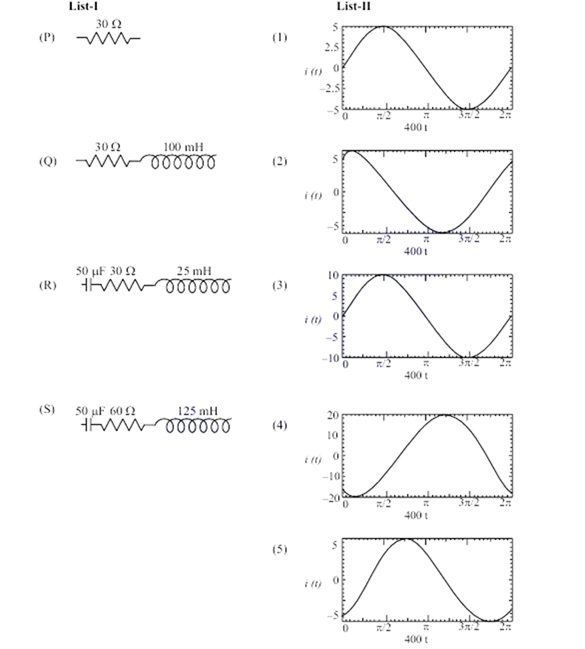
A circuit with an electrical load having impedance is connected with an AC source as shown in the diagram. The source voltage varies in time as , where is time in s. List-I shows various options for the load. The possible currents in the circuit as a function of time are given in List-II.

Choose the option that describes the correct match between the entries in List-I to those in
- Option A:
- Option B:
- Option C:
- Option D:
Answer: AStep-by-step solution → - Question 14Physics· Nuclear Physics
List-I shows various functional dependencies of energy on the atomic number ( ). Energies associated with certain phenomena are given in List-II. Choose the option that describes the correct match between the entries in List-I to those in List-II.
List-I List-II (P) (1) energy of characteristic x-rays (Q) (2) electrostatic part of the nuclear binding energy for stable nuclei with mass numbers in the range 30 to 170 (R) (3) energy of continuous x-rays (S) is practically independent of (4) average nuclear binding energy per nucleon for stable nuclei with mass number in the range 30 to 170 (5) energy of radiation due to electronic transitions from hydrogen-like atoms - Option A:
- Option B:
- Option C:
- Option D:
Answer: CStep-by-step solution → - Question 15Mathematics· Functions
Let denote the set of all real numbers. Let for .
Define the functions , and by
,
,
.
If for every , then the coefficient of in is
- Option A:
8
- Option B:
2
- Option C:
-4
- Option D:
-6
Answer: CStep-by-step solution → - Question 16Mathematics· Probability
Three students and are given a problem to solve. Consider the following events: At least one of and can solve the problem,
can solve the problem, given that neither nor can solve the problem, can solve the problem and cannot solve the problem, can solve the problem. For any event , let denote the probability of . If and , then is equal to
- Option A:
- Option B:
- Option C:
- Option D:
Answer: AStep-by-step solution → - Question 17Mathematics· Limits, Continuity and Differentiability
Let denote the set of all real numbers. Define the function by
Then which one of the following statements is TRUE ?
- Option A:
The function is NOT differentiable at
- Option B:
There is a positive real number , such that is a decreasing function on the interval
- Option C:
For any positive real number , the function is NOT an increasing function on the interval
- Option D:
is a point of local minima of
Answer: CStep-by-step solution → - Question 18Mathematics· Matrices
Consider the matrix Let the transpose of a matrix be denoted by . Then the number of invertible matrices Q with integer entries, such that is
- Option A:
32
- Option B:
8
- Option C:
16
- Option D:
24
Answer: CStep-by-step solution → - Question 19Mathematics· 3D Geometry
Let be the line of intersection of the planes given by the equations Let be the line passing through
the point and parallel to . Let denote the plane given by the equation Suppose that the line meets the plane at the point
. Let be the foot of the perpendicular drawn from to the plane . Then which of the following statements is (are) TRUE ?
- Option A:
The length of the line segment is
- Option B:
The length of the line segment is 15
- Option C:
The area of is
- Option D:
The acute angle between the line segments and is
Answer: A, CStep-by-step solution → - Question 20Mathematics· Functions
Let denote the set of all natural numbers, and denote the set of all integers. Consider the functions and defined by f(n)= \begin{cases}(n+1) / 2 & \text { if } n \text { is odd } \\ (4-n) / 2 & \text { if } n \text { is even }\end{cases} $$ and $$ g(n)=\left\{\begin{array}{cc} 3+2 n & \text { if } n \geq 0 \\ -2 n & \text { if } n<0 \end{array}\right.
Define for all , and for all . Then which of the following statements is (are) TRUE ?
- Option A:
is NOT one-one and is NOT onto
- Option B:
is NOT one-one but is onto
- Option C:
is one-one and is onto
- Option D:
is NOT one-one but is onto
Answer: A, DStep-by-step solution → - Question 21Mathematics· Complex Numbers
Let denote the set of all real numbers. Let and be two
complex numbers, where .
Let
Then which of the following statements is (are) TRUE ?
- Option A:
is a circle with centre
- Option B:
is a circle with centre
- Option C:
is a circle with radius
- Option D:
is a circle with radius
Answer: A, DStep-by-step solution → - Question 22Mathematics· Sets and Relations
Let the set of all relations on the set , such that is reflexive and symmetric, and contains exactly 10 elements, be denoted by . Then the
number of elements in is
Answer: 105Step-by-step solution → - Question 23Mathematics· Vector Algebra
For any two points and in the -plane, let denote the vector from to , and denote the zero vector. Let and be
three distinct points in the -plane. Let be a point inside the triangle
such that
Let and be the mid-points of the
sides and , respectively. Then the value of is
Answer: 1.2Step-by-step solution → - Question 24Mathematics· Permutations and Combinations
Let be the set of all seven-digit numbers that can be formed using the digits 0,1 and 2 . For example, 2210222 is in , but 0210222 is NOT in . Then the number of elements in such that at least one the digits 0 and 1 appears exactly twice in , is equal to
Answer: 762Step-by-step solution → - Question 25Mathematics· Definite Integration
Let and be the real numbers such that \end{enumerate}
Then the value of is
Answer: 2.4Step-by-step solution → - Question 26Mathematics· Functions
Let denote the set of all real numbers. Let be a function such that for all , and for all .
Let the real numbers be in an arithmetic progression. If , and
then the value of is
Answer: 96Step-by-step solution → - Question 27Mathematics· Differential Equations
For all , let , and be the functions satisfying \end{enumerate}
respectively. Then is equal to
Answer: 2Step-by-step solution → - Question 28Mathematics· Statistics
Consider the following frequency distribution
Value 4 5 8 9 6 12 11 Frequency 5 2 1 1 3 Suppose that the sum of the frequencies is 19 and the median of this frequency distribution is 6 . For the given frequency distribution,
let denote the mean deviation about the mean, denote the mean deviation about the median, and denote the variance.
Match each entry in List-I to the correct entry in List-II and choose the correct option.
List-I List-II (P) is equal to (1) 146 (Q) is equal to (2) 47 (R) is equal to (3) 48 (S) is equal to (4) 145 (5) 55 - Option A:
- Option B:
(P) (5), (Q) (2), (R) (3), (S)
- Option C:
- Option D:
Answer: CStep-by-step solution → - Question 29Mathematics· Functions
Let denote the set of all real numbers. For a real number , let denote the greatest integer less than or equal to . Let denote a natural number. Match each entry in List-I to the correct entry in List-II and choose the correct option.
List-I List-II (P) The minimum value of for which the function is continuous on the interval , is (1) 8 (Q) The minimum value of for which , is an increasing function on , is (2) 9 (R) The smallest natural number which is greater than 5 , such that is a point of local minima of , is (3) 5 (S) Number of such that , is NOT differentiable at , is (4) 6 (5) 10 - Option A:
- Option B:
- Option C:
})
- Option D:
Answer: BStep-by-step solution → - Question 30Mathematics· Vector Algebra
Match the following lists.
LIST-I LIST-II A) If and are non-coplanar then the is B) If and are unit vectors inclined at an angle to each other and , then can be equal to C) If is unit vector perpendicular to another unit vector then is equal to 1 D) Let be three unit vectors such that , then the angle between and is equal to 0. - Option A:
- Option B:
- Option C:
- Option D:
Answer: CStep-by-step solution → - Question 31Chemistry· p-Block Elements (Group 15-18)
The heating of at and at is associated with the formation of nitrogen containing compounds and respectively. and , respectively, are
- Option A:
and
- Option B:
and
- Option C:
NO and
- Option D:
and
Answer: AStep-by-step solution → - Question 32Chemistry· Coordination Compounds
The correct order of the wavelength maxima of the absorption band in the ultraviolet-visible region for the given complexes is
- Option A:
- Option B:
- Option C:
- Option D:
Answer: AStep-by-step solution → - Question 33Chemistry· Redox Reactions
One of the products formed from the reaction of permanganate ion with iodide ion in neutral aqueous medium is
- Option A:
- Option B:
- Option C:
- Option D:
Answer: BStep-by-step solution → - Question 34Chemistry· General Organic Chemistry
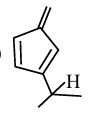
Consider the depicted hydrogen in the hydrocarbons given below. The most
acidic hydrogen is
- Option A:
- Option B:
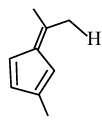
- Option C:

- Option D:
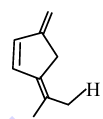
Answer: BStep-by-step solution → - Question 35Chemistry· Chemical Bonding
Regarding the molecular orbital (MO) energy levels for homonuclear diatomic molecules, the INCORRECT statement(s) is(are
- Option A:
Bond order of is zero
- Option B:
The highest occupied molecular orbital (HOMO) of is -type.
- Option C:
Bond energy of is smaller than the bond energy of .
- Option D:
Bond length of is larger than the bond length of
Answer: B, CStep-by-step solution → - Question 36Chemistry· d and f Block Elements
The pair(s) of diamagnetic ions is(are)
- Option A:
- Option B:
- Option C:
- Option D:
Answer: A, BStep-by-step solution → - Question 37Chemistry· Electrochemistry
In an electrochemicalcell, dichromate ions in aqueous acidic medium are reduced to . The current (in amperes) that flows through the cell for 48.25 minutes to produce
1 mole of is . Use: 1 Faraday
Answer: 100Step-by-step solution → - Question 38Chemistry· Ionic Equilibrium
At , the concentration of ions in aqueous solution of a weak monobasic acid having acid dissociation constant is
. The value of is 。 Use: Ionic product of water at
Answer: 2.23Step-by-step solution → - Question 39Chemistry· States of Matter - Gaseous State
Molar volume ( ) of a van der Waals gas can be calculated by expressing the
van der Waals equation as a cubic equation with as the variable. The ratio
(in ) of the coefficient of to the coefficient of
for a gas having van der Waals constants
and
at 300 K and 300 atm is .
Use: Universal gas constant
Answer: -7.1Step-by-step solution → - Question 40Chemistry· Thermodynamics & Thermochemistry
Considering ideal gas behavior, the expansion work done (in kJ ) when 144 g of
water is electrolyzed completely under constant pressure at 300 K is .
Use: Universal gas constant ; Atomic mass (in amu):
Answer: 29.88Step-by-step solution → - Question 41Chemistry· Nitrogen Containing Organic Compounds
The monomer (X) involved in the synthesis of Nylon 6,6 gives positive carbylamine test. If 10 moles of are analyzed using Dumas method, the amount (in grams) of
nitrogen gas evolved is . Use: Atomic mass of N (in amu) = 14
Answer: 280Step-by-step solution → - Question 42Chemistry· Alcohols, Ethers and Phenols
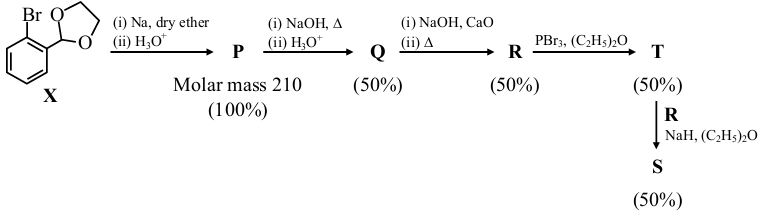
The reaction sequence given below is carried out with 16 moles of . The yield of the major product in each step is given below the product in parentheses.
The amount (in grams) of produced is . Use: Atomic mass (in amu):
 Answer: 175Step-by-step solution →
 - Question 43Chemistry· Practical Inorganic chemistry (Qualitative Analysis)
The correct match of the group reagents in List-I for precipitating the metal ion given in List-II from solutions, is
List-I List-II (P) Passing in the presence of (1) (Q) in the presence of (2) (R) in the presence of (3) (S) Passing in the presence of dilute HCl (4) (5) - Option A:
- Option B:
- Option C:
- Option D:
Answer: AStep-by-step solution → - Question 44Chemistry· Nitrogen Containing Organic Compounds
The major products obtained from the reactions in List-II are the reactants for the named reactions mentioned in List-I. Match each entry in List-I with the appropriate entry in
List-II and choose the correct options.
List-I List-II (P) Stephen reaction 
(Q) Sandmeyer reaction 
(R) Hoffmann bromamide degradation reaction 
(S) Cannizzaro reaction 

- Option A:
\
- Option B:
- Option C:
- Option D:
Answer: BStep-by-step solution → - Question 45Chemistry· Biomolecules
Match the compounds in List-I with the appropriate observations in List-II and choose the correct option
List-I List-II (P) 
(1) Reaction with phenyl diazonium salt gives yellow dye. (Q) 
(2) Reaction with ninhydrin gives purple color and it also reacts with to give violet color. ( R ) 
(3) Reaction with glucose will give corresponding hydrazone. (S) 
(4) Lassiagne extract of the compound treated with dilute HCl followed by addition of aqueous gives blood red color. (5) After complete hydrolysis, it will give ninhydrin test and it DOES NOT give positive phthalein dye test. - Option A:
- Option B:
- Option C:
- Option D:
Answer: BStep-by-step solution →
Stuck on one of these?
Practise questions like them — free, with a tutor that explains every step.