Mathematics · Functions

JEE Advanced 2025 — Paper 1 — Question 29

Let R\mathbb{R} denote the set of all real numbers. For a real number xx, let [x][x] denote the greatest integer less than or equal to xx. Let nn denote a natural number. Match each entry in List-I to the correct entry in List-II and choose the correct option.

List-IList-II
(P)The minimum value of nn for which the function f(x)=[10x3−45x2+60x+35n]f\left( x \right)=\left[ \frac{10{{x}^{3}}-45{{x}^{2}}+60x+35}{n} \right] is continuous on the interval [1,2]\left[ 1,2 \right], is(1)8
(Q)The minimum value of nn for which g(x)=(2n2−13n−15)(x3+3x),x∈Rg\left( x \right)=\left( 2{{n}^{2}}-13n-15 \right)\left( {{x}^{3}}+3x \right),x\in \mathbb{R}, is an increasing function on R\mathbb{R}, is(2)9
(R)The smallest natural number nn which is greater than 5 , such that x=3x=3 is a point of local minima of h(x)=(x2−9)n(x2+2x+3)h\left( x \right)={{\left( {{x}^{2}}-9 \right)}^{n}}\left( {{x}^{2}}+2x+3 \right), is(3)5
(S)Number of x0∈R{{x}_{0}}\in \mathbb{R} such that l(x)=∑k=04(sin∥x−k∥+cos∥x−k+12∥),x∈Rl\left( x \right)=\sum _{k=0}^{4}\left( \text{sin}\left\| x-k \right\|+\text{cos}\left\| x-k+\frac{1}{2} \right\| \right),\text{x}\in \mathbb{R}, is NOT differentiable at x0{{x}_{0}}, is(4)6
(5)10
  1. Option A:

    (P)→(1),(Q)→(3),(R)→(2),(S)→(5)(\mathrm{P}) \rightarrow(1),(\mathrm{Q}) \rightarrow(3),(\mathrm{R}) \rightarrow(2),(\mathrm{S}) \rightarrow(5)

  2. Option B:

    (P)→(2),(Q)→(1),(R)→(4),(S)→(3)(\mathrm{P}) \rightarrow(2),(\mathrm{Q}) \rightarrow(1),(\mathrm{R}) \rightarrow(4),(\mathrm{S}) \rightarrow(3)

    Correct
  3. Option C:

    })(P)→(5),(Q)→(1),(R)→(4),(S)→(3)(\mathrm{P}) \rightarrow(5),(\mathrm{Q}) \rightarrow(1),(\mathrm{R}) \rightarrow(4),(\mathrm{S}) \rightarrow(3)

  4. Option D:

    (P)→(2),(Q)→(3),(R)→(1),(S)→(5)(\mathrm{P}) \rightarrow(2),(\mathrm{Q}) \rightarrow(3),(\mathrm{R}) \rightarrow(1),(\mathrm{S}) \rightarrow(5)

Answer: B

Step-by-step solution

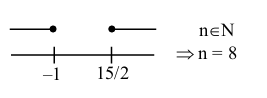
(P)   f(x)=[10x3−45x2+60x+35n],  F(1)=60,F(2)=55  ⟹  n=9\text{(P)\; } f(x)=\left[\frac{10x^3-45x^2+60x+35}{n}\right], \; F(1)=60, F(2)=55 \implies n=9 (Q)   g(x)=(2n2−13n−15)(x3+3x),  g′(x)=3(2n2−13n−15)(x2+1)>0  ⟹  n>7.5  ⟹  n=8\text{(Q)\; } g(x)=(2n^2-13n-15)(x^3+3x), \; g'(x)=3(2n^2-13n-15)(x^2+1)>0 \implies n>7.5 \implies n=8 (R)   h(x)=((x2−9)n)(x2+2x+3),  x=3 is   local   min     ⟹  n   even  ,n>5  ⟹  n=6\text{(R)\; } h(x)=((x^2-9)^n)(x^2+2x+3), \; x=3 \text{ is\; local\; min\; } \implies n\; \text{ even\;}, n>5 \implies n=6 (S)   l(x)=∑k=04(sin⁡∣x−k∣+cos⁡∣x−k+1/2∣), non-diff   at   x=0,1,2,3,4,−1/2,1/2,3/2,5/2,7/2  ⟹  10\text{(S)\; } l(x)=\sum_{k=0}^{4} (\sin|x-k|+\cos|x-k+1/2|), \text{ non-diff\; at\; } x=0,1,2,3,4,-1/2,1/2,3/2,5/2,7/2 \implies 10 Hence,   the   matching   is:    (P,  Q,  R,  S)⟶(9,8,6,10)\text{Hence,\; the\; matching\; is: \; } (P,\; Q,\; R,\; S) \longrightarrow (9, 8, 6, 10)
Solution figure

Answer key and solution verified before publishing.

Practise Functions

Start with this question, then two more from the same chapter — with a tutor that explains every step. Free.

Exam
JEE Advanced 2025
Paper
Paper 1
Subject
Mathematics
Chapter
Functions
Topic
Standard Functions