Mathematics · 3D Geometry

JEE Advanced 2025 — Paper 1 — Question 19

Let L1L_{1} be the line of intersection of the planes given by the equations 2x+3y+z=4 and x+2y+z=5.2 x+3 y+z=4 \text { and } x+2 y+z=5 . Let L2L_{2} be the line passing through

the point P(2,−1,3)P(2,-1,3) and parallel to L1L_{1}. Let MM denote the plane given by the equation 2x+y−2z=62 x+y-2 z=6 Suppose that the line L2L_{2} meets the plane MM at the point QQ

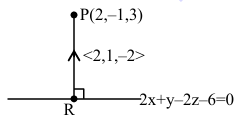
. Let RR be the foot of the perpendicular drawn from PP to the plane MM. Then which of the following statements is (are) TRUE ?

  1. Option A:

    The length of the line segment PQP Q is 939 \sqrt{3}

    Correct
  2. Option B:

    The length of the line segment QRQ R is 15

  3. Option C:

    The area of △PQR\triangle P Q R is 32234\frac{3}{2} \sqrt{234}

    Correct
  4. Option D:

    The acute angle between the line segments PQP Q and PRP R is cos⁡−1(123)\cos ^{-1}\left(\frac{1}{2 \sqrt{3}}\right)

Answer: A, C

Step-by-step solution

Let L1:r⃗=a⃗+tb⃗L_{1}: \vec{r}=\vec{a}+t \vec{b}

b⃗=∣i^j^k^231121∣=i^(1)−j^(1)+k^(1)\vec{b}=\left|\begin{array}{ccc}\hat{i} & \hat{j} & \hat{k} \\ 2 & 3 & 1 \\ 1 & 2 & 1\end{array}\right|=\hat{i}(1)-\hat{j}(1)+\hat{k}(1)

Dr's of L1:<1,−1,1>\mathrm{L}_{1}:<1,-1,1>

L1:x+11=y−0−1=z−61\mathrm{L}_{1}: \frac{\mathrm{x}+1}{1}=\frac{\mathrm{y}-0}{-1}=\frac{\mathrm{z}-6}{1}

L2:x−21=y+1−1=z−31=λ\mathrm{L}_{2}: \frac{\mathrm{x}-2}{1}=\frac{\mathrm{y}+1}{-1}=\frac{\mathrm{z}-3}{1}=\lambda

M : 2x+y−2z−6=02 \mathrm{x}+\mathrm{y}-2 \mathrm{z}-6=0

Let point on L2(λ+2,−λ−1,λ+3)\mathrm{L}_{2}(\lambda+2,-\lambda-1, \lambda+3)

2(λ+2)+(−λ−1)−2(λ+3)−6=02(\lambda+2)+(-\lambda-1)-2 (\lambda+3)-6=0

2λ+4−3λ−13=02 \lambda+4-3 \lambda-13=0

λ=−9\lambda=-9

∴Q(−7,8,−6)\therefore \mathrm{Q}(-7,8,-6)

Line PR: x−22=y+11=z−3−2=μ\frac{x-2}{2}=\frac{y+1}{1}=\frac{z-3}{-2}=\mu

R(2μ+2,μ−1,−2μ+3)\mathrm{R}(2 \mu+2, \mu-1,-2 \mu+3)

Put in plane 2(2μ+2)+(μ−1)−2(−2μ+3)−6=02(2 \mu+2)+(\mu-1)-2(-2 \mu+3)-6=0

4μ+4+μ−1+4μ−6−6=04 \mu+4+\mu-1+4 \mu-6-6=0

9μ−9=0⇒μ=19 \mu-9=0 \Rightarrow \mu=1

R(4,0,1)\mathrm{R}(4,0,1)\ P(2,−1,3)&Q(−7,8,−6)\mathrm{P}(2,-1,3) \& \mathrm{Q}(-7,8,-6)

PQ=81+81+81=93\mathrm{PQ}=\sqrt{81+81+81}=9 \sqrt{3}

Q(−7,8,−6)\mathrm{Q}(-7,8,-6) & R(4,0,1)\mathrm{R}(4,0,1)

QR=121+64+49=234\mathrm{QR}=\sqrt{121+64+49}=\sqrt{234}

Area ( △PQR\triangle \mathrm{PQR} )

=12∣QP→×QR→∣=\frac{1}{2}|\overrightarrow{\mathrm{QP}} \times \overrightarrow{\mathrm{QR}}|

=12∣i^j^k^9−9911−87∣=\frac{1}{2}\left|\begin{array}{ccc}\hat{\mathrm{i}} & \hat{\mathrm{j}} & \hat{\mathrm{k}} \\ 9 & -9 & 9 \\ 11 & -8 & 7\end{array}\right|

=32234=\frac{3}{2} \sqrt{234}

PQ→=−9i^+9j^−9k^=−9(i^−j^+k^)\overrightarrow{\mathrm{PQ}}=-9 \hat{\mathrm{i}}+9 \hat{\mathrm{j}}-9 \hat{\mathrm{k}}=-9(\hat{\mathrm{i}}-\hat{\mathrm{j}}+\hat{\mathrm{k}})

PR→=2i^+j^−2k^\overrightarrow{\mathrm{PR}}=2 \hat{\mathrm{i}}+\hat{\mathrm{j}}-2 \hat{\mathrm{k}}

cos⁡θ=∣PQ→⋅PR→PQ⋅PR∣\cos \theta=\left|\frac{\overrightarrow{\mathrm{PQ}} \cdot \overrightarrow{\mathrm{PR}}}{\mathrm{PQ} \cdot \mathrm{PR}}\right|

=993×3=133=\frac{9}{9 \sqrt{3} \times 3}=\frac{1}{3 \sqrt{3}}

θ=cos⁡−1(133)\theta=\cos ^{-1}\left(\frac{1}{3 \sqrt{3}}\right)

Solution figure

Answer key and solution verified before publishing.

Practise 3D Geometry

Start with this question, then two more from the same chapter — with a tutor that explains every step. Free.
Exam
JEE Advanced 2025
Paper
Paper 1
Subject
Mathematics
Chapter
3D Geometry
Topic
Introduction to 3D Geometry