Physics · Simple Harmonic Motion

JEE Advanced 2025 — Paper 1 — Question 1

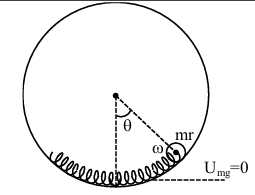
The center of a disk of radius rr and mass mm is attached to a spring of spring constant kk, inside a ring of radius R>rR>r as shown in the figure. The other end of the spring is attached on the periphery of the ring. Both the ring and the disk are in the same vertical plane. The disk can only roll along the inside periphery of the ring, without slipping. The spring can only be stretched or compressed along the periphery of the ring, following the Hooke's law. In equilibrium, the disk is at the bottom of the ring. Assuming small displacement of the disc, the time period of oscillation of center of mass of the disk is written as T=2πωT=\frac{2 \pi}{\omega}. The correct expression for ω\omega is ( gg is the acceleration due to gravity)

figure

  1. Option A:

    23(gR−r+km)\sqrt{\frac{2}{3}\left(\frac{g}{R-r}+\frac{k}{m}\right)}

    Correct
  2. Option B:

    2g3(R−r)+km\sqrt{\frac{2 g}{3(R-r)}+\frac{k}{m}}

  3. Option C:

    16(gR−r+km)\sqrt{\frac{1}{6}\left(\frac{g}{R-r}+\frac{k}{m}\right)}

  4. Option D:

    14(gR−r+km)\sqrt{\frac{1}{4}\left(\frac{g}{R-r}+\frac{k}{m}\right)}

Answer: A

Step-by-step solution

E=12k(R−r)2θ2+mg(R−r)(1−cos⁡θ)+12mv2+12mr22ω2\mathrm{E}=\frac{1}{2} \mathrm{k}(\mathrm{R}-\mathrm{r})^{2} \theta^{2}+\mathrm{mg}(\mathrm{R}-\mathrm{r})(1-\cos \theta)+\frac{1}{2} \mathrm{mv}^{2}+\frac{1}{2} \frac{\mathrm{mr}^{2}}{2} \omega^{2}

Differentiating wrt t , 0=12k(R−r)2⋅2θ dθdt+mg(R−r)⋅ddt(2θ24)+12 m⋅2vdvdt+mr24⋅2ω dωdt0=\frac{1}{2} \mathrm{k}(\mathrm{R}-\mathrm{r})^{2} \cdot 2 \theta \frac{\mathrm{~d} \theta}{\mathrm{dt}}+\mathrm{mg}(\mathrm{R}-\mathrm{r}) \cdot \frac{\mathrm{d}}{\mathrm{dt}}\left(2 \frac{\theta^{2}}{4}\right)+\frac{1}{2} \mathrm{~m} \cdot 2 \mathrm{v} \frac{\mathrm{dv}}{\mathrm{dt}}+\frac{\mathrm{mr}^{2}}{4} \cdot 2 \omega \frac{\mathrm{~d} \omega}{\mathrm{dt}}

⇒0=k(R−r)2θ dθdt+mg(R−r)θdθdt+mvdvdt+mr22ω dωdt\Rightarrow 0=\mathrm{k}(\mathrm{R}-\mathrm{r})^{2} \theta \frac{\mathrm{~d} \theta}{\mathrm{dt}}+\mathrm{mg}(\mathrm{R}-\mathrm{r}) \theta \frac{\mathrm{d} \theta}{\mathrm{dt}}+\mathrm{mv} \frac{\mathrm{dv}}{\mathrm{dt}}+\frac{\mathrm{mr}^{2}}{2} \omega \frac{\mathrm{~d} \omega}{\mathrm{dt}}

Also, dθdt=V(R−r)⇒d2θdt2=1(R−r)dvdt=1R−ra\frac{\mathrm{d} \theta}{\mathrm{dt}}=\frac{\mathrm{V}}{(\mathrm{R}-\mathrm{r})} \Rightarrow \frac{\mathrm{d}^{2} \theta}{\mathrm{dt}^{2}}=\frac{1}{(\mathrm{R}-\mathrm{r})} \frac{\mathrm{dv}}{\mathrm{dt}}=\frac{1}{\mathrm{R}-\mathrm{r}} \mathrm{a}

∴k(R−r)2⋅θ VR−r+mg(R−r)θVR−r=−mvαr−mr22vrα\therefore \mathrm{k}(\mathrm{R}-\mathrm{r})^{2} \cdot \theta \frac{\mathrm{~V}}{\mathrm{R}-\mathrm{r}}+\mathrm{mg}(\mathrm{R}-\mathrm{r}) \theta \frac{\mathrm{V}}{\mathrm{R}-\mathrm{r}}=-\mathrm{mv} \alpha \mathrm{r}-\frac{\mathrm{mr}^{2}}{2} \frac{\mathrm{v}}{\mathrm{r}} \alpha

⇒k(R−r)+mgθ=−32mrα\Rightarrow \mathrm{k}(\mathrm{R}-\mathrm{r})+\mathrm{mg} \theta=-\frac{3}{2} \mathrm{mr} \alpha

⇒−[k(R−r)+mg]θ=32 m(R−r)d2θdt2\Rightarrow-[\mathrm{k}(\mathrm{R}-\mathrm{r})+\mathrm{mg}] \theta=\frac{3}{2} \mathrm{~m}(\mathrm{R}-\mathrm{r}) \frac{\mathrm{d}^{2} \theta}{\mathrm{dt}^{2}} ⇒−23[km+gR−r]=d2θdt2\Rightarrow-\frac{2}{3}\left[\frac{\mathrm{k}}{\mathrm{m}}+\frac{\mathrm{g}}{\mathrm{R}-\mathrm{r}}\right]=\frac{\mathrm{d}^{2} \theta}{\mathrm{dt}^{2}}

Compering with standard equation of SHM ω=23[km+gR−r]\omega=\sqrt{\frac{2}{3}\left[\frac{\mathrm{k}}{\mathrm{m}}+\frac{\mathrm{g}}{\mathrm{R}-\mathrm{r}}\right]}

Hence answer is option(A) OR

kx+mgsin⁡θ−f=ma\mathrm{kx}+\mathrm{mg} \sin \theta-\mathrm{f}=\mathrm{ma} ⇒kx+mgx(R−r)−f=ma\Rightarrow \mathrm{kx}+\mathrm{mg} \frac{\mathrm{x}}{(\mathrm{R}-\mathrm{r})}-\mathrm{f}=\mathrm{ma}

fr=mr22⋅α⇒f=ma2\mathrm{fr}=\frac{\mathrm{mr}^{2}}{2} \cdot \alpha \Rightarrow \mathrm{f}=\frac{\mathrm{ma}}{2}

∴(α+mgR−r)x=3ma2\therefore\left(\alpha+\frac{\mathrm{mg}}{\mathrm{R}-\mathrm{r}}\right) \mathrm{x}=\frac{3 \mathrm{ma}}{2}

∴ω=23[km+gR−r]\therefore \omega=\sqrt{\frac{2}{3}\left[\frac{\mathrm{k}}{\mathrm{m}}+\frac{\mathrm{g}}{\mathrm{R}-\mathrm{r}}\right]}

Solution figure

Answer key and solution verified before publishing.

Practise Simple Harmonic Motion

Start with this question, then two more from the same chapter — with a tutor that explains every step. Free.

Exam
JEE Advanced 2025
Paper
Paper 1
Subject
Physics
Chapter
Simple Harmonic Motion
Topic
Miscellaneous Problems in SHM