Physics · Electromagnetic Induction

JEE Advanced 2025 — Paper 1 — Question 3

A conducting square loop of side LL, mass MM and resistance RR is moving in the XYX Y plane with its edges parallel to the XX and YY axes. The region y≥0y \geq 0 has a uniform magnetic

field, B⃗=B0k\vec{B}=B_{0} k. The magnetic field is zero everywhere else. At time t=0t=0, the loop starts to enter the magnetic field with an initial velocity v0ȷ^ m/sv_{0} \hat{\jmath} \mathrm{~m} / \mathrm{s}, as shown in the figure.

Considering the quantity K=B02L2RMK=\frac{B_{0}^{2} L^{2}}{R M} in appropriate units, ignoring self-inductance of the loop and gravity, which of the following statements is/are correct
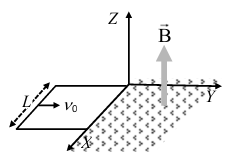
Question figure
  1. Option A:

    If v0=1.5KLv_{0}=1.5 K L, the loop will stop before it enters completely inside the region of magnetic field

  2. Option B:

    When the complete loop is inside the region of magnetic field, the net force acting on the loop is zero.

    Correct
  3. Option C:

    If v0=KL10v_{0}=\frac{K L}{10}, the loop comes to rest at t=(1K)ln⁡(52)t=\left(\frac{1}{K}\right) \ln \left(\frac{5}{2}\right).

  4. Option D:

    If v0=3KLv_{0}=3 K L, the complete loop enters inside the region of magnetic field at time t=(1K)ln⁡(32)t=\left(\frac{1}{K}\right) \ln \left(\frac{3}{2}\right).

    Correct

Answer: B, D

Step-by-step solution

figure

⇒−dϕdt=ddt(B0×ℓ×y)=BVℓ\Rightarrow \frac{-\mathrm{d} \phi}{\mathrm{dt}}=\frac{\mathrm{d}}{\mathrm{dt}}\left(\mathrm{B}_{0} \times \ell \times \mathrm{y}\right)=\mathrm{BV} \ell F→=B(i^)(ℓ)(−j^)\overrightarrow{\mathrm{F}}=\mathrm{B}(\hat{\mathrm{i}})(\ell)(-\hat{\mathrm{j}})

ma=−B0[ B0 VℓR](ℓ)\mathrm{ma}=-\mathrm{B}_{0}\left[\frac{\mathrm{~B}_{0} \mathrm{~V} \ell}{\mathrm{R}}\right](\ell)

a=−B02ℓ2 VmR\mathrm{a}=-\frac{\mathrm{B}_{0}^{2} \ell^{2} \mathrm{~V}}{\mathrm{mR}}

Also K=B02ℓ2 VRM\mathrm{K}=\frac{\mathrm{B}_{0}^{2} \ell^{2} \mathrm{~V}}{\mathrm{RM}}

So [a=−kv][\mathrm{a}=-\mathrm{kv}]

dvdt=−kv\frac{\mathrm{dv}}{\mathrm{dt}}=-\mathrm{kv}

∫v0vdvdt=∫0t−kdt\int_{v_{0}}^{v} \frac{d v}{d t}=\int_{0}^{t}-k d t

ℓnVV0=−kt\ell \mathrm{n} \frac{\mathrm{V}}{\mathrm{V}_{0}}=-\mathrm{kt}

[v=v0e−kt]\left[\mathrm{v}=\mathrm{v}_{0} \mathrm{e}^{-\mathrm{kt}}\right]

dxdt=v0e−kt(x≤ℓ)\frac{d x}{d t}=v_{0} e^{-k t} \quad(x \leq \ell)

∫0xdx=∫0tv0e−ktdt\int_{0}^{x} d x=\int_{0}^{t} v_{0} e^{-k t} d t

=V0k(1−e−kt)=\frac{\mathrm{V}_{0}}{\mathrm{k}}\left(1-\mathrm{e}^{-\mathrm{kt}}\right)

When x=ℓ\mathrm{x}=\ell

ℓ=v0k(1−e−kt)\ell=\frac{\mathrm{v}_{0}}{\mathrm{k}}\left(1-\mathrm{e}^{-\mathrm{kt}}\right)

Option (D) (v0=3kℓ)\left(\mathrm{v}_{0}=3 \mathrm{k} \ell\right)

ℓ=3kℓk(1−e−kt)\ell=\frac{3 \mathrm{k} \ell}{\mathrm{k}}\left(1-\mathrm{e}^{-\mathrm{kt}}\right)

13=1−e−kt\frac{1}{3}=1-\mathrm{e}^{-\mathrm{kt}}

f23=2e−ktf \frac{2}{3}=2 e^{-k t}

−kt=8n(23)-\mathrm{kt}=8 \mathrm{n}\left(\frac{2}{3}\right)

t=1kln⁡(23)\mathrm{t}=\frac{1}{\mathrm{k}} \ln \left(\frac{2}{3}\right)

Complete loop will enter at t=1kln⁡(23)\mathrm{t}=\frac{1}{\mathrm{k}} \ln \left(\frac{2}{3}\right)

Option (B) dϕdt=0,e‾‾=0,i=0, F=0\frac{\mathrm{d} \phi}{\mathrm{dt}}=0, \underline{\underline{\mathrm{e}}}=0, \mathrm{i}=0, \mathrm{~F}=0

Ans. B,D)

Solution figure

Answer key and solution verified before publishing.

Practise Electromagnetic Induction

Start with this question, then two more from the same chapter — with a tutor that explains every step. Free.

Exam
JEE Advanced 2025
Paper
Paper 1
Subject
Physics
Chapter
Electromagnetic Induction
Topic
Motional EMF