JEE Advanced 2023 · previous year paper
JEE Advanced 2023 — Paper 1
43 questions with the verified answer key. Open any question for its step-by-step solution.
- Question 1Mathematics· Application of Derivatives
Let and . Then which of the following statements is(are) true?
- Option A:
There are infinitely many functions from S to T
- Option B:
There are infinitely many strictly increasing functions from S to T
- Option C:
The number of continuous functions from S to T is at most 120
- Option D:
Every continuous function from S to T is differentiable
Answer: A, C, DStep-by-step solution → - Question 2Mathematics· Ellipse
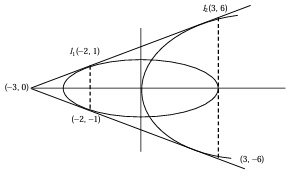
Let and be two distinct common tangents to the ellipse and the parabola .Suppose that the tangent touches and at the points and , respectively and the tangent touches P and E at the points and , respectively. Then which of the following statements is(are) true?
- Option A:
The area of the quadrilateral is 35 square units
- Option B:
The area of the quadrilateral is 36 square units
- Option C:
The tangents and meet the x -axis at the point
- Option D:
The tangents and meet the x -axis at the point
Answer: A, CStep-by-step solution → - Question 3Mathematics· Area under the Curves
Let be the function defined by . Consider the square region . Let be called the green region and be called the red region. Let be the horizontal line . Consider the statements:
- Option A:
There exists an such that the area of the green region above the line equals the area of the green region below the line
- Option B:
There exists an such that the area of the red region above the line equals the area of the red region below the line
- Option C:
There exists an such that the area of the green region above the line equals the area of the red region below the line
- Option D:
There exists an such that the area of the red region above the line equals the area of the green region below the line
Answer: B, CStep-by-step solution → - Question 4Mathematics· 3D Geometry
Let be the cube with the set of vertices . Let be the set of all
twelve lines containing the diagonals of the six faces of the cube Q . Let S be the set of all four lines containing the
main diagonals of the cube Q ; for instance, the line passing through the vertices and is in S .
For lines and , let denote the shortest distance between them. Then the maximum value of
as varies over F and varies over S , is
- Option A:
- Option B:
- Option C:
- Option D:
Answer: AStep-by-step solution → - Question 5Mathematics· Probability
Let and . Three distinct points and are randomly
chosen from X . Then the probability that and R form a triangle whose area is a positive integer, is
- Option A:
- Option B:
- Option C:
- Option D:
Answer: BStep-by-step solution → - Question 6Mathematics· Parabola
Let P be a point on the parabola , where . The normal to the parabola at P meets the x -axis at a point Q . The area of the triangle PFQ , where F is the focus of the parabola, is 120 . If the slope m of the normal and a are both positive integers, then the pair is
- Option A:
- Option B:
- Option C:
- Option D:
Answer: AStep-by-step solution → - Question 7Mathematics· Inverse Trigonometric Functions
Let , for . Then the number of real solutions of the equation
in the set is equal to
Answer: 3Step-by-step solution → - Question 8Mathematics· Area under the Curves
Let be a natural number and be the function defined by
If n is such that the area of the region bounded by the curves and is 4 , then the
maximum value of the function is
Answer: 8Step-by-step solution → - Question 9Mathematics· Sequence and Series
Let denote the digit number where the first and the last digits are 7 and the remaining digits are 5. Consider the sum . If , where m and n are natural numbers less than 3000 , then the value of is
Answer: 1219Step-by-step solution → - Question 10Mathematics· Complex Numbers
Let . If contains exactly one positive integer , then the value of is
Answer: 281Step-by-step solution → - Question 11Mathematics· Vector Algebra
Let be the plane and let and the distance of
from the plane is . Let and be three distinct vectors in S such that
. Let V be the volume of the parallelepiped determined by vectors, and .
Then the value of is
Answer: 45Step-by-step solution → - Question 12Mathematics· Binomial Theorem
Let a and be two nonzero real numbers. If the coefficient of in the expansion of is equal to
the coefficient of in the expansion of , then the value of 2 b is
Answer: 3Step-by-step solution → - Question 13Mathematics· Determinants
Let and be real numbers. Consider the following system of linear equations Match each entry in List-I to the correct entries in List-II.
LIST-I LIST-II P) If and , then the system has 1)A unique solution Q) If and , then the system has 2) No solution R) If where and , then the system has 3) Infinitely many soliutions S) If where and , then the system has 4) and as a solution 5) and as a solution - Option A:
& & &
- Option B:
& & &
- Option C:
& & &
- Option D:
& & &
Answer: AStep-by-step solution → - Question 14Mathematics· Statistics
Consider the given data with frequency distribution
Match each entry in List-I to the correct entries in List-II. The correct option is:
LIST-I LIST-II P) The mean of the above data is 1) 2.5 Q) The median of the above data is 2) 5 R) The mean deviation about the eman of the above data is 3) 6 S) The mean deviation about the median of the above data is 4) 2.7 5) 2.4 - Option A:
(P) (3)(\mathrm{Q}) \rightarrow(2)$$(\mathrm{R}) \rightarrow(4)$$(\mathrm{S}) \rightarrow(5)
- Option B:
\(Q) (2)\\(S) (5)
- Option C:
\(Q) (3)\\
- Option D:
(Q) (3)(\mathrm{R}) \rightarrow(5)$$(\mathrm{S}) \rightarrow(5)
Answer: AStep-by-step solution → - Question 15Mathematics· 3D Geometry
Let and be the lines and , respectively. Let X be the set of all the planes H that contain the line . For a plane H , let denote the smallest possible distance between the points of and H . Let be a plane in X for which is the maximum value of as H varies over all planes in X .Match each entry in List-I to the correct entries in List-II.
LIST-I LIST-II (P) The value of is 1) (Q) The distance of the point from is 2) (R) The distance of origin from is 3) 0 (S) The distance of origin from the point of intersection of planes and is 4) 5) - Option A:
(S)
- Option B:
(S) (1)
- Option C:
(S) (2)
- Option D:
(S) (2)
Answer: BStep-by-step solution → - Question 16Mathematics· Complex Numbers
Let z be a complex number satisfying , where denotes the complex conjugate of z . Let the imaginary part of z be nonzero. Match each entry in List-I to the correct entries in List-II.
LIST-I LIST-II P) 1) 12 Q) is equal to 2) 4 R) is equal to 3) 8 S) 4) 10 5) 7 - Option A:
(P) \rightarrow(1),$$(\mathrm{Q}) \rightarrow(3) , (\mathrm{R}) \rightarrow(5) ,\quad(\mathrm{S}) \rightarrow(4)
- Option B:
,,
- Option C:
,,,(S) (1)
- Option D:
,,,(S) (4)
Answer: BStep-by-step solution → - Question 17Physics· Motion in Plane
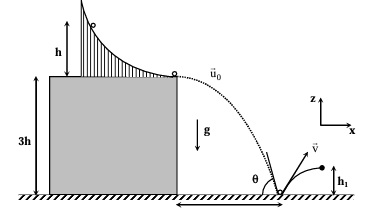
A slide with a frictionless curved surface, which becomes horizontal at its lower end, is fixed on the terrace of a building of height 3 h from the ground, as shown in the figure. A spherical ball of mass m is released on the slide from rest at a height from the top of the terrace. The ball leaves the slide with a velocity and falls on the ground at a distance d from the building making an angle with the horizontal. It bounces off with a velocity and reaches a maximum height . The acceleration due to gravity is and the coefficient of restitution of the ground is . Which of the following statement(s) is(are) correct?
- Option A:
- Option B:
- Option C:
- Option D:
Answer: A, C, DStep-by-step solution → - Question 18Physics· Geometrical Optics
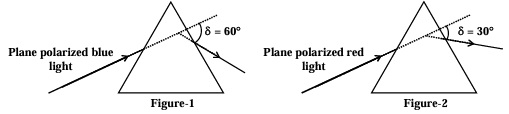
A plane polarized blue light ray is incident on a prism such that there is no reflection from the surface of the prism. The angle of deviation of the emergent ray is (see Figure-1). The angle of minimum deviation for red light from the same prism is (see Figure-2). The refractive index of the prism material for blue light is . Which of the following statement(s) is(are) correct?
- Option A:
The blue light is polarized in the plane of incidence
- Option B:
The angle of the prism is .
- Option C:
The refractive index of the material of the prism for red light is .
- Option D:
The angle of refraction for blue light in air at the exit plane of the prism is
Answer: A, B, DStep-by-step solution → - Question 19Physics· Capacitors and R-C Circuits
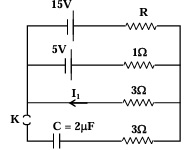
In a circuit shown in the figure, the capacitor C is initially uncharged and the key K is open. In this condition, a current of 1 A flows through the resistor. The key is closed at time . Which of the following statement(s) is(are) correct? [Given: ]
- Option A:
The value of the resistance of R is
- Option B:
For , the value of current is
- Option C:
, the current in the capacitor is 0.6 A
- Option D:
For , the charge on the capacitor is .
Answer: A, B, C, DStep-by-step solution → - Question 20Physics· Rotational Dynamics
A bar of mass and length is lying on a horizontal frictionless surface. One end of the bar is pivoted at a point about which it is free to rotate. A small mass is moving on the same horizontal surface with speed on a path perpendicular to the bar. It hits the bar at a distance from the pivoted end and returns back on the same path with speed v. After this elastic collision, the bar rotates with an angular velocity . Which of the following statement is correct?
- Option A:
and
- Option B:
and
- Option C:
and
- Option D:
and
Answer: AStep-by-step solution → - Question 21Physics· Capacitors and R-C Circuits
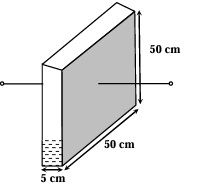
A container has a base of and height 50 cm , as shown in the figure. It has two parallel electrically
conducting walls each of area . The remaining walls of the container are thin and non-conducting.
The container is being filled with a liquid of dielectric constant 3 at a uniform rate of 250 . What is the
value of the capacitance of the container after 10 seconds? [Given: Permittivity of free space
, the effects of the non-conducting walls on the capacitance are negligible
- Option A:
27 pF
- Option B:
63 pF
- Option C:
81 pF
- Option D:
135 pF
Answer: BStep-by-step solution → - Question 22Physics· Thermodynamics
One mole of an ideal gas expands adiabatically from an initial state ( ) to final state . Another mole of the same gas expands isothermally from a different initial state to the same final state . The ratio of the specific heats at constant pressure and constant volume of this ideal gas is . What is the ratio ?
- Option A:
- Option B:
- Option C:
- Option D:
Answer: AStep-by-step solution → - Question 23Physics· Gravitation
Two satellites P and Q are moving in different circular orbits around the Earth (radius R). The heights of P and from the Earth surface are and , respectively, where . The accelerations of and due to Earth's gravity are and , respectively. If , what is the value of ?
- Option A:
- Option B:
- Option C:
- Option D:
Answer: AStep-by-step solution → - Question 24Physics· Atomic Physics
A Hydrogen-like atom has atomic number Z. Photons emitted in the electronic transitions from level to level in these atoms are used to perform photoelectric effect experiment on a target metal. The maximum kinetic energy of the photoelectrons generated is 1.95 eV . If the photoelectric threshold wavelength for the target metal is 310 nm , the value of Z is [0pt] [Given: hc and , where R is the Rydberg constant, h is the Planck's constant and is the speed of light in vacuum]
Answer: 3Step-by-step solution → - Question 25Physics· Geometrical Optics
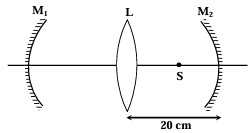
An optical arrangement consists of two concave mirrors and , and a convex lens L with a common principal axis, as shown in the figure. The focal length of is 10 cm . The radii of curvature of and are 20 cm and 24 cm , respectively. The distance between and is 20 cm . A point object is placed at the mid-point between and on the axis. When the distance between and is , one of the images coincides with . The value of is
 Answer: 220Step-by-step solution →
 - Question 26Physics· Units, Dimensions & Error Analysis
In an experiment for determination of the focal length of a thin convex lens, the distance of the object from the lens is and the distance of its real image from the lens is . The error in the determination of focal length of the lens is . The value of is
Answer: 1Step-by-step solution → - Question 27Physics· Thermodynamics
A closed container contains a homogeneous mixture of two moles of an ideal monatomic gas and one mole of an ideal diatomic gas . Here, is the ratio of the specific heats at constant pressure and constant volume of an ideal gas. The gas mixture does a work of 66 Joule when heated at constant pressure. The change in its internal energy is Joule.
Answer: 121Step-by-step solution → - Question 28Physics· Motion in one Dimension
A person of height 1.6 m is walking away from a lamp post of height 4 m along a straight path on the flat ground. The lamp post and the person are always perpendicular to the ground. If the speed of the person is , The speed of the tip of the person's shadow on the ground with respect to the person is
Answer: 40Step-by-step solution → - Question 29Physics· Simple Harmonic Motion
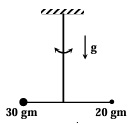
Two point-like objects of masses 20 gm and 30 gm are fixed at the two ends of a rigid massless rod of length 10 cm . This system is suspended vertically from a rigid ceiling using a thin wire attached to its center of mass, as shown in the figure. The resulting torsional pendulum undergoes small oscillations. The torsional constant of the wire is . The angular frequency of the oscillations in . The value of n is
 Answer: 10Step-by-step solution →
 - Question 30Physics· Nuclear Physics
List-I shows different radioactive decay processes and List-II provides possible
emitted particles. Match each entry in List-I with an appropriate entry from List-II, and choose the correct option.
LIST-I LIST-II P) 1) one particle and one particle Q) 2) three particles and one particle R) & 3) two particles and one particle S) 4) one particle and one particle 5) one particle and two particles - Option A:
- Option B:
- Option C:
- Option D:
Answer: AStep-by-step solution → - Question 31Physics· Heat Transfer
Match the temperature of a black body given in List-I with an appropriate statement in List-II, and choose the correct option. [Given: Wien's constant as and ]
LIST-I LIST-II P) 2000 K 1) The radiation at peak wavelength can lead to emission of photoelectrons from a metal of work function 4 eV Q) 3000 K 2) The radiation at peak wavelength is visible to human eye. R) 5000 K 3) The radiation at peak emission wavelength will result in the widest central maximum of a single slit diffraction S) 10000 K 4) The power emitted per unit area is of that emitted by a blackbody at temperature 6000 K. 5) The radiation at peak emission wavelength can be used to - Option A:
- Option B:
- Option C:
- Option D:
Answer: CStep-by-step solution → - Question 32Physics· Alternating Current
A series LCR circuit is connected to a Volt source. The resonant angular frequency of the circuit is and current amplitude at resonance is . When the angular frequency of the source is , the current amplitude in the circuit is . If , match each entry in List-I with an appropriate value from List-II and choose the correct option
LIST-I LIST-II P) in mA & 1) 44.4 Q) The quality factor of the circuit 2) 18 R) The bandwidth of the circuit in rad s s 3) 400 S) The peak power dissipated at resonance in Watt 4) 2250 5) 500 - Option A:
- Option B:
- Option C:
- Option D:
Answer: BStep-by-step solution → - Question 33Physics· Electromagnetic Induction
A thin conducting rod MN of mass 20 gm , length 25 cm and resistance is held on frictionless, long, perfectly conducting vertical rails as shown in the figure. There is a uniform magnetic field directed perpendicular to the plane of the rod-rail arrangement. The rod is released from rest at time and it moves down along the rails. Assume air drag is negligible. Match each quantity in List-I with an appropriate value from List-II, and choose the correct option.[0pt] [Given: The acceleration due to gravity and ]
LIST-I LIST-II P) At , the magnitude of the induced emf in Volt 1) 0.07 Q) At , the magnitude of the magnetic force in Newton 2) 0.14 R) At s, the power dissipated as heat in Watt 3) 1.20 S) The magnitude of terminal velocity of the rod in 4) 0.12 5) 2.00 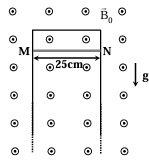
- Option A:
- Option B:
- Option C:
- Option D:
Answer: DStep-by-step solution → - Question 34Chemistry· Practical Inorganic chemistry (Qualitative Analysis)
In the scheme given below, and , respectively, are
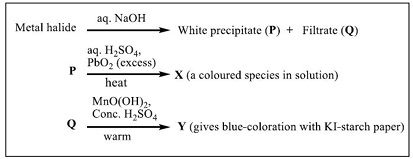
- Option A:
and
- Option B:
and
- Option C:
and
- Option D:
and HOCl
Answer: CStep-by-step solution → - Question 35Chemistry· Electrochemistry
Plotting against for aqueous solutions of a monobasic weak acid (HX) resulted in a straight line with y -axis intercept of P and slope of S . The ratio is [ molar conductivity limiting molar conductivity molar concentration dissociation constant of HX]
- Option A:
- Option B:
- Option C:
- Option D:
Answer: AStep-by-step solution → - Question 36Chemistry· Ionic Equilibrium
On decreasing the pH from 7 to 2, the solubility of a sparingly soluble salt (MX) of a weak acid (HX) increased from to . The of HX is
- Option A:
3
- Option B:
4
- Option C:
5
- Option D:
2
Answer: BStep-by-step solution → - Question 37Chemistry· Alcohols, Ethers and Phenols
In the given reaction scheme, is a phenyl alkyl ether, is an aromatic compound; and are the major products.The correct statement about is

- Option A:
It primarily inhibits noradrenaline degrading enzymes
- Option B:
It inhibits the synthesis of prostaglandin
- Option C:
It is a narcotic drug
- Option D:
It is ortho-acetylbenzoic acid.
Answer: BStep-by-step solution → - Question 38Chemistry· Some Basic Concepts of Chemistry (Mole Concept) + Stoichiometry
The stoichiometric reaction of of dimethyldichlorosilane with water results in a tetrameric cyclic product in yield. The weight (in ) of obtained is . [Given: molar mass ]
Answer: 222Step-by-step solution → - Question 39Chemistry· States of Matter - Gaseous State
A gas has a compressibility factor of 0.5 and a molar volume of at a temperature of 800 K and pressure atm. If it shows ideal gas behaviour at the same temperature and pressure, the molar volume will be dna nol . The value of is - [Use: Gas constant, atm nol ]
Answer: 100Step-by-step solution → - Question 40Chemistry· Chemical Equilibrium
The plot of versus for a reversible reaction is shown Pre-exponential factors for the forward and backward reactions are and , respectively. If the value of for the reaction at 500 K is 6 , the value of at 250 K is . [ equilibrium constant of the reaction rate constant of forward reaction rate constant of backward reaction]
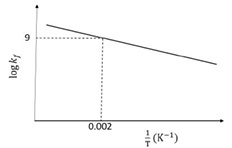 Answer: 5Step-by-step solution →
 - Question 41Chemistry· Thermodynamics & Thermochemistry
One mole of an ideal monoatomic gas undergoes two reversible processes ( and ) as shown in the given figure: is an adiabatic process. If the total heat absorbed in the entire process ( and ) is , the value of is —. [Use, molar heat capacity of the gas at constant pressure, ]
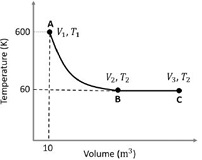 Answer: 7Step-by-step solution →
 - Question 42Chemistry· Thermodynamics & Thermochemistry
In a one-litre flask, 6 moles of A undergoes the reaction (g). The progress of product formation at two temperatures (in Kelvin), and , is shown in the figure: If and , then the value of is . [ and are standard Gibb's free energy change for the reaction at temperatures and , respectively.]
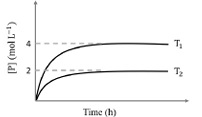 Answer: 8Step-by-step solution →
 - Question 43Chemistry· p-Block Elements (Group 15-18)
Match the reactions (in the given stoichiometry of the reactants) in List-I with one of their products given in List-II
and choose the correct option.
LIST-I LIST-II P) Q) R) S) - Option A:
;
- Option B:
; Q ; R ;
- Option C:
; Q ;
- Option D:
;
Answer: DStep-by-step solution →
Stuck on one of these?
Practise questions like them — free, with a tutor that explains every step.