JEE Advanced 2023 · previous year paper
JEE Advanced 2023 — Paper 2
44 questions with the verified answer key. Open any question for its step-by-step solution.
- Question 1Mathematics· Definite Integration
Let be a differentiable function such that and , . Let e denote the base of the natural logarithm. Then the value of is
- Option A:
- Option B:
- Option C:
- Option D:
Answer: CStep-by-step solution → - Question 2Mathematics· Probability
Consider an experiment of tossing a coin repeatedly until the outcomes of two consecutive tosses are same. If the probability of a random toss resulting in head is , then the probability that the experiment stops with head is
- Option A:
- Option B:
- Option C:
- Option D:
0
Answer: BStep-by-step solution → - Question 3Mathematics· Inverse Trigonometric Functions
For any , let and . Then the sum of all the solutions of the
equation for , is equal to
- Option A:
- Option B:
- Option C:
- Option D:
Answer: CStep-by-step solution → - Question 4Mathematics· Vector Algebra
Let the position vectors of the points and be ,
and , respectively. Then which of the following statements is true?
- Option A:
The points and are NOT coplanar
- Option B:
is the position vector of a point which divides internally in the ratio
- Option C:
is the position vector of a point which divides externally in the ratio
- Option D:
The square of the magnitude of the vector is 95
Answer: BStep-by-step solution → - Question 5Mathematics· Matrices
Let , be the matrix such that if is divisible by , otherwise
aij . Then which of the following statements is(are) true?
- Option A:
is invertible
- Option B:
There exists a nonzero column matrix and such that
- Option C:
The set , where
- Option D:
The matrix is invertible, where is the identity matrix
Answer: B, CStep-by-step solution → - Question 6Mathematics· Limits, Continuity and Differentiability
Let be the function defined as , where denotes the greatest
integer less than or equal to x . Then which of the following statements is(are) true?
- Option A:
The function is discontinuous exactly at one point in
- Option B:
There is exactly one point in at which the function is continuous but NOT differentiable
- Option C:
The function f is NOT differentiable at more than three points in
- Option D:
The minimum value of the function f is
Answer: A, BStep-by-step solution → - Question 7Mathematics· Application of Derivatives
Let be the set of all twice differentiable functions from to such that for all . For , let be the number of points for which . Then which of the following statements is(are) true?
- Option A:
There exists a function such that
- Option B:
For every function , we have
- Option C:
There exists a function such that
- Option D:
There does NOT exist any function in such that
Answer: A, B, CStep-by-step solution → - Question 8Mathematics· Definite Integration
For , let . Then the minimum value of the function defined by
is
Answer: 0Step-by-step solution → - Question 9Mathematics· Differential Equations
For , let be a solution of the differential equation such that
. Then the maximum value of the function is
Answer: 16Step-by-step solution → - Question 10Mathematics· Probability
Let be the set of all five digit numbers formed using 1, 2, 2, 2, 4, 4, 0. For example, 22240 is in while 02244 and 44422 are not in . Suppose that each element of has an equal chance of being chosen. Let be the conditional probability that an element chosen at random is a multiple of 20 given that it is a multiple of 5 . Then the value of is equal to
Answer: 31Step-by-step solution → - Question 11Mathematics· Complex Numbers
Let be the vertices of a regular octagon that lie on a circle of radius 2 . Let P be a point on the circle and let denote the distance between the points and for . If varies over the circle, then the maximum value of the product , is
Answer: 512Step-by-step solution → - Question 12Mathematics· Permutations and Combinations
Let . Then the number of invertible matrices in R is
Answer: 3780Step-by-step solution → - Question 13Mathematics· Circles
Let be the circle of radius 1 with center at the origin. Let be the circle of radius with center at the point , where . Two distinct common tangents and of and are drawn. The tangent touches at and at . The tangent touches at and at . Mid points of the line segments and are joined to form a line which meets the -axis at a point . If , then the value of is
Answer: 2Step-by-step solution → - Question 14Physics· Electrostatics
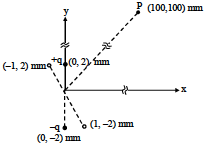
An electric dipole is formed by two charges +q and -q located in xy-plane at and , respectively, as shown in the figure. The electric potential at point due to the dipole is . The charges +q and -q are then moved to the points and , respectively. What is the value of electric potential at due to the new dipole?
- Option A:
- Option B:
- Option C:
- Option D:
Answer: BStep-by-step solution → - Question 15Physics· Units, Dimensions & Error Analysis
Young's modulus of elasticity Y is expressed in terms of three derived quantities, namely, the gravitational constant G, Planck's constant and the speed of light , as . Which of the following is the correct option?
- Option A:
- Option B:
- Option C:
- Option D:
Answer: AStep-by-step solution → - Question 16Physics· Motion in one Dimension
A particle of mass is moving in the -plane such that its velocity at a point is given as
, where is a non-zero constant. What is the force acting on the particle?
- Option A:
- Option B:
- Option C:
- Option D:
Answer: AStep-by-step solution → - Question 17Physics· Kinetic Theory of Gases
An ideal gas is in thermodynamic equilibrium. The number of degrees of freedom of a molecule of the gas is . The internal energy of one mole of the gas is and the speed of sound in the gas is . At a fixed temperature and pressure, which of the following is the correct option ?
- Option A:
and
- Option B:
and
- Option C:
and
- Option D:
and
Answer: CStep-by-step solution → - Question 18Physics· Geometrical Optics
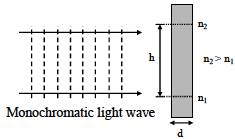
A monochromatic light wave is incident normally on a glass slab of thickness d, as shown in the figure. The refractive index of the slab increases linearly from to over the height . Which of the following statement(s) is(are) true about the light wave emerging out of the slab?
- Option A:
It will deflect up by an angle
- Option B:
It will deflect up by an angle .
- Option C:
It will not deflect
- Option D:
The deflection angle depends only on and not on the individual values of and .
Answer: B, DStep-by-step solution → - Question 19Physics· Rotational Dynamics
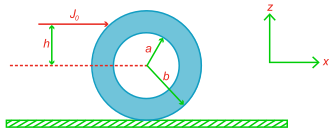
An annular disk of mass M , inner radius a and outer radius b is placed on a horizontal surface with coefficient of friction , as shown in the figure. At some time, an impulse is applied at a height above the center of the disk. If then the disk rolls without slipping along the -axis. Which of the following statement(s) is(are) correct?
- Option A:
For and
- Option B:
For and
- Option C:
For , the initial angular velocity does not depend on the inner radius a.
- Option D:
For and , the wheel always slides without rolling.
Answer: A, B, C, DStep-by-step solution → - Question 20Physics· Electromagnetic Waves
The electric field associated with an electromagnetic wave propagating in a dielectric medium is given by
. Which of the following option(s) is(are) correct ? [Given: The speed of light in vacuum, ]
- Option A:
.
- Option B:
- Option C:
The wave is polarized in the -plane with polarization angle with respect to the -axis
- Option D:
The refractive index of the medium is 2
Answer: A, DStep-by-step solution → - Question 21Physics· Rotational Dynamics
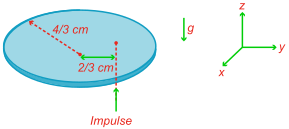
A thin circular coin of mass 5 gm and radius is initially in a horizontal xy -plane. The coin is tossed vertically up ( +z direction) by applying an impulse of -s at a distance from its center. The coin spins about its diameter and moves along the +z direction. By the time the coin reaches back to its initial position, it completes rotations. The value of is -. [Given: The acceleration due to gravity ]
 Answer: 30Step-by-step solution →
 - Question 22Physics· Electromagnetic Induction
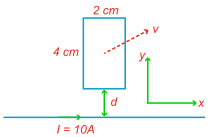
A rectangular conducting loop of length 4 cm and width 2 cm is in the xy-plane, as shown in the figure. It is being moved away from a thin and long conducting wire along the direction with a constant speed v . The wire is carrying a steady current in the positive x-direction. A current of flows through the loop when it is at a distance from the wire. If the resistance of the loop is , then the value of is . [Given: The permeability of free space ]
 Answer: 4Step-by-step solution →
 - Question 23Physics· Transverse waves
A string of length 1 m and mass is under tension . When the string vibrates, two successive harmonics are found to occur at frequencies 750 Hz and 1000 Hz . The value of tension is Newton.
Answer: 5Step-by-step solution → - Question 24Physics· Mechanical Properties of Matter
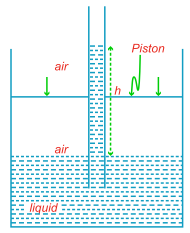
An incompressible liquid is kept in a container having a weightless piston with a hole. A capillary tube of inner radius 0.1 mm is dipped vertically into the liquid through the airtight piston hole, as shown in the figure. The air in the container is isothermally compressed from its original volume to with the movable piston. Considering air as an ideal gas, the height (h) of the liquid column in the capillary above the liquid level in cm is . [Given: Surface tension of the liquid is , atmospheric pressure is , acceleration due to gravity is , density of the liquid is and contact angle of capillary surface with the liquid is zero]
 Answer: 25Step-by-step solution →
 - Question 25Physics· Nuclear Physics
In a radioactive decay process, the activity is defined as , where is the number of radioactive nuclei at time . Two radioactive sources, and have same activity at time . At a later time, the activities of and are and , respectively. When and have just completed their and half-lives, respectively, the ratio is
Answer: 16Step-by-step solution → - Question 26Physics· Thermodynamics
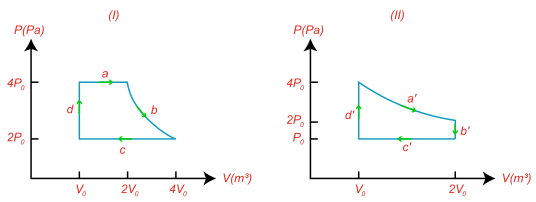
One mole of an ideal gas undergoes two different cyclic processes I and II, as shown in the diagrams below. In cycle I, processes a, b, c and d are isobaric, isothermal, isobaric and isochoric, respectively. In cycle II, processes , , and are isothermal, isochoric, isobaric and isochoric, respectively. The total work done during cycle I is and that during cycle II is . The ratio / is .
 Answer: 2Step-by-step solution →
 - Question 27Chemistry· Surface Chemistry
Consider the following statements related to colloids. (I) Lyophobic colloids are not formed by simple mixing of dispersed phase and dispersion medium. (II) For emulsions, both the dispersed phase and the dispersion medium are liquid. (III) Micelles are produced by dissolving a surfactant in any solvent at any temperature. (IV) Tyndall effect can be observed from a colloidal solution with dispersed phase having the same refractive index as that of the dispersion medium.
- Option A:
(I) and (II)
- Option B:
(II) and (III)
- Option C:
(III) and (IV)
- Option D:
(II) and (IV)
Answer: AStep-by-step solution → - Question 28Chemistry· Biomolecules
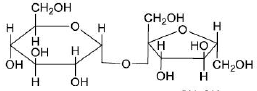
A disaccharide cannot be oxidised by bromine water. The acid hydrolysis of leads to a laevorotatory solution. The disaccharide is
- Option A:
- Option B:
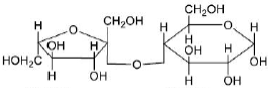
- Option C:
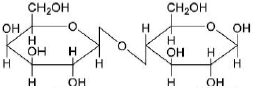
- Option D:
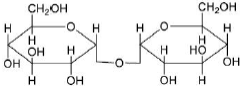
Answer: AStep-by-step solution → - Question 29Chemistry· Coordination Compounds
The complex(es), which can exhibit the type of isomerism shown by , is(are) [en ]
- Option A:
- Option B:
- Option C:
- Option D:
Answer: C, DStep-by-step solution → - Question 30Chemistry· Solid State
Atoms of metals , and z form face-centred cubic (fcc) unit cell of edge length , body-centred cubic (bcc)
unit cell of edge length , and simple cubic unit cell of edge length , respectively. If and , then the correct statement(s) is(are) [Given: , and are molar masses of metals x , y , and z , respectively. , and are atomic radii of metals , and , respectively.]
- Option A:
Packing efficiency of unit cell of Packing efficiency of unit cell of Packing efficiency of unit cell of z
- Option B:
- Option C:
- Option D:
Density of Density of y
Answer: A, B, DStep-by-step solution → - Question 31Chemistry· Redox Reactions
(5 moles) reacts completely with acidified aqueous potassium permanganate solution. In this reaction, the number of moles of water produced is , and the number of moles of electrons involved is . The value of is .
Answer: 18Step-by-step solution → - Question 32Chemistry· Redox Reactions
Consider the following molecules: , , , , and . Count the number of atoms existing in their zero oxidation state in each molecule. Their sum is .
Answer: 6Step-by-step solution → - Question 33Chemistry· Structure of Atom
For , a transition takes place from the orbit of radius 105.8 pm to the orbit of radius 26.45 pm . The wavelength (in nm ) of the emitted photon during the transition is _. [Use: Bohr radius, Rydberg constant, Planck's constant, h Speed of light, ]
Answer: 30Step-by-step solution → - Question 34Chemistry· Solutions and Colligative Properties
50 mL of 0.2 molal urea solution (density at 300 K ) is mixed with 250 mL of a solution containing 0.06 g of urea. Both the solutions were prepared in the same solvent. The osmotic pressure (in Torr) of the resulting solution at 300 K is -. [Use: Molar mass of urea ; gas constant, ; Assume, ]
Answer: 682Step-by-step solution → - Question 35Mathematics· properties of traingles
Consider an obtuse angled triangle ABC in which the difference between the largest and the smallest angle is and whose sides are in arithmetic progression. Suppose that the vertices of this triangle lie on a circle of radius 1.
Let be the area of the triangle . Then the value of is
Answer: 1008Step-by-step solution → - Question 36Mathematics· properties of traingles
Consider an obtuse angled triangle ABC in which the difference between the largest and the smallest angle is and whose sides are in arithmetic progression. Suppose that the vertices of this triangle lie on a circle of radius 1.
Then the inradius of the triangle is
Answer: 0.25Step-by-step solution → - Question 37Mathematics· Probability
Consider the square in the figure. Let be the points of intersections (dots in the picture) in some order. We say that and are friends if they are adjacent along a row or along a column. Assume that each point has an equal chance of being chosen.
Let be the probability that a randomly chosen point has many friends, . Let be a random variable such that for , the probability . Then the value of is
Answer: 24Step-by-step solution → - Question 38Mathematics· Probability
Consider the square in the figure. Let be the points of intersections (dots in the picture) in some order. We say that and are friends if they are adjacent along a row or along a column. Assume that each point has an equal chance of being chosen.
Two distinct points are chosen randomly out of the points . Let be the probability that they are friends. Then the value of is
Answer: 0.5Step-by-step solution → - Question 39Physics· Sound Waves
and are two identical sound sources of frequency 656 Hz . The source is located at and moves anticlockwise with a uniform speed on a circular path around O , as shown in the figure. There are three points and R on this path such that P and R are diametrically opposite while Q is equidistant from them. A sound detector is placed at point . The source can move along direction OP. [Given: The speed of sound in air is ]
When only is emitting sound and it is at Q , the frequency of sound measured by the detector in Hz is —.
Answer: 648Step-by-step solution → - Question 40Physics· Sound Waves
and are two identical sound sources of frequency 656 Hz . The source is located at and moves anticlockwise with a uniform speed on a circular path around O , as shown in the figure. There are three points and R on this path such that P and R are diametrically opposite while Q is equidistant from them. A sound detector is placed at point . The source can move along direction OP. [Given: The speed of sound in air is ]
Consider both sources emitting sound. When is at R and approaches the detector with a speed , the beat frequency measured by the detector is Hz.
Answer: 8.2Step-by-step solution → - Question 41Physics· Fluid Mechanics
A cylindrical furnace has height and diameter (D) both 1 m . It is maintained at temperature 360 K . The air gets heated inside the furnace at constant pressure and its temperature becomes . The hot air with density rises up a vertical chimney of diameter and height above the furnace and exits the chimney (see the figure). As a result, atmospheric air of density , pressure and temperature enters the furnace. Assume air as an ideal gas, neglect the variations in and T inside the chimney and the furnace. Also ignore the viscous effects. [Given: The acceleration due to gravity and ]
Considering the air flow to be streamline, the steady mass flow rate of air exiting the chimney is .
Answer: 49.61Step-by-step solution → - Question 42Physics· Fluid Mechanics
A cylindrical furnace has height and diameter (D) both 1 m . It is maintained at temperature 360 K . The air gets heated inside the furnace at constant pressure and its temperature becomes . The hot air with density rises up a vertical chimney of diameter and height above the furnace and exits the chimney (see the figure). As a result, atmospheric air of density , pressure and temperature enters the furnace. Assume air as an ideal gas, neglect the variations in and T inside the chimney and the furnace. Also ignore the viscous effects. [Given: The acceleration due to gravity and ]
When the chimney is closed using a cap at the top, a pressure difference develops between the top and the bottom surfaces of the cap. If the changes in the temperature and density of the hot air, due to the stoppage of air flow, are negligible then the value of is .
Answer: 20Step-by-step solution → - Question 43Chemistry· Thermodynamics & Thermochemistry
The entropy versus temperature plot for phases and at 1 bar pressure is given. and are entropies of the phases at temperatures T and 0 K , respectively.

The transition temperature for to phase change is 600 K and . Assume
is independent of temperature in the range of 200 to and are heat
capacities of and phases, respectively.
The value of entropy change, in ), at 300 K is . [Use: Given: at 0 K ]
Answer: 0.31Step-by-step solution → - Question 44Chemistry· Thermodynamics & Thermochemistry
The entropy versus temperature plot for phases and at 1 bar pressure is given. and are entropies of the phases at temperatures T and 0 K , respectively.
The transition temperature for to phase change is 600 K and . Assume
is independent of temperature in the range of 200 to and are heat
capacities of and phases, respectively.
The value of enthalpy change, in , at 300 K is .
Answer: 300Step-by-step solution →
Stuck on one of these?
Practise questions like them — free, with a tutor that explains every step.