Mathematics · Area under the Curves

JEE Advanced 2023 — Paper 1 — Question 3

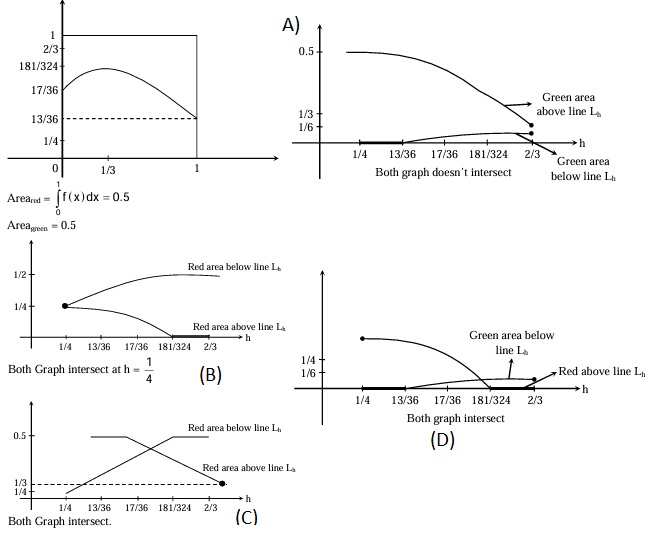
Let f:[0,1]→[0,1]f :[0,1] \to [0,1] be the function defined by f(x)=x33−x2+59x+1736f(x) = \frac{x^3}{3} - x^2 + \frac{5}{9}x + \frac{17}{36}. Consider the square region S=[0,1]×[0,1]S = [0,1] \times [0,1]. Let G={(x,y)∈S:y>f(x)}G = \{(x,y) \in S : y > f(x)\} be called the green region and R={(x,y)∈S:y<f(x)}R = \{(x,y) \in S : y < f(x)\} be called the red region. Let LhL_h be the horizontal line y=hy = h. Consider the statements:

  1. Option A:

    There exists an h∈[14,23]\mathrm{h} \in\left[\frac{1}{4}, \frac{2}{3}\right] such that the area of the green region above the line Lh\mathrm{L}_{\mathrm{h}} equals the area of the green region below the line LhL_{h}

  2. Option B:

    There exists an h∈[14,23]\mathrm{h} \in\left[\frac{1}{4}, \frac{2}{3}\right] such that the area of the red region above the line Lh\mathrm{L}_{\mathrm{h}} equals the area of the red region below the line LhL_{h}

    Correct
  3. Option C:

    There exists an h∈[14,23]\mathrm{h} \in\left[\frac{1}{4}, \frac{2}{3}\right] such that the area of the green region above the line Lh\mathrm{L}_{\mathrm{h}} equals the area of the red region below the line Lh\mathrm{L}_{\mathrm{h}}

    Correct
  4. Option D:

    There exists an h∈[14,23]\mathrm{h} \in\left[\frac{1}{4}, \frac{2}{3}\right] such that the area of the red region above the line Lh\mathrm{L}_{\mathrm{h}} equals the area of the green region below the line Lh\mathrm{L}_{\mathrm{h}}

Answer: B, C

Step-by-step solution

f(x)=x33−x2+59x+1736,x∈[0,1],f(x)=\frac{x^{3}}{3}-x^{2}+\frac{5}{9}x+\frac{17}{36},\qquad x\in[0,1], Lh: y=h.L_h:\ y=h.
  1. Total green and red areas
∫01f(x) dx=∫01(x33−x2+59x+1736)dx=[x412−x33+5x218+17x36]01=12.\int_{0}^{1} f(x)\,dx = \int_{0}^{1}\left(\frac{x^{3}}{3}-x^{2}+\frac{5}{9}x+\frac{17}{36}\right)dx = \left[\frac{x^{4}}{12}-\frac{x^{3}}{3}+\frac{5x^{2}}{18}+\frac{17x}{36}\right]_{0}^{1} = \frac12.

Hence, in the square S=[0,1]×[0,1]S=[0,1]\times[0,1],

AR=∫01f(x) dx=12,AG=∫01(1−f(x)) dx=1−12=12.A_R = \int_{0}^{1} f(x)\,dx = \frac12,\qquad A_G = \int_{0}^{1} (1-f(x))\,dx = 1-\frac12 = \frac12.
  1. Mean–value level

Note that

∫01(f(x)−12) dx=∫01f(x) dx−12=0.\int_{0}^{1}\bigl(f(x)-\tfrac12\bigr)\,dx = \int_{0}^{1}f(x)\,dx - \frac12 = 0.

Thus the horizontal line y=12y=\tfrac12 splits the total red area into two equal parts (above and below the line) and likewise splits the total green area into two equal parts.

Therefore, for h=12∈[14,23]h=\tfrac12\in\left[\tfrac14,\tfrac23\right],

(i) red   area   above   Lh=red   area   below   Lh,\text{(i) red\; area\; above\; }L_h = \text{red\; area\; below\; }L_h, (ii) green   area   above   Lh=green   area   below   Lh.\text{(ii) green\; area\; above\; }L_h = \text{green\; area\; below\; }L_h.

From the way the options are phrased, this yields that the statements in options B\mathbf{B} and C\mathbf{C} are true.

Solution figure

Answer key and solution verified before publishing.

Practise Area under the Curves

Start with this question, then two more from the same chapter — with a tutor that explains every step. Free.

Exam
JEE Advanced 2023
Paper
Paper 1
Subject
Mathematics
Chapter
Area under the Curves
Topic
Area under the Curves