JEE Advanced 2021 · previous year paper
JEE Advanced 2021 — Paper 1
46 questions with the verified answer key. Open any question for its step-by-step solution.
- Question 1Physics· Units, Dimensions & Error Analysis
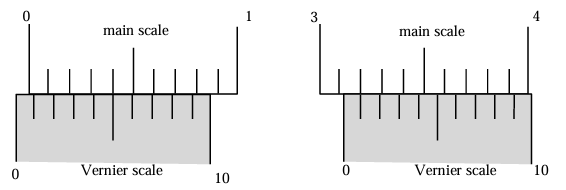
The smallest division on the main scale of a Vernier calipers is 0.1 cm . Ten divisions of the Vernier scale correspond to nine divisions of the main scale. The figure below on the left shows the reading of this calipers with no gap between its two jaws. The figure on the right shows the reading with a solid sphere held between the jaws. The correct diameter of the sphere is
- Option A:
3.07 cm
- Option B:
3.11 cm
- Option C:
3.15 cm
- Option D:
3.17 cm
Answer: CStep-by-step solution → - Question 2Physics· Geometrical Optics
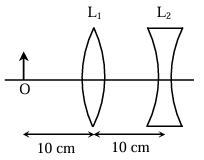
An extended object is placed at point in front of a convex lens and a concave lens
is placed 10 cm behind it, as shown in the figure. The radii of curvature of all the curved surfaces in both the lenses are 20 cm .
The refractive index of both the lenses is 1.5 . The total magnification of this lens system is
- Option A:
0.4
- Option B:
0.8
- Option C:
1.3
- Option D:
1.6
Answer: BStep-by-step solution → - Question 3Physics· Nuclear Physics
A heavy nucleus Q of half-life 20 minutes undergoes alpha-decay with probability of and beta-decay with probability of .
Initially, the number of Q nuclei is 1000 . The number of alpha-decay of Q in the first one hour is
- Option A:
50
- Option B:
75
- Option C:
350
- Option D:
525
Answer: DStep-by-step solution → - Question 4Physics· Rotational Dynamics
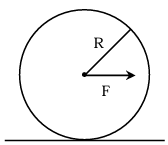
A horizontal force F is applied at the centre of mass of a cylindrical object of mass m and radius R , perpendicular to its axis as shown in the figure. The coefficient of friction between the object and the ground is . The center of mass of the object has an acceleration . The acceleration due to gravity is g . Given that the object rolls without slipping, which of the following statement(s) is(are) correct?
- Option A:
For the same F, the value of does not depend on whether the cylinder is solid or hollow
- Option B:
For a solid cylinder, the maximum possible value of is
- Option C:
The magnitude of the frictional force on the object due to the ground is always
- Option D:
For a thin-walled hollow cylinder,
Answer: B, DStep-by-step solution → - Question 5Physics· Rotational Dynamics
A particle of mass is initially at rest in the xy -plane at a point , where and . The particle is accelerated at time with a constant acceleration along the positive x-direction. Its angular momentum and torque with respect to the origin, in SI units, are represented by and respectively. and are unit vectors along the positive x , y and z-directions, respectively. If then which of the following statement(s) is(are) correct?
- Option A:
The particle arrives at the point at time .
- Option B:
when the particle passes through the point
- Option C:
when the particle passes through the point
- Option D:
when the particle passes through the point
Answer: A, B, CStep-by-step solution → - Question 6Physics· Atomic Physics
Which of the following statement(s) is(are) correct about the spectrum of hydrogen atom?
- Option A:
The ratio of the longest wavelength to the shortest wavelength in Balmer series is 9/5
- Option B:
There is an overlap between the wavelength ranges of Balmer and Paschen series
- Option C:
The wavelength of Lyman series are given by , where is the shortest wavelength of Lyman series and is an integer
- Option D:
The wavelength ranges of Lyman and Balmer series do not overlap
Answer: A, DStep-by-step solution → - Question 7Physics· Electromagnetic Induction
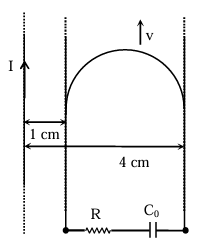
A long straight wire carries a current, ampere. A semi-circular conducting rod is placed beside it on two conducting parallel rails of negligible resistance. Both the rails are parallel to the wire. The wire, the rod and the rails lie in the same horizontal plane, as shown in the figure.
Two ends of the semi-circular rod are at distances 1 cm and 4 cm from the wire. At time , the rod starts moving on the rails with a speed
(see the figure) A resistor and a capacitor
are connected in series between the rails. At time is uncharged.
Which of the following statement(s) is(are) correct? [ SI units. Take ]
- Option A:
Maximum current through R is ampere
- Option B:
Maximum current through R is ampere
- Option C:
Maximum charge on capacitor is coulomb
- Option D:
Maximum charge on capacitor is coulomb
Answer: A, CStep-by-step solution → - Question 8Physics· Fluid Mechanics
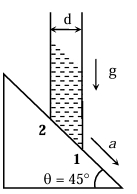
A cylindrical tube, with its base as shown in the figure, is filled with water. It is moving down with a constant acceleration
along a fixed inclined plane with angle and are pressures at points 1 and 2 ,
respectively located at the base of the tube. Let , where is density of water,
is the inner diameter of the tube and is the acceleration due to gravity. Which of the following statement(s) is(are) correct?
- Option A:
when
- Option B:
when
- Option C:
when
- Option D:
when
Answer: A, CStep-by-step solution → - Question 9Physics· Moving Charges and Magnetic Field
An -particle (mass 4 amu ) and a singly charged sulfur ion (mass 32 amu ) are initially at rest. They are accelerated through a potential V and then
allowed to pass into a region of uniform magnetic field which is normal to the velocities of the particles. Within this region,
the -particle and the sulfur ion move in circular orbits of radii and , respectively.
The ratio is .
Answer: 4Step-by-step solution → - Question 10Physics· Rotational Dynamics
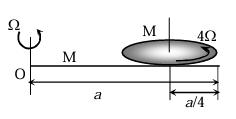
A thin rod of mass M and length is free to rotate in horizontal plane about a fixed vertical axis passing through point O . A thin circular disc of mass M and of radius
is pivoted on this rod with its center at a distance from the free end so that it can rotate freely about its vertical axis, as shown in the figure.
Assume that both the rod and the disc have uniform density and they remain horizontal during the motion.
An outside stationary observer finds the rod rotating with an angular velocity and the disc rotating about its vertical axis with angular velocity
. The total angular momentum of the system about the point O is .
The value of n is .
 Answer: 49Step-by-step solution →
 - Question 11Physics· Heat Transfer
A small object is placed at the center of a large evacuated hollow spherical container. Assume that the container is maintained at 0 K . At time , the temperature of the object is 200 K . The temperature of the object becomes 100 K at and 50 K at . Assume the object and the container to be ideal black bodies. The heat capacity of the object does not depend on temperature. The ratio is ,
Answer: 9Step-by-step solution → - Question 12Chemistry· Isomerism
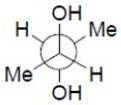
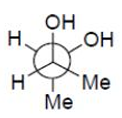
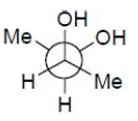
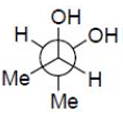
Among the following, the conformation that corresponds to the most stable conformation of meso-butane- 2,3-diol is
- Option A:
- Option B:
- Option C:
- Option D:
Answer: BStep-by-step solution → - Question 13Chemistry· Solid State
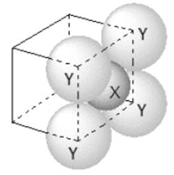
For the given close packed structure of a salt made of cation and anion shown below (ions of only one face are shown for clarity), the packing fraction is approximately (packing fraction )
- Option A:
0.74
- Option B:
0.63
- Option C:
0.52
- Option D:
0.48
Answer: BStep-by-step solution → - Question 14Chemistry· Coordination Compounds
The calculated spin only magnetic moments of and
in BM , respectively, are (Atomic number of Cr and Cu are 24 and 29, respectively)
- Option A:
3.87 and 2.84
- Option B:
4.90 and 1.73
- Option C:
3.87 and 1.73
- Option D:
4.90 and 2.84
Answer: AStep-by-step solution → - Question 15Chemistry· Practical Inorganic chemistry (Qualitative Analysis)
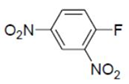
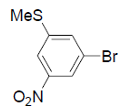
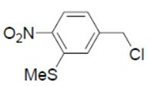
The reaction of with PhSNa yields an organic compound (major product) that gives positive Carius test on treatment with
followed by addition of . The correct option(s) for is(are)
- Option A:
- Option B:
- Option C:
- Option D:
Answer: A, DStep-by-step solution → - Question 16Chemistry· Surface Chemistry
The correct statement(s) related to colloids is(are)
- Option A:
The process of precipitating colloidal sol by an electrolyte is called peptization.
- Option B:
Colloidal solution freezes at higher temperature than the true solution at the same concentration.
- Option C:
Surfactants form micelle above critical micelle concentration (CMC). CMC depends on temperature.
- Option D:
Micelles are macromolecular colloids.
Answer: B, CStep-by-step solution → - Question 17Chemistry· Metallurgy
The correct statement(s) related to the metal extraction processes is(are)
- Option A:
A mixture of PbS and PbO undergoes self-reduction to produce Pb and SO 2 .
- Option B:
In the extraction process of copper from copper pyrites, silica is added to produce copper silicate.
- Option C:
Partial oxidation of sulphide ore of copper by roasting, followed by self-reduction produces blister copper.
- Option D:
In cyanide process, zinc powder is utilized to precipitate gold from .
Answer: A, C, DStep-by-step solution → - Question 18Chemistry· Practical Inorganic chemistry (Qualitative Analysis)
A mixture of two salts is used to prepare a solution S , which gives the following results: The correct option(s) for the salt mixture is(are)

- Option A:
and
- Option B:
and
- Option C:
and
- Option D:
and
Answer: A, B, CStep-by-step solution → - Question 19Mathematics· Circles
Consider a triangle whose two sides lie on the x -axis and the line .
If the orthocentre of is , then the equation of the circle passing through the vertices of the triangle is
- Option A:
- Option B:
- Option C:
- Option D:
Answer: BStep-by-step solution → - Question 20Mathematics· Area under the Curves
The area of the region is
- Option A:
- Option B:
- Option C:
- Option D:
Answer: AStep-by-step solution → - Question 21Mathematics· Probability
Consider three sets and .
Two elements are chosen at random, without replacement, from the set and let denote the set of these chose elements.
Let and . Now two elements are chosen at random, without replacement, from the set
and let denote the set of these chosen elements. Let . Finally, two elements are chosen at random,
without replacement, from the set and let denote the set of these chosen elements. Let .
Given that , let be the conditional probability of the event . Then the value of is
- Option A:
- Option B:
- Option C:
- Option D:
Answer: CStep-by-step solution → - Question 22Mathematics· Complex Numbers
Let be positive valued angles (in radian) such that . Define the complex numbers for , where . Consider the statements and Q given below:

- Option A:
P is TRUE and Q is FALSE
- Option B:
Q is TRUE and P is FALSE
- Option C:
both P and Q are TRUE
- Option D:
both and are FALSE
Answer: CStep-by-step solution → - Question 23Mathematics· Matrices
For any matrix , let denote the determinant of .
Let
If Q is a non-singular matrix of order
, then which of the following statements is(are) TRUE?
- Option A:
PEP and
- Option B:
- Option C:
- Option D:
Sum of the diagonal entries of is equal to the sum of diagonal entries of
Answer: A, B, DStep-by-step solution → - Question 24Mathematics· Application of Derivatives
Let be defined by . Then which of the following statements is(are) TRUE?
- Option A:
f is decreasing in the interval
- Option B:
f is increasing in the interval
- Option C:
f is onto
- Option D:
Range of f is
Answer: A, BStep-by-step solution → - Question 25Mathematics· Probability
Let and be three events having probabilities and , and
let . For any event H , if denotes its complement,
then which of the following statements is(are) TRUE?
- Option A:
- Option B:
- Option C:
- Option D:
Answer: A, B, CStep-by-step solution → - Question 26Mathematics· Matrices
For any matrix M , let denote the determinant of M . Let I be the identity matrix. Let E and F be two matrices such that ( ) is invertible. If , then which of the following statements is(are) TRUE?
- Option A:
- Option B:
- Option C:
EFG = GEF
- Option D:
Answer: A, B, CStep-by-step solution → - Question 27Mathematics· Inverse Trigonometric Functions
For any positive integer , let be defined by
where for any and .
Then which of the following statements is(are) TRUE?
- Option A:
, for all
- Option B:
, for all
- Option C:
The equation has a root in
- Option D:
, for all and
Answer: A, BStep-by-step solution → - Question 28Mathematics· Complex Numbers
For any complex number id, let , where . Let and be real numbers such that for all complex numbers Let satisfy
Then the ordered pair lies on the circle
Which of the following statements is(are) TRUE?
- Option A:
- Option B:
- Option C:
- Option D:
Answer: B, DStep-by-step solution → - Question 29Mathematics· Quadratic Equations
For , the number of real roots of the equation is
Answer: 4Step-by-step solution → - Question 30Mathematics· Trigonometry Ratios and Identities
In a triangle , let and . Then the value of is
Answer: 2Step-by-step solution → - Question 31Mathematics· Vector Algebra
Let and be vectors in three-dimensional space, where and are unit vectors which are not perpendicular to each other and . If the volume of the parallelepiped, whose adjacent sides are represented by the vectors and is , then the value of is
Answer: 7Step-by-step solution → - Question 32Physics· Capacitors and R-C Circuits
A projectile is thrown from a point on the ground at an angle from the vertical and with a speed . The projectile at the highest point of its trajectory splits into two equal parts. One part falls vertically down to the ground, 0.5 s after the splitting. The other part, t seconds after the splitting, falls to the ground at a distance x meters from the point O . The acceleration due to gravity .
The value of is
Answer: 0.50Step-by-step solution → - Question 33Physics· Capacitors and R-C Circuits
A projectile is thrown from a point on the ground at an angle from the vertical and with a speed . The projectile at the highest point of its trajectory splits into two equal parts. One part falls vertically down to the ground, 0.5 s after the splitting. The other part, t seconds after the splitting, falls to the ground at a distance x meters from the point O . The acceleration due to gravity .
The value of is .
Answer: 7.50Step-by-step solution → - Question 34Physics· Capacitors and R-C Circuits
The magnitude of is .
Answer: 1.33Step-by-step solution → - Question 35Physics· Capacitors and R-C Circuits
In the circuit shown below, the switch is connected to position for a long time so that the charge on the capacitor becomes
. Then S is switched to position Q . After a long time, the charge on the capacitor is
.
The magnitude of is .
Answer: 0.67Step-by-step solution → - Question 36Physics· Electrostatics
Two point charges -Q and are placed in the xy-plane at the origin and a point ,respectively, as shown in the figure.This results in an equipotential circle of radius R and potential in the xy -plane with its center at (b, 0). All lengths are measured in meters.
The value of R is _______ meter.
Answer: 1.73Step-by-step solution → - Question 37Physics· Electrostatics
Two point charges -Q and are placed in the xy-plane at the origin and a point ,respectively, as shown in the figure.This results in an equipotential circle of radius R and potential in the xy -plane with its center at (b, 0). All lengths are measured in meters.
The value of b is _______ meter.
Answer: 3.00Step-by-step solution → - Question 38Chemistry· Some Basic Concepts of Chemistry (Mole Concept) + Stoichiometry
The value of is .
Answer: 1.62Step-by-step solution → - Question 39Chemistry· Some Basic Concepts of Chemistry (Mole Concept) + Stoichiometry
The value of is . .
Answer: 3.20Step-by-step solution → - Question 40Chemistry· Chemical Kinetics
The value of standard enthalpy, for the given reaction is .
Answer: 166.28Step-by-step solution → - Question 41Chemistry· Chemical Kinetics
For the reaction, , the plot of
versus is given below (in solid line), where is the pressure (in bar) of the gas at temperature
and bar. (Given, ,
where the equilibrium constant, and the gas constant, )
The value of (in ) for the given reaction, at 1000 K is
Answer: 141.34Step-by-step solution → - Question 42Chemistry· Solutions and Colligative Properties
The value of is .
Answer: 100.10Step-by-step solution → - Question 43Chemistry· Solutions and Colligative Properties
The boiling point of water in a 0.1 molal silver nitrate solution (solution ) is . To this solution ,
an equal volume of 0.1 molal aqueous barium chloride solution is added to make a new solution .
The difference in the boiling points of water in the two solutions and is .
(Assume: Densities of the solutions and are the same as that of water and the soluble salts dissociate completely.
Use: Molal elevation constant (Ebullioscopic Constant), ;
Boiling point of pure water as .)
The value of is .
Answer: 2.5Step-by-step solution → - Question 44Mathematics· 3D Geometry
Three numbers are chosen at random, one after another with replacement, from the set . Let be the probability that the maximum of chosen numbers is at least 81 and be the probability that the minimum of chosen numbers is at most 40 .
The value of is
Answer: 24.5Step-by-step solution → - Question 45Mathematics· Straight lines
Let and be real numbers such that the system of linear equation is consistent. Let represent the determinant of the matrix Let P be the plane containing all those for which the above system of linear equations is consistent, and be the square of the distance of the point from the plane .
The value of is
Answer: 1Step-by-step solution → - Question 46Mathematics· Straight lines
Consider the lines and defined by For a fixed constant , let be the locus of a point such that the product of the distance of from and the distance of from is . The line meets at two points and , where the distance between R and S is . Let the perpendicular bisector of RS meet at two distinct points and . Let be the square of the distance between and
The value of is
Answer: 9Step-by-step solution →
Stuck on one of these?
Practise questions like them — free, with a tutor that explains every step.