Mathematics · Complex Numbers

JEE Advanced 2021 — Paper 1 — Question 28

For any complex number w=c+\mathrm{w}=\mathrm{c}+ id, let arg⁡(w)∈(−π,π]\arg (\mathrm{w}) \in(-\pi, \pi], where i=−1\mathrm{i}=\sqrt{-1}. Let α\alpha and β\beta be real numbers such that for all complex numbers Let z=x+iyz = x + iy satisfy

arg⁡ ⁣(z+αz+β)=π4.\arg\!\left(\frac{z+\alpha}{z+\beta}\right) = \frac{\pi}{4}.

Then the ordered pair (x,y)(x, y) lies on the circle

x2+y2+5x−3y+4=0.x^{2} + y^{2} + 5x - 3y + 4 = 0.

Which of the following statements is(are) TRUE?

  1. Option A:

    α=−1\alpha=-1

  2. Option B:

    αβ=4\alpha \beta=4

    Correct
  3. Option C:

    αβ=−4\alpha \beta=-4

  4. Option D:

    β=4\beta=4

    Correct

Answer: B, D

Step-by-step solution

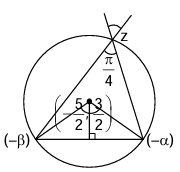
Rewrite the circle: x2+y2+5x−3y+4=0x^2+y^2+5x-3y+4=0 as (x+52)2+(y−32)2=92(x+\frac{5}{2})^2+(y-\frac{3}{2})^2 = \frac{9}{2}. So center C=−52+32iC = -\frac{5}{2}+\frac{3}{2}i, radius R=32R = \frac{3}{\sqrt{2}}. The condition arg⁡(z+αz+β)=π4\arg\left(\frac{z+\alpha}{z+\beta}\right)=\frac{\pi}{4} describes a circular arc with endpoints −α,−β-\alpha,-\beta. The inscribed angle is π4\frac{\pi}{4}, so the central angle subtended by chord (−α,−β)(-\alpha,-\beta) is π2\frac{\pi}{2}. For the whole set of zz to lie on the given circle, that circle must be exactly this arc's circle. Hence its center is CC and radius RR. Step 4: The endpoints −α,−β-\alpha,-\beta lie on the circle. Their coordinates (real axis) satisfy x2+5x+4=0x^2+5x+4=0, giving x=−1,−4x=-1,-4. So {α,β}={1,4}\{\alpha,\beta\}=\{1,4\}. The chord length is ∣α−β∣=3|\alpha-\beta| = 3. This equals R2=32⋅2=3R\sqrt{2} = \frac{3}{\sqrt{2}}\cdot\sqrt{2}=3, confirming consistency. The midpoint of the chord is M=(−α+β2,0)M = \left(-\frac{\alpha+\beta}{2},0\right). Distance from CC to MM must be R/2=32R/\sqrt{2} = \frac{3}{2}: (α+β−52)2+(32)2=(32)2\left(\frac{\alpha+\beta-5}{2}\right)^2 + \left(\frac{3}{2}\right)^2 = \left(\frac{3}{2}\right)^2, so α+β=5\alpha+\beta=5. Both (1,4)(1,4) and (4,1)(4,1) have sum 5, but only α=1,β=4\alpha=1,\beta=4 makes arg⁡(z+αz+β)=π4\arg\left(\frac{z+\alpha}{z+\beta}\right)=\frac{\pi}{4} for points on the upper arc (e.g., test a point). Thus α=1,β=4\alpha=1,\beta=4, giving αβ=4\alpha\beta=4 and β=4\beta=4. The true statements are B and D.

Solution figure

Answer key and solution verified before publishing.

Practise Complex Numbers

Start with this question, then two more from the same chapter — with a tutor that explains every step. Free.

Exam
JEE Advanced 2021
Paper
Paper 1
Subject
Mathematics
Chapter
Complex Numbers
Topic
Geometry of Complex Numbers
For any complex number w = c + id, let arg ( w ) in(-π, π] , where i… | JEE Advanced 2021 PYQ with Solution · DhiX AI