JEE Advanced 2021 · previous year paper
JEE Advanced 2021 — Paper 2
50 questions with the verified answer key. Open any question for its step-by-step solution.
- Question 1Physics· Rotational Dynamics
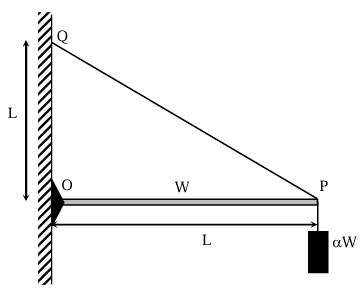
One end of a horizontal uniform beam of weight W and length L is hinged on a vertical wall at point O and its other end is supported by a light inextensible rope. The other end of the rope is fixed at point Q , at a height L above the hinge at point O . A block of weight is attached at the point P of the beam, as shown in the figure (not to scale). The rope can sustain a maximum tension of . Which of the following statement(s) is(are) correct?
- Option A:
The vertical component of reaction force at O does not depend on
- Option B:
The horizontal component of reaction force at O is equal to W for
- Option C:
The tension in the rope is 2 W for
- Option D:
The rope breaks if
Answer: A, B, DStep-by-step solution → - Question 2Physics· Sound Waves
A source, approaching with speed towards the open end of a stationary pipe of length , is emitting a sound of frequency .
The farther end of the pipe is closed. The speed of sound in air is and is the fundamental frequency of the pipe.
For which of the following combination(s) of and , will the sound reaching the pipe lead to a resonance?
- Option A:
and
- Option B:
and
- Option C:
and
- Option D:
and
Answer: A, DStep-by-step solution → - Question 3Physics· Geometrical Optics
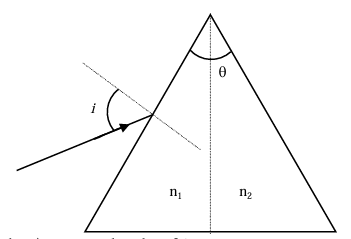
For a prism of prism angle , the refractive indices of the left half and the right half are, respectively, and as shown in the figure. The angle of incidence is chosen such that the incident light rays will have minimum deviation if . For the case of unequal refractive indices, and (where ), the angle of emergence . Which of the following statement(s) is(are) correct?
- Option A:
The value of (in radians) is greater than that of
- Option B:
is proportional to
- Option C:
lies between 2.0 and 3.0 milliradians, if
- Option D:
lies between 1.0 and 1.6 milliradians, if
Answer: B, CStep-by-step solution → - Question 4Physics· Units, Dimensions & Error Analysis
A physical quantity is defined as , where is electric field, is magnetic field and
is the permeability of free space. The dimensions of are the same as the dimensions of which of the following quantity(ies)?
- Option A:
- Option B:
- Option C:
- Option D:
Answer: B, DStep-by-step solution → - Question 5Physics· Nuclear Physics
A heavy nucleus , at rest, undergoes fission , where and Q are two lighter nuclei.
Let , where and are the masses of and , respectively.
and are the kinetic energies of and , respectively. The speeds of and are and , respectively.
If is the speed of light, which of the following statement(s) is(are) correct ?
- Option A:
- Option B:
- Option C:
- Option D:
The magnitude of momentum for P as well as Q is , where
Answer: A, C, DStep-by-step solution → - Question 6Physics· Moving Charges and Magnetic Field
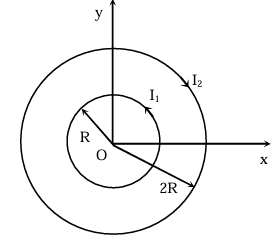
Two concentric circular loops, one of radius R and the other of radius 2 R , lie in the xy-plane with the origin as their common centre, as shown in the figure.
The smaller loop carries current in the anti-clockwise direction and the larger loop carries current in the clock wise direction, with
. denotes the magnetic field at a point ( ) in the xy-plane.
Which of the following statement(s) is(are) correct?
- Option A:
is perpendicular to the xy-plane at any point in the plane
- Option B:
depends on and only through the radial distance
- Option C:
is non-zero at all points for
- Option D:
points normally outward from the xy-plane for all the points between the two loops
Answer: A, BStep-by-step solution → - Question 7Physics· Current Electricity
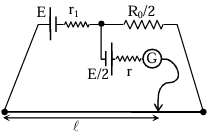
In order to measure the internal resistance of a cell of emf , a meter bridge of wire resistance , a resistance
, another cell of emf (internal resistance ) and a galvanometer are used in a circuit, as shown in the figure.
If the null point is found at , then the value of .
 Answer: 3Step-by-step solution →
 - Question 8Physics· Gravitation
The distance between two stars of masses and is . Here is the mean distance between the centers of the Earth and the Sun, and is the mass of the Sun. The two stars orbit around their common centre of mass in circular orbits with period nT , where T is the period of Earth's revolution around the Sun. The value of is
Answer: 9Step-by-step solution → - Question 9Physics· Atomic Physics
In a photoemission experiment, the maximum kinetic energies of photoelectrons from metals and R are
and , respectively, and they are related by . In this experiment, the same source of monochromatic light is used for metal P and Q while a different source of monochromatic light is used for the metal R.The work functions for metals and R are and 5.5 eV ,
respectively. The energy of the incident photon used for metal , in eV , is _.
Answer: 6Step-by-step solution → - Question 10Chemistry· Alkyl and Aryl Halides
Correct option(s) for the following sequence of reactions is (are)
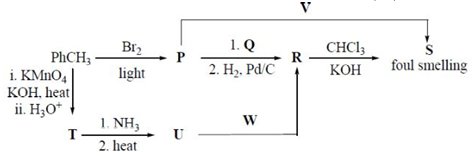
- Option A:
- Option B:
benzenamine,
- Option C:
phenylmethanamine
- Option D:
Answer: C, DStep-by-step solution → - Question 11Chemistry· Chemical Kinetics
For the following reaction the rate of reaction is . Two moles of are mixed with one mole of to make 1.0 L of solution. At mole of is left in the reaction mixture. The correct statement(s) about the reaction is(are) (Use: )
- Option A:
The rate constant, k , of the reaction is
- Option B:
Half-life of X is 50 s
- Option C:
At .
- Option D:
At .
Answer: B, C, DStep-by-step solution → - Question 12Chemistry· Electrochemistry
Some standard electrode potentials at 298 K are given below:
To a solution containing 0.001 M of and 0.1 M of , the metal rods and are inserted (at 298 K ) and connected by a conducting wire. This resulted in dissolution of . The correct combination(s) of and , respectively, is(are) (Given: Gas constant, , Faraday constant, )
- Option A:
Cd and Ni
- Option B:
Cd and Fe
- Option C:
Ni and Pb
- Option D:
Ni and Fe
Answer: A, B, CStep-by-step solution → - Question 13Chemistry· Coordination Compounds
The pair(s) of complexes wherein both exhibit tetrahedral geometry is(are) (Note: py = pyridine Given: Atomic numbers of and Cu are 26, 27, 28 and 29, respectively)
- Option A:
and
- Option B:
and
- Option C:
and
- Option D:
and
Answer: A, B, DStep-by-step solution → - Question 14Chemistry· p-Block Elements (Group 15-18)
The correct statement(s) related to oxoacids of phosphorous is(are)
- Option A:
Upon heating, undergoes disproportionation reaction to produce and .
- Option B:
While can act as reducing agent, cannot.
- Option C:
is a monobasic acid.
- Option D:
The H atom of bond in is not ionizable in water.
Answer: A, B, DStep-by-step solution → - Question 15Chemistry· Thermodynamics & Thermochemistry
One mole of an ideal gas at 900 K , undergoes two reversible processes, I followed by II, as shown below. If the work done by the gas in the two process are same, the value of
Answer: 10Step-by-step solution → - Question 16Chemistry· Structure of Atom
Consider a helium (He) atom that absorbs a photon of wavelength 330 nm . The change in the velocity (in ) of He atom after the photon absorption is . (Assume: Momentum is conserved when photon is absorbed. Use: Planck constant , Avogadro number , Molar mass of )
Answer: 30Step-by-step solution → - Question 17Chemistry· p-Block Elements (Group 15-18)
Ozonolysis of produces an oxide of chlorine. The average oxidation state of chlorine in this oxide is
Answer: 6Step-by-step solution → - Question 18Mathematics· Permutations and Combinations
Let
and
If the total number of elements in the set is , , then which of the following statements is (are) \textbf{TRUE}?
- Option A:
- Option B:
- Option C:
- Option D:
Answer: A, B, DStep-by-step solution → - Question 19Mathematics· Limits, Continuity and Differentiability
Let be a continuous function such that and . Then which of the following statements is(are) TRUE?
- Option A:
The equation has at least one solution in
- Option B:
The equation has at least one solution in
- Option C:
- Option D:
Answer: A, B, CStep-by-step solution → - Question 20Mathematics· Differential Equations
For any real numbers and , let , be the solution of the differential equation
Let . Then which of the following functions belong(s) the set ?
- Option A:
- Option B:
- Option C:
- Option D:
Answer: A, CStep-by-step solution → - Question 21Mathematics· Vector Algebra
Let O be the origin and and for some . If , then which of the following statements is(are) TRUE?
- Option A:
Projection of on is
- Option B:
Area of the triangle OAB is
- Option C:
Area of the triangle ABC is
- Option D:
The acute angle between the diagonals of the parallelogram with adjacent sides and is
Answer: A, B, CStep-by-step solution → - Question 22Mathematics· Parabola
Let E denote the parabola . Let and let Q and be two distinct points on E such that the lines PQ and are tangents to E . Let F be the focus of E . Then which of the following statements is(are) TRUE?
- Option A:
The triangle PFQ is a right-angled triangle
- Option B:
The triangle QPQ' is a right-angle triangle
- Option C:
The distance between and is
- Option D:
F lies on the line joining Q and
Answer: A, B, DStep-by-step solution → - Question 23Mathematics· Probability
A number is chosen at random from the set . Let be the probability that the chosen number is a multiple of 3 or a multiple of 7 . Then the value of 500 p is
Answer: 214Step-by-step solution → - Question 24Mathematics· Ellipse
Let be the ellipse . For any three distinct points and on , let be the midpoint of the line segment joining and , and be the mid-point of the line segment joining and . Then the maximum possible value of the distance between and , as and vary on E , is
Answer: 4Step-by-step solution → - Question 25Mathematics· Definite Integration
For any real number x , let ] denote the largest integer less than or equal to x . If
then the value of 9I is
Answer: 182Step-by-step solution → - Question 26Physics· Kinetic Theory of Gases
A Soft plastic bottle, filled with water of density , carries an inverted glass test-tube with some air (ideal gas)
trapped as shown in the figure. The test-tube has a mass of 5 gm , and it is made of a thick glass of density .
Initially the bottle is sealed at atmospheric pressure so that the volume of the trapped air is
. When the bottle is squeezed from outside at constant temperature, the pressure inside rises and the volume of the trapped air reduces. It is found that the test tube begins to sink at pressure without changing its orientation. At this pressure,
the volume of the trapped air is . Let cc and
.
The value of X is .
Answer: 0.30Step-by-step solution → - Question 27Physics· Kinetic Theory of Gases
A Soft plastic bottle, filled with water of density , carries an inverted glass test-tube with some air (ideal gas)
trapped as shown in the figure. The test-tube has a mass of 5 gm , and it is made of a thick glass of density .
Initially the bottle is sealed at atmospheric pressure so that the volume of the trapped air is
. When the bottle is squeezed from outside at constant temperature, the pressure inside rises and the volume of the trapped air reduces. It is found that the test tube begins to sink at pressure without changing its orientation. At this pressure,
the volume of the trapped air is . Let cc and
.
The value of Y is .
Answer: 10.00Step-by-step solution → - Question 28Physics· Rotational Dynamics
A pendulum consists of a bob of mass and a massless inextensible string of length .
It is suspended from a fixed point at height above a frictionless horizontal floor. Initially,
the bob of the pendulum is lying on the floor at rest vertically below the point of suspension. A horizontal impulse is imparted to the bob at some instant. After the bob slides for some distance, the string becomes taut and the bob lifts off the floor.
The magnitude of the angular momentum of the pendulum about the point of suspension just before the bob lifts off is
. The kinetic energy of the pendulum just after the lift-off is K Joules.
The value of J is .
Answer: 0.18Step-by-step solution → - Question 29Physics· Alternating Current
In the circuit, a metal filament lamp is connected in series with a capacitor of capacitance across a Hz supply. The power consumed by the lamp is 500 W while the voltage drop across it is 100 V . Assume that there is no inductive load in the circuit. Take rms values of the voltages. The magnitude of the phase-angle (in degrees) between the current and supply voltage is . Assume, .
The value of C is .
Answer: 100.00Step-by-step solution → - Question 30Physics· Alternating Current
In the circuit, a metal filament lamp is connected in series with a capacitor of capacitance across a Hz supply. The power consumed by the lamp is 500 W while the voltage drop across it is 100 V . Assume that there is no inductive load in the circuit. Take rms values of the voltages. The magnitude of the phase-angle (in degrees) between the current and supply voltage is . Assume, .
The value of is .
Answer: 60.00Step-by-step solution → - Question 31Physics· Electromagnetic Induction
A special metal S conducts electricity without any resistance. A closed wire loop, made of S, does not allow any change in flux through itself by inducing a suitable current to generate a compensating flux. The induced current in the loop cannot decay due to its zero resistance. This current gives rise to a magnetic moment which in turn repels the source of magnetic field or flux. Consider such a loop, of radius a, with its centre at the origin. A magnetic dipole of moment is brought along the axis of this loop from infinity to a point at distance a) from the centre of the loop with its north pole always facing the loop, as shown in the figure below.
The magnitude of magnetic field of a dipole , at a point on its axis at distance , is ,
where is the permeability of free space. The magnitude of the force between two magnetic dipoles with moments, and , separated by a distance on the common axis, with their north poles facing each other, is , where is a constant of appropriate dimensions. The direction of this force is along the line joining the two dipoles.
When the dipole

is placed at a distance

from the center of the loop (as shown in the figure), the current induced in the loop will be proportional to
- Option A:
- Option B:
- Option C:
- Option D:
Answer: AStep-by-step solution → - Question 32Physics· Electromagnetic Induction
A special metal S conducts electricity without any resistance. A closed wire loop, made of S, does not allow any change in flux through itself by inducing a suitable current to generate a compensating flux. The induced current in the loop cannot decay due to its zero resistance. This current gives rise to a magnetic moment which in turn repels the source of magnetic field or flux. Consider such a loop, of radius a, with its centre at the origin. A magnetic dipole of moment is brought along the axis of this loop from infinity to a point at distance a) from the centre of the loop with its north pole always facing the loop, as shown in the figure below.
The magnitude of magnetic field of a dipole , at a point on its axis at distance , is ,
where is the permeability of free space. The magnitude of the force between two magnetic dipoles with moments, and , separated by a distance on the common axis, with their north poles facing each other, is , where is a constant of appropriate dimensions. The direction of this force is along the line joining the two dipoles.
The work done in bringing the dipole from infinity to a distance from the center of the loop by the given process is proportional to
- Option A:
- Option B:
- Option C:
- Option D:
Answer: CStep-by-step solution → - Question 33Physics· Thermodynamics
A thermally insulating cylinder has a thermally insulating and frictionless movable partition in the middle, as shown in the figure below. On each side of the partition, there is one mole of an ideal gas, with specific heat at constant volume, . Here, R is the gas constant. Initially, each side has a volume and temperature . The left side has an electric heater, which is turned on at very low power to transfer heat Q to the gas on the left side. As a result the partition moves slowly towards the right reducing the right side volume to . Consequently, the gas temperatures on the left and the right sides become and , respectively. Ignore the changes in the temperatures of the cylinder, heater and the partition.
The value of is
- Option A:
- Option B:
- Option C:
- Option D:
Answer: BStep-by-step solution → - Question 34Chemistry· Electrochemistry
At 298 K, the limiting molar conductivity of a weak monobasic acid is
At 298 K, for an aqueous solution of the acid the degree of dissociation is and the molar conductivity is
At 298 K, upon 20 times dilution with water, the molar conductivity of the solution becomes
The value of is .
Answer: 0.22Step-by-step solution → - Question 35Chemistry· Electrochemistry
At 298 K, the limiting molar conductivity of a weak monobasic acid is
At 298 K, for an aqueous solution of the acid the degree of dissociation is and the molar conductivity is
At 298 K, upon 20 times dilution with water, the molar conductivity of the solution becomes
The value of is .
Answer: 0.88Step-by-step solution → - Question 36Chemistry· Some Basic Concepts of Chemistry (Mole Concept) + Stoichiometry
Reaction of of with quantitatively produced a salt. Entire amount of the salt reacted with of nitrobenzene in the presence of required amount of to produce of an organic salt (quantitatively).
(Use molar masses in of as respectively.)
The value of is and the value of is .
The value of is .
Answer: 3.57Step-by-step solution → - Question 37Chemistry· Some Basic Concepts of Chemistry (Mole Concept) + Stoichiometry
Reaction of of with quantitatively produced a salt. Entire amount of the salt reacted with of nitrobenzene in the presence of required amount of to produce of an organic salt (quantitatively).
(Use molar masses in of as respectively.)
The value of is and the value of is .
The value of is .
Answer: 1.23Step-by-step solution → - Question 38Chemistry· Some Basic Concepts of Chemistry (Mole Concept) + Stoichiometry
A sample ( 5.6 g ) containing iron is completely dissolved in cold dilute HCl to prepare a 250 mL of solution. Titration of 25.0 mL of this solution requires 12.5 mL of solution to reach the end point. Number of moles of present in 250 mL solution is (consider complete dissolution of ). The amount of iron present in the sample is by weight. (Assume: reacts only with in the solution Use: Molar mass of iron as )
The value of is .
Answer: 1.875Step-by-step solution → - Question 39Chemistry· Some Basic Concepts of Chemistry (Mole Concept) + Stoichiometry
A sample ( 5.6 g ) containing iron is completely dissolved in cold dilute HCl to prepare a 250 mL of solution. Titration of 25.0 mL of this solution requires 12.5 mL of solution to reach the end point. Number of moles of present in 250 mL solution is (consider complete dissolution of ). The amount of iron present in the sample is by weight. (Assume: reacts only with in the solution Use: Molar mass of iron as )
The value of is .
Answer: 18.75Step-by-step solution → - Question 40Chemistry· Thermodynamics & Thermochemistry
The amount of energy required to break a bond is same as the amount of energy released when the same bond is formed. In gaseous state, the energy required for homolytic cleavage of a bond is called Bond Dissociation Energy (BDE) or Bond Strength. BDE is affected by s-character of the bond and the stability of the radicals formed. Shorter bonds are typically stronger bonds. BDEs for some bonds are given below:
For the following reaction The correct statement is
- Option A:
Initiation step is exothermic with .
- Option B:
Propagation step involving formation is exothermic with .
- Option C:
Propagation step involving formation is endothermic with .
- Option D:
The reaction is exothermic with .
Answer: DStep-by-step solution → - Question 41Chemistry· Practical Inorganic chemistry (Qualitative Analysis)
The reaction of with freshly prepared solution produces a dark blue precipitate called Turnbull's blue. Reaction of with the solution in complete absence of air produces a white precipitate , which turns blue in air. Mixing the solution with , followed by a slow addition of concentrated through the side of the test tube produces a brown ring.
Precipitate is
- Option A:
- Option B:
- Option C:
- Option D:
Answer: CStep-by-step solution → - Question 42Chemistry· Practical Inorganic chemistry (Qualitative Analysis)
The reaction of with freshly prepared solution produces a dark blue precipitate called Turnbull's blue. Reaction of with the solution in complete absence of air produces a white precipitate , which turns blue in air. Mixing the solution with , followed by a slow addition of concentrated through the side of the test tube produces a brown ring.
Among the following, the brown ring is due to the formation of
- Option A:
- Option B:
- Option C:
- Option D:
Answer: DStep-by-step solution → - Question 43Mathematics· Circles
The radius of the circle C is
Answer: 1.5Step-by-step solution → - Question 44Mathematics· Circles
The value of is
Answer: 2Step-by-step solution → - Question 45Mathematics· Application of Derivatives
Let and be defined by and , where, for any positive integer and real numbers , denotes the product of . Let and , respectively, denote the number of points of local minima and the number of points of local maxima of function , in the interval ( 0 , .
The value of is
Answer: 57Step-by-step solution → - Question 46Mathematics· Application of Derivatives
Let and be defined by and , where, for any positive integer and real numbers , denotes the product of . Let and , respectively, denote the number of points of local minima and the number of points of local maxima of function , in the interval ( 0 , .
The value of is
Answer: 6Step-by-step solution → - Question 47Mathematics· Definite Integration
Let and be functions such that and , for all . Define
The value of is
Answer: 2Step-by-step solution → - Question 48Mathematics· Definite Integration
Let and be functions such that and , for all . Define
The value of is
Answer: 1.5Step-by-step solution → - Question 49Mathematics· Application of Derivatives
Which of the following statements is TRUE?
- Option A:
- Option B:
For every , there exists an such that
- Option C:
For every , there exists a such that
- Option D:
is an increasing function on the interval
Answer: CStep-by-step solution → - Question 50Mathematics· Definite Integration
Which of the following statements is TRUE?
- Option A:
, for all
- Option B:
, for all
- Option C:
, for all
- Option D:
, for all
Answer: DStep-by-step solution →
Stuck on one of these?
Practise questions like them — free, with a tutor that explains every step.