JEE Advanced 2018 · previous year paper
JEE Advanced 2018 — Paper 2
45 questions with the verified answer key. Open any question for its step-by-step solution.
- Question 1Physics· Work, Power & Energy
A particle of mass is initially at rest at the origin. It is subjected to a force and starts moving along the x axis. Its kinetic energy K changes with time as , where is a positive constant of appropriate dimensions. Which of the following statements is (are) true?
- Option A:
The force applied on the particle is constant
- Option B:
The speed of the particle is proportional to time
- Option C:
The distance of the particle from the origin increases linearly with time
- Option D:
The force is conservative
Answer: A, B, DStep-by-step solution → - Question 2Physics· Mechanical Properties of Matter
Consider a thin square plate floating on a viscous liquid in a large tank. The height of the liquid in the tank is much less than the width of the tank. The floating plate is pulled horizontally with a constant velocity . Which of the following statements is (are) true?
- Option A:
The resistive force of liquid on the plate is inversely proportional to
- Option B:
The resistive force of liquid on the plate is independent of the area of the plate
- Option C:
The tangential (shear) stress on the floor of the tank increases with
- Option D:
The tangential (shear) stress on the plate varies linearly with the viscosity of the liquid
Answer: A, C, DStep-by-step solution → - Question 3Physics· Electrostatics
An infinitely long thin non-conducting wire is parallel to the z -axis and carries a uniform line charge density . It pierces a thin nonconducting spherical shell of radius in such a way that the arc subtends an angle at the centre of the spherical shell, as shown in the figure. The permittivity of free space is . Which of the following statements is (are) true?
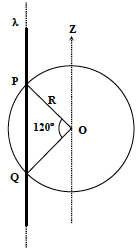
- Option A:
The electric flux through the shell is
- Option B:
The z-component of the electric field is zero at all the points on the surface of the shell
- Option C:
The electric flux through the shell is
- Option D:
The electric field is normal to the surface of the shell at all points
Answer: A, BStep-by-step solution → - Question 4Physics· Nuclear Physics
In a radioactive decay chain, nucleus decays to nucleus. Let and be the number of and particles, respectively, emitted in this decay process. Which of the following statements is (are) true?
- Option A:
- Option B:
- Option C:
- Option D:
Answer: A, CStep-by-step solution → - Question 5Physics· Sound Waves
In an experiment to measure the speed of sound by a resonating air column, a tuning fork of frequency 500 Hz is used. The length of the air column is varied by changing the level of water in the resonance tube. Two successive resonances are heard at air columns of length 50.7 cm and 83.9 cm . Which of the following statements is (are) true?
- Option A:
The speed of sound determined from this experiment is
- Option B:
The end correction in this experiment is 0.9 cm
- Option C:
The wavelength of the sound wave is 66.4 cm
- Option D:
The resonance at 50.7 cm corresponds to the fundamental harmonic
Answer: A, CStep-by-step solution → - Question 6Physics· Newton's Laws of Motion
A solid horizontal surface is covered with a thin layer of oil. A rectangular block of mass is at rest on this surface. An impulse of 1.0 Ns is applied to the block at time so that it starts moving along the x -axis with a velocity , where is a constant and . The displacement of the block, in meters, at is Take .
Answer: 6.3Step-by-step solution → - Question 7Physics· Motion in Plane
A ball is projected from the ground at an angle of with the horizontal surface. It reaches a maximum height of 120 m and returns to the ground. Upon hitting the ground for the first time, it loses half of its kinetic energy. Immediately after the bounce, the velocity of the ball makes an angle of with the horizontal surface. The maximum height it reaches after the bounce, in metres, is -.
Answer: 30Step-by-step solution → - Question 8Physics· Moving Charges and Magnetic Field
A particle, of mass and charge 1.0 C , is initially at rest. At time , the particle comes under the influence of an electric field , where and . Consider the effect of only the electrical force on the particle. Then the maximum speed, in , attained by the particle at subsequent times is .
Answer: 2Step-by-step solution → - Question 9Physics· Current Electricity
A moving coil galvanometer has 50 turns and each turn has an area . The magnetic field produced by the magnet inside the galvanometer is 0.02 T . The torsional constant of the suspension wire is . When a current flows through the galvanometer, a full scale deflection occurs if the coil rotates by 0.2 rad . The resistance of the coil of the galvanometer is . This galvanometer is to be converted into an ammeter capable of measuring current in the range . For this purpose, a shunt resistance is to be added in parallel to the galvanometer. The value of this shunt resistance, in ohms, is .
Answer: 5.56Step-by-step solution → - Question 10Physics· Mechanical Properties of Matter
A steel wire of diameter 0.5 mm and Young's modulus carries a load of mass M. The length of the wire with the load is 1.0 m . A vernier scale with 10 divisions is attached to the end of this wire. Next to the steel wire is a reference wire to which a main scale, of least count 1.0 mm , is attached. The 10 divisions of the vernier scale correspond to 9 divisions of the main scale. Initially, the zero of vernier scale coincides with the zero of main scale. If the load on the steel wire is increased by 1.2 kg , the vernier scale division which coincides with a main scale division is . Take and is .
Answer: 3Step-by-step solution → - Question 11Physics· Thermodynamics
One mole of a monatomic ideal gas undergoes an adiabatic expansion in which its volume becomes eight times its initial value. If the initial temperature of the gas is 100 K and the universal gas constant , the decrease in its internal energy, in Joule, is .
Answer: 900Step-by-step solution → - Question 12Physics· Atomic Physics
In a photoelectric experiment a parallel beam of monochromatic light with power of 200 W is incident on a perfectly absorbing cathode of work function 6.25 eV . The frequency of light is just above the threshold frequency so that the photoelectrons are emitted with negligible kinetic energy. Assume that the photoelectron emission efficiency is . A potential difference of 500 V is applied between the cathode and the anode. All the emitted electrons are incident normally on the anode and are absorbed. The anode experiences a force due to the impact of the electrons. The value of n is .
Mass of the electron and .
Answer: 24Step-by-step solution → - Question 13Physics· Atomic Physics
Consider a hydrogen-like ionized atom with atomic number Z with a single electron. In the emission spectrum of this atom, the photon emitted in the to transition has energy 74.8 eV higher than the photon emitted in the to transition. The ionization energy of the hydrogen atom is 13.6 eV . The value of Z is .
Answer: 3Step-by-step solution → - Question 14Physics· Electrostatics
The electric field E is measured at a point generated due to various charge distributions and the dependence of E on d is found to be different for different charge distributions. List-I contains different relations between and d. List-II describes different electric charge distributions, along with their locations. Match the functions in List-I with the related charge distributions in List-II.
List-I List-II P. is independent of d 1. A point charge Q at the origin Q. 2. A small dipole with point charges Q at and -Q at . Take R. 3. An infinite line charge coincident with the -axis, with uniform linear charge density S. 4. Two infinite wires carrying uniform linear charge density parallel to the - axis. The one along has a charge density and the one along has a charge density . Take 5. Infinite plane charge coincident with the -plane with uniform surface charge density - Option A:
- Option B:
- Option C:
- Option D:
Answer: BStep-by-step solution → - Question 15Physics· Gravitation
A planet of mass , has two natural satellites with masses and . The radii of their circular orbits are and respectively. Ignore the gravitational force between the satellites. Define and to be, respectively, the orbital speed, angular momentum, kinetic energy and time period of revolution of satellite 1 ; and and to be the corresponding quantities of satellite 2 . Given and , match the ratios in List-I to the numbers in List-II.
List-I List-II P. 1. Q. 2. R. 3. S. 4. - Option A:
- Option B:
- Option C:
- Option D:
Answer: BStep-by-step solution → - Question 16Physics· Thermodynamics
One mole of a monatomic ideal gas undergoes four thermodynamic processes as shown schematically in the PVdiagram below. Among these four processes, one is isobaric, one is isochoric, one is isothermal and one is adiabatic. Match the processes mentioned in List-1 with the corresponding statements in List-II.
List-I List-II P. In process I 1. Work done by the gas is zero Q. In process II 2. Temperature of the gas remains unchanged R. In process III 3. No heat is exchanged between the gas and its surroundings S. In process IV 4. Work done by the gas is 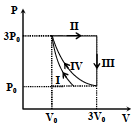
- Option A:
- Option B:
- Option C:
- Option D:
Answer: CStep-by-step solution → - Question 17Physics· Work, Power & Energy
In the List-I below, four different paths of a particle are given as functions of time. In these functions, and are positive constants of appropriate dimensions and . In each case, the force acting on the particle is either zero or conservative. In List-II, five physical quantities of the particle are mentioned: is the linear momentum, is the angular momentum about the origin, K is the kinetic energy, U is the potential energy and E is the total energy. Match each path in List-I with those quantities in List-II, which are conserved for that path.
List-I List-II P. 1. Q. 2. R. 3. K S. 4. U 5. E - Option A:
- Option B:
- Option C:
- Option D:
Answer: AStep-by-step solution → - Question 18Chemistry· Coordination Compounds
The correct option(s) regarding the complex
is (are)
- Option A:
It has two geometrical isomers
- Option B:
It will have three geometrical isomers if bidentate 'en' is replaced by two cyanide ligands
- Option C:
It is paramagnetic
- Option D:
It absorbs light at longer wavelength as compared to
Answer: A, B, DStep-by-step solution → - Question 19Chemistry· Practical Inorganic chemistry (Qualitative Analysis)
The correct option(s) to distinguish nitrate salts of and taken separately is (are)
- Option A:
shows the characteristic green colour in the flame test
- Option B:
shows the formation of precipitate by passing in acidic medium
- Option C:
Only shows the formation of precipitate by passing in faintly basic medium
- Option D:
has higher reduction potential than (measured under similar conditions)
Answer: B, DStep-by-step solution → - Question 20Chemistry· Chemical Kinetics
For a first order reaction at constant volume and 300 K , the total pressure at the beginning and at time are and , respectively. Initially, only is present with concentration , and is the time required for the partial pressure of to reach of its initial value. The correct option(s) is (are) (Assume that all these gases behave as ideal gases)
- Option A:
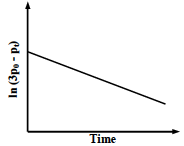
- Option B:
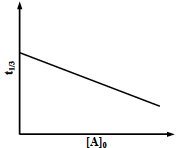
- Option C:
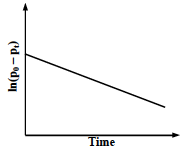
- Option D:
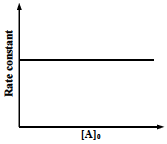
Answer: A, DStep-by-step solution → - Question 21Chemistry· Thermodynamics & Thermochemistry
For a reaction, , the plots of and with time at temperatures and are given below.

If T > T, the correct statement(s) is (are) (Assume H and S are independent of temperature and ratio of at to at is greater than . Here and are enthalpy, entropy, Gibbs energy and equilibrium constant, respectively.)
- Option A:
- Option B:
- Option C:
- Option D:
Answer: A, CStep-by-step solution → - Question 22Chemistry· Metallurgy
Galena (an ore) is partially oxidized by passing air through it at high temperature. After some time, the passage of
air is stopped, but the heating is continued in a closed furnace such that the contents undergo self-reduction.
The weight (in kg ) of Pb produced per kg of consumed is .
(Atomic weights in )
Answer: 6.47Step-by-step solution → - Question 23Chemistry· Redox Reactions
To measure the quantity of dissolved in an aqueous solution, it was completely converted to
using the reaction, (equation not
balanced). Few drops of concentrated HCl were added to this solution and gently warmed. Further, oxalic acid
( 225 mg ) was added in portions till the colour of the permanganate ion disappeared. The quantity of (in
mg ) present in the initial solution is
(Atomic weights in )
Answer: 126Step-by-step solution → - Question 24Chemistry· Thermodynamics & Thermochemistry
The surface of copper gets tarnished by the formation of copper oxide. gas was passed to prevent the oxide
formation during heating of copper at 1250 K . However, the gas contains of water vapour as
impurity. The water vapour oxidises copper as per the reaction given below:
is the minimum partial pressure
of (in bar) needed to prevent the oxidation at 1250 K . The value of is
(Given: total pressure bar, (universal gas constant)
and are mutually immiscible.
Answer: -14.6Step-by-step solution → - Question 25Chemistry· Thermodynamics & Thermochemistry
Consider an electrochemical cell: . The value of for the
cell reaction is twice that of at 300 K . If the emf of the cell is zero, the (in ) of the
cell reaction per mole of B formed at 300 K is .
(Given: , R (universal gas constant) and are enthalpy, entropy
and Gibbs energy, respectively.)
Answer: -11.62Step-by-step solution → - Question 26Chemistry· Coordination Compounds
Match each set of hybrid orbitals from LIST-I with complex(es) given in LIST-II. The correct option is
LIST-I LIST-II P. 1. Q. 2. R. 3. S. 4. 5. 6. - Option A:
- Option B:
- Option C:
- Option D:
Answer: CStep-by-step solution → - Question 27Chemistry· Ionic Equilibrium
Dilution processes of different aqueous solutions, with water, are given in LIST-I. The effects of dilution of the solutions on are given in LIST-II.
(Note: Degree of dissociation ( ) of weak acid and weak base is ; degree of hydrolysis of salt ; represents the concentration of ions)
LIST-I LIST-II P. of of 0.1 M acetic acid) diluted to 60 mL 1. the value of does not change on dilution Q. ( 20 mL of of 0.1 M acetic acid) diluted to 80 mL 2. the value of changes to half of its initial value on dilution R. of of 0.1 M ammonia solution) diluted to 80 mL 3. the value of changes to two times of its initial value on dilution S. 10 mL saturated solution of in equilibrium with excess solid is diluted to 20 mL (solid is still present after dilution). 4. the value of changes to times of its initial value on dilution 5. the value of changes to times of its initial value on dilution Match each process given in LIST-I with one or more effect(s) in LIST-II. The correct option is
- Option A:
- Option B:
- Option C:
- Option D:
Answer: DStep-by-step solution → - Question 28Mathematics· Inverse Trigonometric Functions
For any positive integer , define as (Here, the inverse trigonometric function assumes values in ) Then, which of the following statement(s) is (are) TRUE ?
- Option A:
- Option B:
- Option C:
For any fixed positive integer
- Option D:
For any fixed positive integer
Answer: DStep-by-step solution → - Question 29Mathematics· Circles
Let T be the line passing through the points and . Let be the set of all pairs of circles such that is tangent to at and tangent to at , and also such that and touch each other at a point, say, . Let be the set representing the locus of as the pair varies in . Let the set of all straight line segments joining a pair of distinct points of and passing through the point be . Let be the set of the mid-points of the line segments in the set . Then, which of the following statement(s) is (are) TRUE?
- Option A:
The point lies in
- Option B:
The point does NOT lie in
- Option C:
The point lies in
- Option D:
The point does NOT lie in
Answer: B, DStep-by-step solution → - Question 30Mathematics· Determinants
Let S be the set of all column matrices such that and the system of equations (in real variables) has at least one solution. Then, which of the following system(s) (in real variables) has (have) at least one solution for each ?
- Option A:
and
- Option B:
and
- Option C:
and
- Option D:
and
Answer: A, DStep-by-step solution → - Question 31Mathematics· Ellipse
Consider two straight lines, each of which is tangent to both the circle and the parabola . Let these lines intersect at the point Q . Consider the ellipse whose center is at the origin and whose semi-major axis is OQ. If the length of the minor axis of this ellipse is , then which of the following statement(s) is (are) TRUE?
- Option A:
For the ellipse, the eccentricity is and the length of the latus rectum is 1
- Option B:
For the ellipse, the eccentricity is and the length of the latus rectum is
- Option C:
The area of the region bounded by the ellipse between the lines and is
- Option D:
The area of the region bounded by the ellipse between the lines and is
Answer: A, CStep-by-step solution → - Question 32Mathematics· Complex Numbers
Let be non-zero complex numbers and L be the set of solutions of
the equation , where . Then, which of the following statement(s) is (are) TRUE?
- Option A:
If L has exactly one element, then
- Option B:
If , then L has infinitely many elements
- Option C:
The number of elements in is at most 2
- Option D:
If L has more than one element, then L has infinitely many elements
Answer: A, C, DStep-by-step solution → - Question 33Mathematics· Limits, Continuity and Differentiability
Let be a twice differentiable function such that If , then which of the following statement(s) is (are) TRUE ?
- Option A:
- Option B:
for all
- Option C:
There exists such that
- Option D:
Answer: B, C, DStep-by-step solution → - Question 34Mathematics· Definite Integration
The value of the integral is .
Answer: 2Step-by-step solution → - Question 35Mathematics· Determinants
Let P be a matrix of order such that all the entries in P are from the set . Then, the maximum possible value of the determinant of is .
Answer: 4Step-by-step solution → - Question 36Mathematics· Functions
Let X be a set with exactly 5 elements and Y be a set with exactly 7 elements. If is the number of oneone functions from to and is the number of onto functions from to , then the value of is .
Answer: 119Step-by-step solution → - Question 37Mathematics· Differential Equations
Let be a differentiable function with . If satisfies the differential equation then the value of is .
Answer: 0.4Step-by-step solution → - Question 38Mathematics· Functions
Let be a differentiable function with and satisfying the equation
for all .
Then, the value of is
Answer: 2Step-by-step solution → - Question 39Mathematics· 3D Geometry
Let P be a point in the first octant, whose image Q in the plane (that is, the line segment PQ is perpendicular to the plane and the mid-point of PQ lies in the plane ) lies on the -axis. Let the distance of P from the x -axis be 5 . If R is the image of P in the xy-plane, then the length of PR is .
Answer: 8Step-by-step solution → - Question 40Mathematics· Vector Algebra
Consider the cube in the first octant with sides OP, OQ and OR of length 1, along the x -axis, y -axis and z-axis,
respectively, where is the origin. Let be the centre of the cube and T be the vertex of
the cube opposite to the origin O such that S lies on the diagonal OT. If and
, then the value of is .
Answer: 0.5Step-by-step solution → - Question 41Mathematics· Binomial Theorem
Let where denote binomial coefficients. Then the value of is .
Answer: 646Step-by-step solution → - Question 42Mathematics· Functions
Let and and is a real number (Here, the inverse trigonometric function assumes values in .) Let be the function defined by and be the function defined by .
LIST-I LIST-II P. The range of is 1. Q. The range of contains 2. R. The domain of contains 3. S. The domain of is 4. 5. 6. - Option A:
- Option B:
- Option C:
- Option D:
Answer: AStep-by-step solution → - Question 43Mathematics· Permutations and Combinations
In a high school, a committee has to be formed from a group of 6 boys and 5
girls .
(i) Let be the total number of ways in which the committee can be formed such that the committee has 5 members, having exactly 3 boys and 2 girls.
(ii) Let be the total number of ways in which the committee can be formed such that the committee has at least 2 members, and having an equal number of boys and girls.
(iii) Let be the total number of ways in which the committee can be formed such that the committee has 5 members, at least 2 of them being girls.
(iv) Let be the total number of ways in which the committee can be formed such that the committee has 4 members, having atleast 2 girls and such that both and are NOT in the committee together.
LIST-I LIST-II P. The value of is 1. 136 Q. The value of is 2. 189 R. The value of is 3. 192 S. The value of is 4. 200 5. 381 6. 461 - Option A:
- Option B:
- Option C:
- Option D:
Answer: CStep-by-step solution → - Question 44Mathematics· Hyperbola
Let , where , be a hyperbola in the xy-plane whose conjugate axis LM subtends an angle of at one of its vertices . Let the area of the triangle LMN be .
LIST-I LIST-II P. The length of the conjugate axis of H is 1. 8 Q. The eccentricity of H is 2. R. The distance between the foci of H is 3. S. The length of the latus rectum of H is 4. 4 - Option A:
- Option B:
- Option C:
- Option D:
Answer: BStep-by-step solution → - Question 45Mathematics· Limits, Continuity and Differentiability
Let and be functions defined by
(i) ,
(ii) , where the inverse trigonometric function assumes values in ,
(iii) , where, for denotes the greatest integer less than or equal to ,
(iv) .
LIST-I LIST-II P. The function is 1. NOT continuous at Q. The function is 2. continuous at and NOT differentiable at R. The function is 3. differentiable at and its derivative is NOT continuous at S. The function is 4. differentiable at and its derivative is continuous at - Option A:
- Option B:
- Option C:
; Q
- Option D:
Answer: DStep-by-step solution →
Stuck on one of these?
Practise questions like them — free, with a tutor that explains every step.