JEE Advanced 2018 · previous year paper
JEE Advanced 2018 — Paper 1
48 questions with the verified answer key. Open any question for its step-by-step solution.
- Question 1Physics· Gravitation
The potential energy of a particle of mass at a distance from a fixed point is given by , where is a positive constant of appropriate dimensions. This particle is moving in a circular orbit of radius about the point . If is the speed of the particle and is the magnitude of its angular momentum about , which of the following statements is (are) true?
- Option A:
- Option B:
- Option C:
- Option D:
Answer: B, CStep-by-step solution → - Question 2Physics· Rotational Dynamics
Consider a body of mass 1.0 kg at rest at the origin at time . A force is applied on the body, where and . The torque acting on the body about the origin at time is . Which of the following statements is (are) true?
- Option A:
- Option B:
The torque is in the direction of the unit vector
- Option C:
The velocity of the body at is
- Option D:
The magnitude of displacement of the body at is
Answer: A, CStep-by-step solution → - Question 3Physics· Mechanical Properties of Matter
A uniform capillary tube of inner radius is dipped vertically into a beaker filled with water. The water rises to a height in the capillary tube above the water surface in the beaker. The surface tension of water is . The angle of contact between water and the wall of the capillary tube is . Ignore the mass of water in the meniscus. Which of the following statements is (are) true?
- Option A:
For a given material of the capillary tube, h decreases with increase in
- Option B:
For a given material of the capillary tube, h is independent of
- Option C:
If this experiment is performed in a lift going up with a constant acceleration, then decreases
- Option D:
is proportional to contact angle
Answer: AStep-by-step solution → - Question 4Physics· Electromagnetic Induction
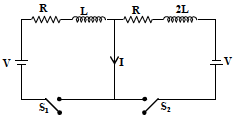
In the figure below, the switches and are closed simultaneously at and a current starts to flow in the circuit. Both the batteries have the same magnitude of the electromotive force (emf) and the polarities are as indicated in the figure. Ignore mutual inductance between the inductors. The current in the middle wire reaches its maximum magnitude at time . Which of the following statements is (are) true?
- Option A:
- Option B:
- Option C:
- Option D:
Answer: B, DStep-by-step solution → - Question 5Physics· Moving Charges and Magnetic Field
Two infinitely long straight wires lie in the -plane along the lines . The wire located at carries a constant current and the wire located at carries a constant current . A circular loop of radius is suspended with its centre at and in a plane parallel to the -plane. This loop carries a constant current in the clockwise direction as seen from above the loop. The current in the wire is taken to be positive if it is in the direction. Which of the following statements regarding the magnetic field is (are) true?
- Option A:
If , then cannot be equal to zero at the origin
- Option B:
If , and , then can be equal to zero at the origin
- Option C:
If , and , then can be equal to zero at the origin
- Option D:
If , then the -component of the magnetic field at the centre of the loop is
Answer: A, B, DStep-by-step solution → - Question 6Physics· Thermodynamics
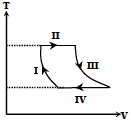
One mole of a monatomic ideal gas undergoes a cyclic process as shown in the figure (where is the volume and is the temperature). Which of the statements below is (are) true?
- Option A:
Process I is an isochoric process
- Option B:
In process II, gas absorbs heat
- Option C:
In process IV, gas releases heat
- Option D:
Processes I and III are not isobaric
Answer: B, C, DStep-by-step solution → - Question 7Physics· Vectors and Scalars
Two vectors and are defined as and , where is a constant and
. If at time for the first time, the value of , in seconds,
is -.
Answer: 2Step-by-step solution → - Question 8Physics· Sound Waves
Two men are walking along a horizontal straight line in the same direction. The man in front walks at a speed and the man behind walks at a speed . A third man is standing at a height 12 m above the same horizontal line such that all three men are in a vertical plane. The two walking men are blowing identical whistles which emit a sound of frequency 1430 Hz . The speed of sound in air is . At the instant, when the moving men are 10 m apart, the stationary man is equidistant from them. The frequency of beats in Hz , heard by the stationary man at this instant, is -.
Answer: 5Step-by-step solution → - Question 9Physics· Rotational Dynamics
A ring and a disc are initially at rest, side by side, at the top of an inclined plane which makes an angle with the horizontal. They start to roll without slipping at the same instant of time along the shortest path. If the time difference between their reaching the ground is , then the height of the top of the inclined plane, in metres, is . Take .
Answer: 0.75Step-by-step solution → - Question 10Physics· System Of Particles
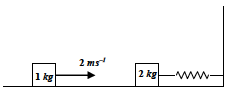
A spring-block system is resting on a frictionless floor as shown in the figure. The spring constant is 2.0 N m -1 and the mass of the block is 2.0 kg . Ignore the mass of the spring. Initially the spring is in an unstretched condition. Another block of mass 1.0 kg moving with a speed of collides elastically with the first block. The collision is such that the 2.0 kg block does not hit the wall. The distance, in metres, between the two blocks when the spring returns to its unstretched position for the first time after the collision is -.
 Answer: 2.09Step-by-step solution →
 - Question 11Physics· Capacitors and R-C Circuits
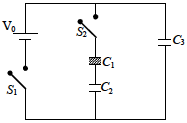
Three identical capacitors and have a capacitance of each and they are uncharged initially. They are connected in a circuit as shown in the figure and is then filled completely with a dielectric material of relative permittivity . The cell electromotive force (emf) . First the switch is closed while the switch is kept open. When the capacitor is fully charged, is opened and is closed simultaneously. When all the capacitors reach equilibrium, the charge on is found to be . The value of .
 Answer: 1.5Step-by-step solution →
 - Question 12Physics· Moving Charges and Magnetic Field
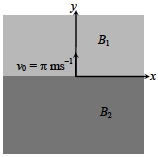
In the -plane, the region has a uniform magnetic field and the region has another uniform magnetic field . A positively charged particle is projected from the origin along the positive -axis with speed at , as shown in the figure. Neglect gravity in this problem. Let be the time when the particle crosses the -axis from below for the first time. If , the average speed of the particle, in , along the -axis in the time interval is .
 Answer: 2Step-by-step solution →
 - Question 13Physics· Geometrical Optics
Sunlight of intensity is incident normally on a thin convex lens of focal length 20 cm . Ignore the energy loss of light due to the lens and assume that the lens aperture size is much smaller than its focal length. The average intensity of light, in , at a distance 22 cm from the lens on the other side is .
Answer: 130Step-by-step solution → - Question 14Physics· Heat Transfer
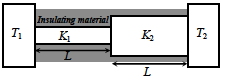
Two conducting cylinders of equal length but different radii are connected in series between two heat baths kept at temperatures and , as shown in the figure. The radius of the bigger cylinder is twice that of the smaller one and the thermal conductivities of the materials of the smaller and the larger cylinders are and respectively. If the temperature at the junction of the two cylinders in the steady state is 200 K , then .
 Answer: 4Step-by-step solution →
 - Question 15Chemistry· p-Block Elements (Group 15-18)
The compound(s) which generate(s) gas upon thermal decomposition below is (are)
- Option A:
- Option B:
- Option C:
- Option D:
Answer: B, CStep-by-step solution → - Question 16Chemistry· Coordination Compounds
The correct statement(s) regarding the binary transition metal carbonyl compounds is (are)
(Atomic numbers: )
- Option A:
Total number of valence shell electrons at metal centre in or is 16
- Option B:
These are predominantly low spin in nature
- Option C:
Metal-carbon bond strengthens when the oxidation state of the metal is lowered
- Option D:
The carbonyl C-O bond weakens when the oxidation state of the metal is increased
Answer: B, CStep-by-step solution → - Question 17Chemistry· p-Block Elements (Group 15-18)
ased on the compounds of group 15 elements, the correct statement(s) is (are)
- Option A:
is more basic than
- Option B:
is more covalent than
- Option C:
boils at lower temperature than
- Option D:
The single bond is stronger than the single bond
Answer: A, B, CStep-by-step solution → - Question 18Chemistry· Thermodynamics & Thermochemistry
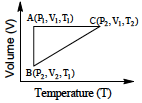
A reversible cyclic process for an ideal gas is shown below. Here, , and are pressure, volume and temperature, respectively. The thermodynamic parameters and are heat, work, enthalpy and internal energy, respectively. The correct option(s) is (are)
- Option A:
and
- Option B:
and
- Option C:
and
- Option D:
and
Answer: B, CStep-by-step solution → - Question 19Chemistry· Coordination Compounds
Among the species given below, the total number of diamagnetic species is .
H atom, monomer, (superoxide), dimeric sulphur in vapour phase,
Answer: 1Step-by-step solution → - Question 20Chemistry· Coordination Compounds
The ammonia prepared by treating ammonium sulphate with calcium hydroxide is completely used by
to form a stable coordination compound. Assume that both the reactions are complete.
If 1584 g of ammonium sulphate and 952 g of are used in the preparation, the combined weight
(in grams) of gypsum and the nickel-ammonia coordination compound thus produced is .
(Atomic weights in )
Answer: 2992Step-by-step solution → - Question 21Chemistry· Solid State
Consider an ionic solid MX with NaCl structure. Construct a new structure ( ) whose unit cell is constructed from the unit cell of MX following the sequential instructions given below. Neglect the charge balance. (i) Remove all the anions ( ) except the central one (ii) Replace all the face centered cations (M) by anions ( (iii) Remove all the corner cations (M) (iv) Replace the central anion (X) with cation (M) The value of in is .
Answer: 3Step-by-step solution → - Question 22Chemistry· Electrochemistry
F or the electrochemical cell,
the standard emf of the cell is 2.70 V at 300 K . When the concentration of is changed to ,
the cell potential changes to 2.67 V at 300 K . The value of is .
(given, , where is the Faraday constant and is the gas constant, )
Answer: 10Step-by-step solution → - Question 23Chemistry· States of Matter - Gaseous State
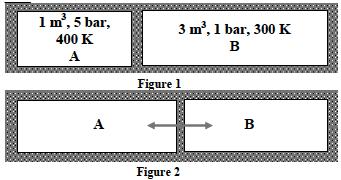
A closed tank has two compartments and , both filled with oxygen (assumed to be ideal gas). The partition separating the two compartments is fixed and is a perfect heat insulator (Figure 1). If the old partition is replaced by a new partition which can slide and conduct heat but does NOT allow the gas to leak across (Figure 2), the volume (in ) of the compartment after the system attains equilibrium is
 Answer: 2.22Step-by-step solution →
 - Question 24Chemistry· Solutions and Colligative Properties
Liquids and form ideal solution over the entire range of composition. At temperature , equimolar binary solution of liquids and has vapour pressure 45 Torr. At the same temperature, a new solution of and having mole fractions and , respectively, has vapour pressure of 22.5 Torr. The value of in the new solution is -. (given that the vapour pressure of pure liquid is 20 Torr at temperature T )
Answer: 19Step-by-step solution → - Question 25Chemistry· Ionic Equilibrium
The solubility of a salt of weak acid ( ) at pH 3 is . The value of is .
(Given that the value of solubility product of and the value
of ionization constant of HB
Answer: 4.47Step-by-step solution → - Question 26Chemistry· Solutions and Colligative Properties
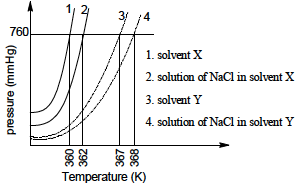
The plot given below shows curves (where is the pressure and is the temperature) for two solvents and and isomolal solutions of NaCl in these solvents. NaCl completely dissociates in both the solvents. On addition of equal number of moles of a non-volatile solute in equal amount (in kg ) of these solvents, the elevation of boiling point of solvent is three times that of solvent . Solute is known to undergo dimerization in these solvents. If the degree of dimerization is 0.7 in solvent , the degree of dimerization in solvent is .
 Answer: 0.05Step-by-step solution →
 - Question 27Mathematics· Complex Numbers
For a non-zero complex number , let denote the principal with . Then, which of the following statement(s) is (are) FALSE ?
- Option A:
, where
- Option B:
The function , defined by for all , is continuous at all points of , where
- Option C:
For any two non-zero complex numbers and is an integer multiple of
- Option D:
For any three given distinct complex numbers and , the locus of the point satisfying the condition , lies on a straight line
Answer: CStep-by-step solution → - Question 28Mathematics· properties of traingles
In a triangle PQR , let and the sides PQ and QR have lengths and 10 , respectively. Then, which of the following statement(s) is (are) TRUE ?
- Option A:
- Option B:
The area of the triangle PQR is and
- Option C:
The radius of the incircle of the triangle PQR is
- Option D:
The area of the circumcircle of the triangle PQR is
Answer: B, C, DStep-by-step solution → - Question 29Mathematics· 3D Geometry
Let and be two planes. Then, which of the following statement(s) is (are) TRUE ?
- Option A:
The line of intersection of and has direction ratios 1, 2, -1
- Option B:
The line is perpendicular to the line of intersection of and
- Option C:
The acute angle between and is
- Option D:
If is the plane passing through the point and perpendicular to the line of intersection of and , then the distance of the point from the plane is
Answer: C, DStep-by-step solution → - Question 30Mathematics· Limits, Continuity and Differentiability
For the curve lying in the first quadrant
, where L exists and is non zero. Then
- Option A:
- Option B:
- Option C:
- Option D:
Answer: B, DStep-by-step solution → - Question 31Mathematics· Methods of Differentiation
Let and be two non-constant differentiable functions. If
for all ,
and , then which of the following statement(s) is (are) TRUE ?
- Option A:
- Option B:
- Option C:
- Option D:
Answer: B, CStep-by-step solution → - Question 32Mathematics· Definite Integration
Let be a continuous function such that for all
. Then, which of the following statement(s) is (are) TRUE ?
- Option A:
The curve passes through the point
- Option B:
The curve passes through the point
- Option C:
The area of the region is
- Option D:
The area of the region is
Answer: B, CStep-by-step solution → - Question 33Mathematics· Logrithms
The value of is .
Answer: 8Step-by-step solution → - Question 34Mathematics· Permutations and Combinations
The number of 5 digit numbers which are divisible by 4 , with digits from the set and the repetition of digits is allowed, is .
Answer: 625Step-by-step solution → - Question 35Mathematics· Sequence and Series
Let X be the set consisting of the first 2018 terms of the arithmetic progression . , and Y be the set consisting of the first 2018 terms of arithmetic progression . . Then, the number of elements in the set is .
Answer: 3748Step-by-step solution → - Question 36Mathematics· Inverse Trigonometric Functions
The number of real solutions of the equation
lying in the interval is .
(Here, the inverse trigonometric functions and assume values in and ,
respectively.)
Answer: 2Step-by-step solution → - Question 37Mathematics· Definite Integration
For each positive integer n , let For , let be the greatest integer less than or equal to . If , then the value of [L] is .
Answer: 1Step-by-step solution → - Question 38Mathematics· Vector Algebra
Let and be two unit vectors such that . For some , let . If and the vector is inclined at the same angle to both and , then the value of is .
Answer: 3Step-by-step solution → - Question 39Mathematics· Trigonometry Ratios and Identities
Let be three non-zero real numbers such that the equation
has two distinct real roots and with . Then, the value of is .
Answer: 0.5Step-by-step solution → - Question 40Mathematics· Area under the Curves
A farmer has a land in the shape of a triangle with vertices at and . From this land, a neighbouring farmer takes away the region which lies between the side PQ and a curve of the form . If the area of the region taken away by the farmer is exactly of the area of , then the value of is .
Answer: 4Step-by-step solution → - Question 41Physics· Units, Dimensions & Error Analysis
In electromagnetic theory, the electric and magnetic phenomena are related to each other. Therefore, the dimensions of electric and magnetic quantities must also be related to each other. In the questions below, and stand for dimensions of electric and magnetic fields respectively, while and stand for dimensions of the permittivity and permeability of free space respectively. [L] and are dimensions of length and time respectively. All the quantities are given in SI units.
The relation between and is
- Option A:
- Option B:
- Option C:
- Option D:
Answer: CStep-by-step solution → - Question 42Physics· Units, Dimensions & Error Analysis
In electromagnetic theory, the electric and magnetic phenomena are related to each other. Therefore, the dimensions of electric and magnetic quantities must also be related to each other. In the questions below, and stand for dimensions of electric and magnetic fields respectively, while and stand for dimensions of the permittivity and permeability of free space respectively. [L] and are dimensions of length and time respectively. All the quantities are given in SI units.
The relation between and is
- Option A:
- Option B:
- Option C:
- Option D:
Answer: DStep-by-step solution → - Question 43Physics· Units, Dimensions & Error Analysis
Consider the ratio to be determined by measuring a dimensionless quantity . If the error in the measurement of is (), then what is the error in determining ?
- Option A:
- Option B:
- Option C:
- Option D:
Answer: BStep-by-step solution → - Question 44Physics· Units, Dimensions & Error Analysis
If the measurement errors in all the independent quantities are known, then it is possible to determine the error in
any dependent quantity. This is done by the use of series expansion and truncating the expansion at the first
power of the error. For example, consider the relation . If the errors in and are and ,
respectively, then
The series expansion for , to first power in , is . The relative errors in
independent variables are always added. So the error in will be
The above derivation makes the assumption that . Therefore, the higher powers of
these quantities are neglected.
In an experiment the initial number of radioactive nuclei is 3000. It is found that nuclei decayed in the first 1.0s. For , up to first power in . The error , in the determination of the decay constant , in s, is
- Option A:
0.04
- Option B:
0.03
- Option C:
0.02
- Option D:
0.01
Answer: CStep-by-step solution → - Question 45Mathematics· Circles
Let EE and FF be the chords of S passing through the point P(1, 1) and parallel to the x-axis and the y-axis, respectively. Let GG be the chord of S passing through P and having slope . Let the tangents to S at E and E meet at E, the tangents to S at F and F meet at F, and the tangents to S at G and G meet at G. Then, the points E, F and G lie on the curve
- Option A:
- Option B:
- Option C:
- Option D:
Answer: AStep-by-step solution → - Question 46Mathematics· Circles
Let P be a point on the circle S with both coordinates being positive. Let the tangent to S at P intersect the coordinate axes at the points M and N. Then the mid-point of the line segment MN must lie on the curve
- Option A:
- Option B:
- Option C:
- Option D:
Answer: DStep-by-step solution → - Question 47Mathematics· Probability
The probability that, on the examination day, the student S gets the previously allotted seat R, and NONE of the remaining students gets the seat previously allotted to him/her is
- Option A:
- Option B:
- Option C:
- Option D:
Answer: AStep-by-step solution → - Question 48Mathematics· Probability
There are five students and in a music class and for them there are five seats and arranged in a row, where initially the seat is allotted to the student . But, on the examination day, the five students are randomly allotted the five seats.
For i=1, 2, 3, 4, let T denote the event that the students S and S do NOT sit adjacent to each other on the day of the examination. Then, the probability of the event T T T T is
- Option A:
- Option B:
- Option C:
- Option D:
Answer: CStep-by-step solution →
Stuck on one of these?
Practise questions like them — free, with a tutor that explains every step.