Physics · Atomic Physics
JEE Advanced 2019 — Paper 2 — Question 7
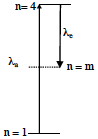
A free hydrogen atom after absorbing a photon of wavelength gets excited from the state to the state
. Immediately after that the electron jumps to state by emitting a photon of wavelength . Let
the change in momentum of atom due to the absorption and the emission are and . respectively. If
, which of the option(s) is /are correct ? [Use hc , h and c are
Planck's constant and speed of light, respectively]
- Option A:
- Option B:Correct
The ratio of kinetic energy of the electron in the state to the state is
- Option C:
- Option D:Correct
Answer: B, D
Step-by-step solution
The energy level diagram is shown in the figure
It is given :
or,
clearly
The ratio of the kinetic energies is also the ratio of the corresponding total energies
correct options are B, D
Answer key and solution verified before publishing.
Practise Atomic Physics
Start with this question, then two more from the same chapter — with a tutor that explains every step. Free.
- Exam
- JEE Advanced 2019
- Paper
- Paper 2
- Subject
- Physics
- Chapter
- Atomic Physics
- Topic
- Hydrogen Spectrum