Mathematics · Straight lines

JEE Main 2026 — 4 April, Morning Shift — Question 34

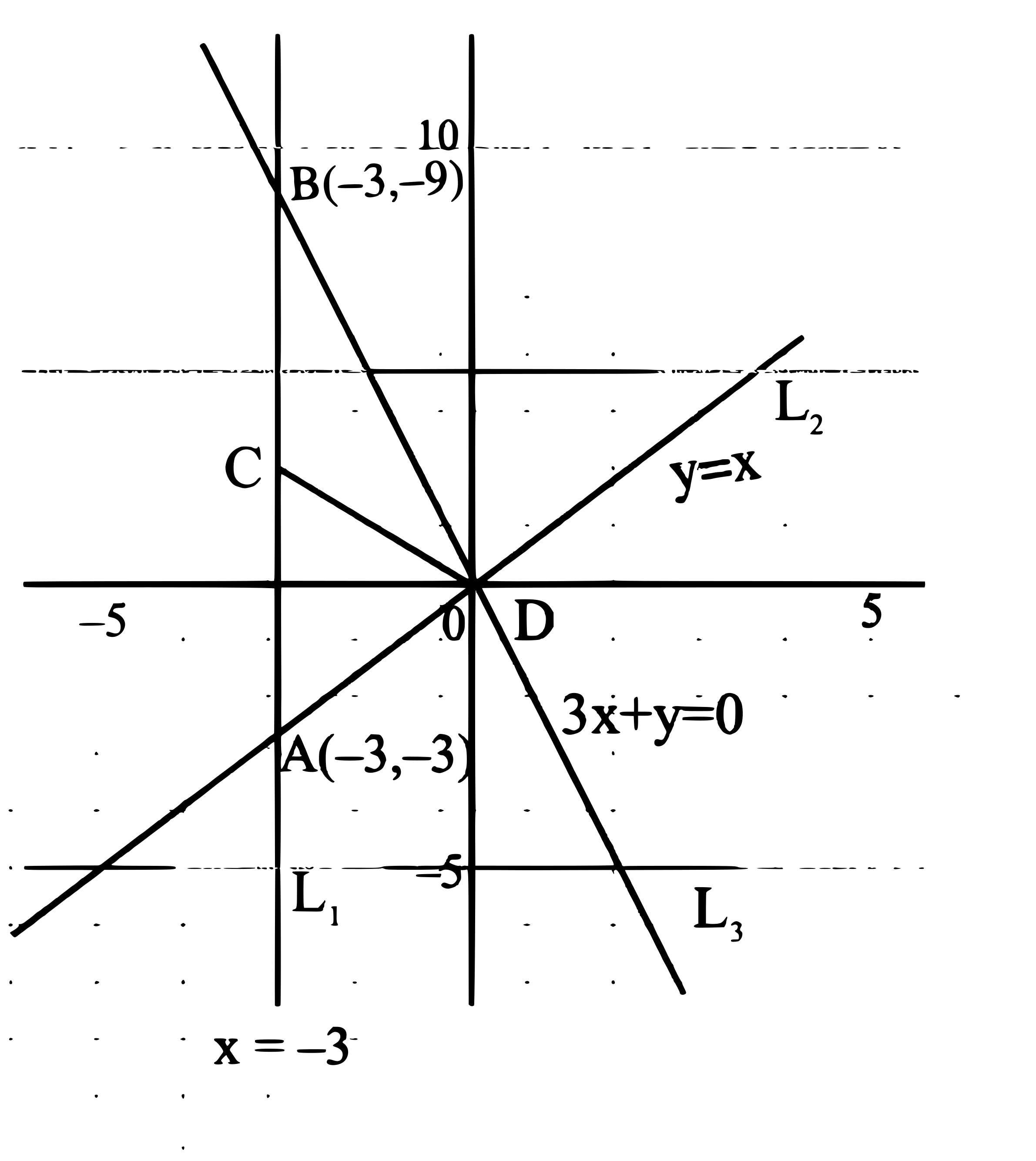
Let the line L1 : x + 3 = 0 intersect the lines L2 : x – y = 0 and L3 : 3x + y = 0 at the points A and B, respectively. Let the bisector of the obtuse angle between the lines L2 and L3 intersect the line L1 at the point C. Then BC² : AC² is equal to :

  1. Option A:

    5:1

    Correct
  2. Option B:

    1:5

  3. Option C:

    2:3

  4. Option D:

    3:2

Answer: A

Step-by-step solution

Finding Coordinates of A and B The line L1L_1 is x=−3x = -3. Point A: Intersection of x=−3x = -3 and x−y=0x - y = 0.

−3−y=0  ⟹  y=−3  ⟹  A=(−3,−3)-3 - y = 0 \implies y = -3 \implies A = (-3, -3)

Point B: Intersection of x=−3x = -3 and 3x+y=03x + y = 0.

3(−3)+y=0  ⟹  y=9  ⟹  B=(−3,9)3(-3) + y = 0 \implies y = 9 \implies B = (-3, 9)

Identifying the Obtuse Angle Bisector For lines L2:x−y=0L_2: x - y = 0 and L3:3x+y=0L_3: 3x + y = 0, the bisectors are:

x−y12+(−1)2=±3x+y32+12  ⟹  x−y2=±3x+y10\frac{x - y}{\sqrt{1^2 + (-1)^2}} = \pm \frac{3x + y}{\sqrt{3^2 + 1^2}} \implies \frac{x - y}{\sqrt{2}} = \pm \frac{3x + y}{\sqrt{10}} 5(x−y)=±(3x+y)\sqrt{5}(x - y) = \pm(3x + y)

To find the obtuse bisector, we check a1a2+b1b2a_1a_2 + b_1b_2:

(1)(3)+(−1)(1)=3−1=2(1)(3) + (-1)(1) = 3 - 1 = 2

Since a1a2+b1b2>0a_1a_2 + b_1b_2 > 0, the positive sign gives the \textbf{obtuse} bisector:

5x−5y=3x+y  ⟹  (5−3)x=(5+1)y\sqrt{5}x - \sqrt{5}y = 3x + y \implies (\sqrt{5} - 3)x = (\sqrt{5} + 1)y

Finding Point C Point CC lies on L1L_1 (x=−3x = -3):

(5−3)(−3)=(5+1)yC  ⟹  yC=9−355+1(\sqrt{5} - 3)(-3) = (\sqrt{5} + 1)y_C \implies y_C = \frac{9 - 3\sqrt{5}}{\sqrt{5} + 1}

Calculating the Ratio BC2:AC2BC^2 : AC^2 Since A,B,CA, B, C are collinear on the vertical line x=−3x = -3, the ratio of distances depends only on yy-coordinates:

BC2AC2=(yB−yCyA−yC)2\frac{BC^2}{AC^2} = \left( \frac{y_B - y_C}{y_A - y_C} \right)^2

Calculating the differences:

yB−yC=9−9−355+1=95+9−9+355+1=1255+1y_B - y_C = 9 - \frac{9 - 3\sqrt{5}}{\sqrt{5} + 1} = \frac{9\sqrt{5} + 9 - 9 + 3\sqrt{5}}{\sqrt{5} + 1} = \frac{12\sqrt{5}}{\sqrt{5} + 1} yA−yC=−3−9−355+1=−35−3−9+355+1=−125+1y_A - y_C = -3 - \frac{9 - 3\sqrt{5}}{\sqrt{5} + 1} = \frac{-3\sqrt{5} - 3 - 9 + 3\sqrt{5}}{\sqrt{5} + 1} = \frac{-12}{\sqrt{5} + 1}

The ratio is:

BC2AC2=(125−12)2=(−5)2=5\frac{BC^2}{AC^2} = \left( \frac{12\sqrt{5}}{-12} \right)^2 = (-\sqrt{5})^2 = 5

Final Answer: BC2:AC2=5:1BC^2 : AC^2 = 5 : 1

Solution figure

Answer key and solution verified before publishing.

Practise Straight lines

Start with this question, then two more from the same chapter — with a tutor that explains every step. Free.

Exam
JEE Main 2026
Subject
Mathematics
Chapter
Straight lines
Topic
Angle bisectors, concurrent lines.
Let the line L1 : x + 3 = 0 intersect the lines L2 : x – y = 0 and L3… | JEE Main 2026 PYQ with Solution · DhiX AI