Mathematics · Straight lines

JEE Main 2026 — 4 April, Morning Shift — Question 35

Let the vertex A of a triangle ABC be (1, 2), and the mid-point of the side AB be (5, –1). If the centroid of this triangle is (3, 4) and its circumcenter is (α, β), then 21(α+β) is equal to :

  1. Option A:

    309

  2. Option B:

    403

  3. Option C:

    497

    Correct
  4. Option D:

    524

Answer: C

Step-by-step solution

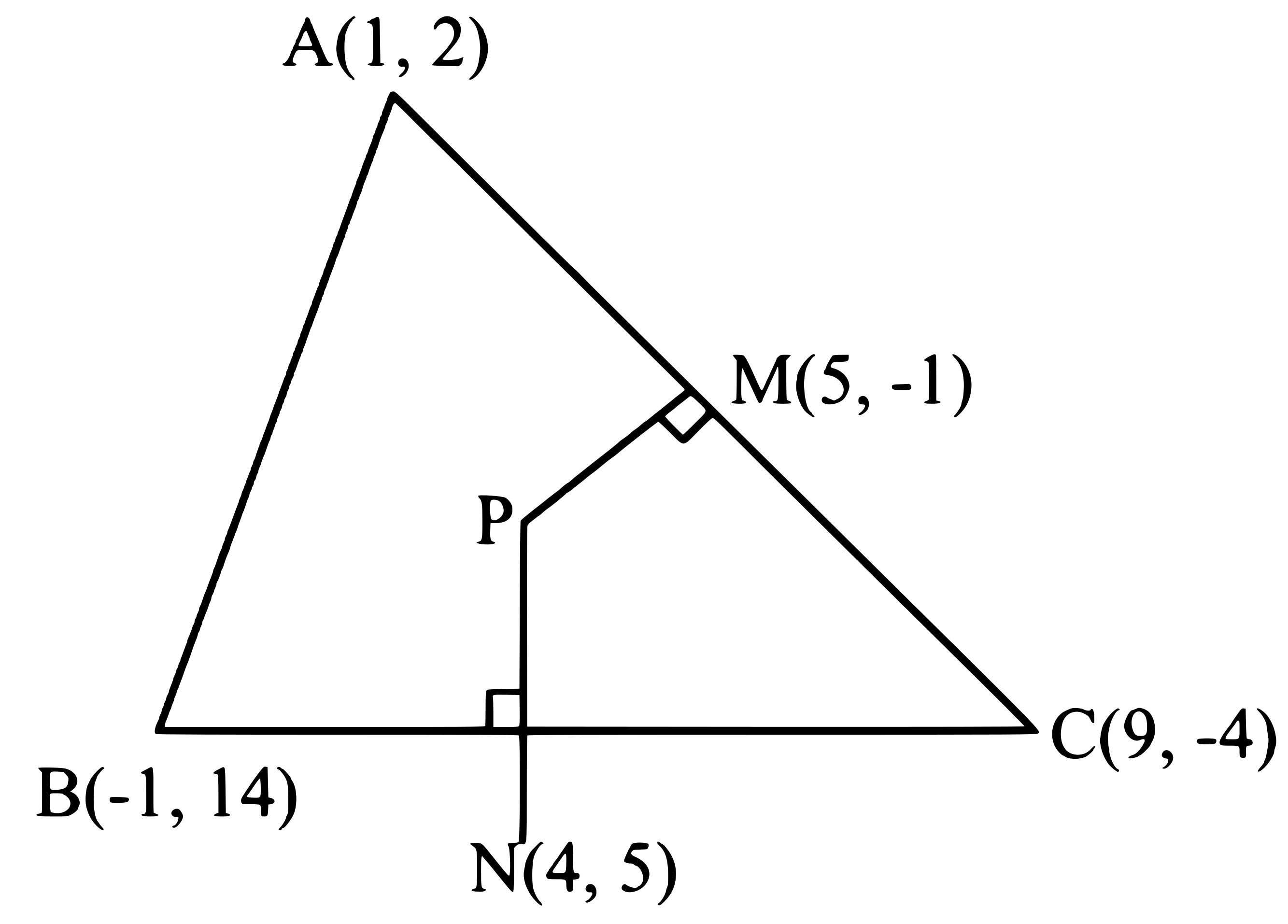
Let A(1,2)A(1,2), midpoint of AB is M(5,−1)M(5,-1). Then B=2M−A=(10−1,−2−2)=(9,−4)B = 2M - A = (10-1, -2-2) = (9,-4). Let centroid G(3,4)G(3,4). For triangle ABC, G=(xA+xB+xC3,yA+yB+yC3)G = \left(\frac{x_A+x_B+x_C}{3}, \frac{y_A+y_B+y_C}{3}\right). Thus 1+9+xC3=3⇒xC=−1\frac{1+9+x_C}{3}=3 \Rightarrow x_C=-1, and 2−4+yC3=4⇒yC=14\frac{2-4+y_C}{3}=4 \Rightarrow y_C=14. So C(−1,14)C(-1,14). Now find circumcenter O(α,β)O(\alpha,\beta) of triangle ABC. It is the intersection of perpendicular bisectors of any two sides. Midpoint of AB is M(5,−1)M(5,-1), slope of AB = −4−29−1=−68=−34\frac{-4-2}{9-1} = \frac{-6}{8} = -\frac{3}{4}.

So slope of perpendicular bisector of AB = 43\frac{4}{3}.

Equation: y+1=43(x−5)⇒3y+3=4x−20⇒4x−3y=23y+1 = \frac{4}{3}(x-5) \Rightarrow 3y+3 = 4x-20 \Rightarrow 4x-3y=23. Midpoint of BC: B(9,−4),C(−1,14)B(9,-4), C(-1,14) gives midpoint N(4,5)N(4,5).

Slope of BC = 14+4−1−9=18−10=−95\frac{14+4}{-1-9} = \frac{18}{-10} = -\frac{9}{5}.

So slope of perpendicular bisector of BC = 59\frac{5}{9}. Equation: y−5=59(x−4)⇒9y−45=5x−20⇒5x−9y=−25y-5 = \frac{5}{9}(x-4) \Rightarrow 9y-45 = 5x-20 \Rightarrow 5x-9y = -25. Solve 4x−3y=234x-3y=23 and 5x−9y=−255x-9y=-25. Multiply first by 3: 12x−9y=6912x-9y=69.

Subtract second: (12x−9y)−(5x−9y)=69−(−25)⇒7x=94⇒x=947(12x-9y)-(5x-9y)=69-(-25) \Rightarrow 7x=94 \Rightarrow x = \frac{94}{7}.

Then 4⋅947−3y=23⇒3767−3y=23⇒3y=3767−1617=2157⇒y=215214\cdot\frac{94}{7} - 3y = 23 \Rightarrow \frac{376}{7} - 3y = 23 \Rightarrow 3y = \frac{376}{7} - \frac{161}{7} = \frac{215}{7} \Rightarrow y = \frac{215}{21}.

So α=947,β=21521\alpha = \frac{94}{7}, \beta = \frac{215}{21}. Then α+β=947+21521=28221+21521=49721\alpha+\beta = \frac{94}{7} + \frac{215}{21} = \frac{282}{21} + \frac{215}{21} = \frac{497}{21}.

Hence 21(α+β)=49721(\alpha+\beta) = 497.

Solution figure

Answer key and solution verified before publishing.

Practise Straight lines

Start with this question, then two more from the same chapter — with a tutor that explains every step. Free.

Exam
JEE Main 2026
Subject
Mathematics
Chapter
Straight lines
Topic
Special Points in a Triangle