Mathematics · Limits, Continuity and Differentiability

JEE Main 2024 — 5 April, Shift 2 — Question 26

Let a>0\mathrm{a}>0 be a root of the equation 2x2+x−2=02 \mathrm{x}^{2}+\mathrm{x}-2=0. If lim⁡x→1a16(1−cos⁡(2+x−2x2))(1−ax2)=α+β17\lim _{x \rightarrow \frac{1}{a}} \frac{16\left(1-\cos \left(2+x-2 x^{2}\right)\right)}{\left(1-a x^{2}\right)}=\alpha+\beta \sqrt{17},

where α,β∈Z\alpha, \beta \in \mathrm{Z} then α+β\alpha+\beta is equal to \qquad

Answer: 170

Numerical answer — enter this value.

Step-by-step solution
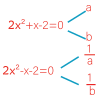
lim⁡x→1a16⋅(1−cos⁡2(x−1a)(x−1b))4(x−1b)2×4(x−1b)2a2(x−1a)2\lim _{x \rightarrow \frac{1}{a}} 16 \cdot \frac{\left(1-\cos 2\left(x-\frac{1}{a}\right)\left(x-\frac{1}{b}\right)\right)}{4\left(x-\frac{1}{b}\right)^{2}} \times \frac{4\left(x-\frac{1}{b}\right)^{2}}{a^{2}\left(x-\frac{1}{a}\right)^{2}}

=16×2a2(1a−1 b)2=16 \times \frac{2}{\mathrm{a}^{2}}\left(\frac{1}{\mathrm{a}}-\frac{1}{\mathrm{~b}}\right)^{2}

=32a2(174)=17.8a2=17×8×16(−1+117)2=\frac{32}{\mathrm{a}^{2}}\left(\frac{17}{4}\right)=\frac{17.8}{\mathrm{a}^{2}}=\frac{17 \times 8 \times 16}{(-1+\sqrt{117})^{2}} =136.1618.27×18+2718+27=\frac{136.16}{18.2 \sqrt{7}} \times \frac{18+2 \sqrt{7}}{18+2 \sqrt{7}}

=136256(18+27)⋅16=\frac{136}{256}(18+2 \sqrt{7}) \cdot 16

=153+1717=α+β17=153+17 \sqrt{17}=\alpha+\beta \sqrt{17}

α+β=153+17=170\alpha+\beta=153+17=170

Solution figure

Answer key and solution verified before publishing.

Practise Limits, Continuity and Differentiability

Start with this question, then two more from the same chapter — with a tutor that explains every step. Free.

Exam
JEE Main 2024
Subject
Mathematics
Chapter
Limits, Continuity and Differentiability
Topic
Indeterminate forms & its solving methods