Physics · Rotational Dynamics
JEE Main 2024 — 27 January, Shift 2 — Question 48
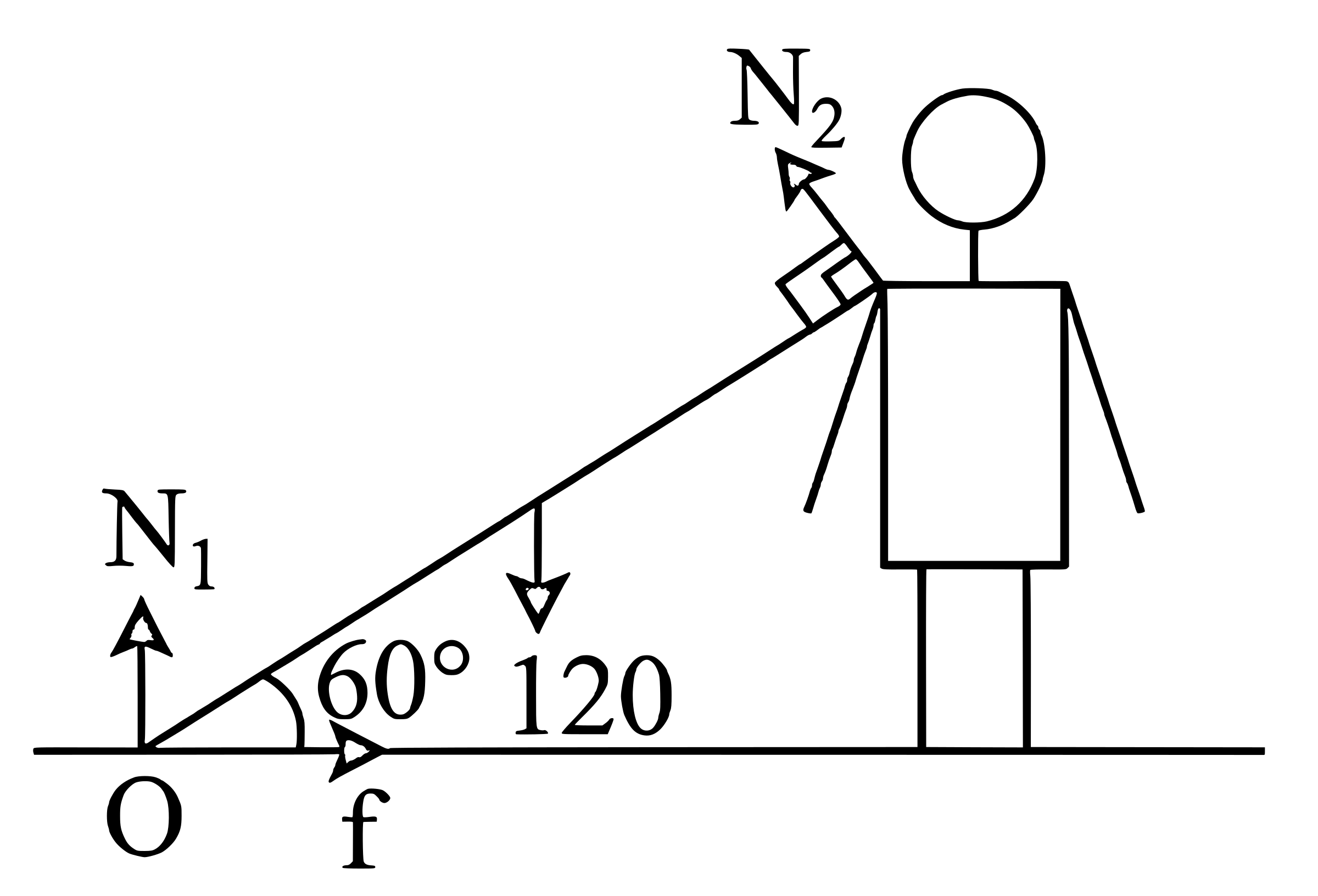
A heavy iron bar of weight 12 kg is having its one end on the ground and the other on the shoulder of a man. The rod makes an angle with the horizontal, the weight experienced by the man is :
- Option A:Correct
6 kg
- Option B:
12 kg
- Option C:
3 kg
- Option D:
Answer: A
Step-by-step solution
Let the mass of the heavy iron bar be . The weight of the bar is . Let the length of the bar be . Since it's a uniform bar (implied by typical physics problems of this nature), its weight acts at its center of mass, which is at a distance from either end.
Let be the normal force exerted by the ground on one end of the bar. Let be the force exerted by the man's shoulder on the other end of the bar. This is the "weight experienced by the man".
The bar makes an angle with the horizontal.
To find , we can apply the condition for rotational equilibrium. We will take moments (torques) about the end of the bar resting on the ground (let's call this point O). Taking moments about this point eliminates the normal force from the ground () from the torque equation.
The forces acting on the bar and their lever arms with respect to point O are:
- Weight of the bar (): This acts downwards at the center of mass, which is at a distance from O. The perpendicular distance from O to the line of action of the weight is . This creates a clockwise torque about O.
- Force from the man's shoulder (): This acts upwards at the other end of the bar, which is at a distance from O. The perpendicular distance from O to the line of action of is . This creates a counter-clockwise torque about O.
For rotational equilibrium, the sum of clockwise torques must equal the sum of counter-clockwise torques:
Since and , we can cancel out from both sides of the equation:
The weight is given in terms of mass as . The question asks for the "weight experienced by the man", which typically refers to the effective mass supported by the man. Substituting :
The force experienced by the man is . The "weight experienced by the man" in kilograms refers to the mass equivalent of this force, which is . Given :
The weight experienced by the man is .
The final answer is .
Answer key and solution verified before publishing.
Practise Rotational Dynamics
Start with this question, then two more from the same chapter — with a tutor that explains every step. Free.
- Exam
- JEE Main 2024
- Paper
- 27 January, Shift 2
- Subject
- Physics
- Chapter
- Rotational Dynamics
- Topic
- Torque, Equation of Motion and Toppling