Mathematics · Circles

JEE Main 2025 — 23 January, Morning Shift — Question 23

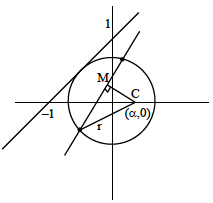
Let the circle C touch the line x−y+1=0\mathrm{x}-\mathrm{y}+1=0, have the centre on the positive x -axis, and cut off a chord of length 413\frac{4}{\sqrt{13}} along the line −3x+2y=1-3 x+2 y=1. Let HH be the hyperbola x2α2−y2β2=1\frac{x^{2}}{\alpha^{2}}-\frac{y^{2}}{\beta^{2}}=1, whose one of the foci is the centre of CC and the length of the transverse axis is the diameter of C . Then 2α2+3β22 \alpha^{2}+3 \beta^{2} is equal to _____\_\_\_\_\_

Answer: 19

Numerical answer — enter this value.

Step-by-step solution

Let   the   centre   of   C   be   (h,0) (h>0). \text{Let\; the\; centre\; of\; }C\; \text{ be\; }(h,0)\ (h>0). Distance   from   (h,0) to   x−y+1=0 is   h+12, so   r=h+12.\text{Distance\; from\; }(h,0)\text{ to\; }x-y+1=0\text{ is\; } \dfrac{h+1}{\sqrt2},\ \text{so\; } r=\dfrac{h+1}{\sqrt2}. Distance   from   (h,0) to   −3x+2y−1=0   is   3h+113.\text{Distance\; from\; }(h,0)\text{ to\; }-3x+2y-1=0\;\text{ is\; } \dfrac{3h+1}{\sqrt{13}}. Chord   length   l=2r2−(3h+1)213=413.\text{Chord\; length\; }l=2\sqrt{r^2-\dfrac{(3h+1)^2}{13}}=\dfrac{4}{\sqrt{13}}. ⇒4(r2−(3h+1)213)=1613;⟹;13r2−(3h+1)2=4.\Rightarrow 4\left(r^2-\dfrac{(3h+1)^2}{13}\right)=\dfrac{16}{13} ;\Longrightarrow;13r^2-(3h+1)^2=4. r2=(h+1)22⇒13(h+1)22−(3h+1)2=4.r^2=\dfrac{(h+1)^2}{2} \Rightarrow 13\frac{(h+1)^2}{2}-(3h+1)^2=4. ⇒5h2−14h−3=0⇒h=14±1610⇒h=3 (positive   root).\Rightarrow 5h^2-14h-3=0 \Rightarrow h=\frac{14\pm16}{10} \Rightarrow h=3\ (\text{positive\; root}). ∴r=3+12=42=22,;r2=8.\therefore r=\dfrac{3+1}{\sqrt2}=\dfrac{4}{\sqrt2}=2\sqrt2,; r^2=8.

Hyperbola   x2α2−y2β2=1 has   foci   (±c,0), c2=α2+β2. \text{Hyperbola\; } \dfrac{x^2}{\alpha^2}-\dfrac{y^2}{\beta^2}=1 \text{ has\; foci\; }(\pm c,0),\ c^2=\alpha^2+\beta^2. One   focus   is   (3,0)⇒c=3⇒α2+β2=9.\text{One\; focus\; is\; }(3,0)\Rightarrow c=3\Rightarrow \alpha^2+\beta^2=9. Transverse   axis   length   2α=diameter   of   C=2r=42⇒α=22⇒α2=8. \text{Transverse\; axis\; length\; }2\alpha=\text{diameter\; of\; }C=2r=4\sqrt2\Rightarrow \alpha=2\sqrt2\Rightarrow \alpha^2=8. ⇒β2=9−8=1. \Rightarrow \beta^2=9-8=1.

∴2α2+3β2=2⋅8+3⋅1=16+3=19.\therefore 2\alpha^2+3\beta^2=2\cdot8+3\cdot1=16+3=19.

19\boxed{19}

Solution figure

Answer key and solution verified before publishing.

Practise Circles

Start with this question, then two more from the same chapter — with a tutor that explains every step. Free.
Exam
JEE Main 2025
Subject
Mathematics
Chapter
Circles
Topic
Considering a Line or a Point wrt a Circle