Physics · Electrostatics

JEE Advanced 2025 — Paper 2 — Question 2

Two co-axial conducting cylinders of same length ℓ\ell with radii 2R\sqrt{2} R and 2R2 R are kept, as shown in Fig. 1. The charge on the inner cylinder is QQ and the outer cylinder is grounded

The annular region between the cylinders is filled with a material of dielectric constant κ=5\kappa=5. Consider an imaginary plane of the same length ℓ\ell at a distance R from the common axis of the cylinders.

This plane is parallel to the axis of the cylinders. The cross-sectional view of this arrangement is shown in Fig. 2. Ignoring edge effects, the flux of the electric field through the plane is ( ϵ0\epsilon_{0} is the permittivity of free space):

figure

s

  1. Option A:

    Q30∈0\frac{\mathrm{Q}}{30 \in_{0}}

  2. Option B:

    Q15ϵ0\frac{\mathrm{Q}}{15 \epsilon_{0}}

  3. Option C:

    Q60ϵ0\frac{\mathrm{Q}}{60 \epsilon_{0}}

    Correct
  4. Option D:

    Q120ϵ0\frac{\mathrm{Q}}{120 \epsilon_{0}}

Answer: C

Step-by-step solution

figure

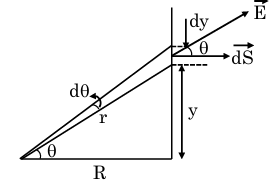
Here we are assuming that " ℓ\ell " is very large just for the sake of symmetry. Outside cylinder will have zero electric field inside, so the flux generated on the plate will be due

to inner cylinder only in sections AB and CD , as section be will be at that place where electric field is zero.

flux through element will be dϕ=E→⋅dS→\mathrm{d} \phi=\overrightarrow{\mathrm{E}} \cdot \overrightarrow{\mathrm{dS}}

dϕ=2kλrdy.ℓ.cos⁡θ\mathrm{d} \phi=\frac{2 \mathrm{k} \lambda}{\mathrm{r}} \mathrm{dy} . \ell . \cos \theta.

from figure we can say that cos⁡θ=Rr⇒r=Rsec⁡θ\cos \theta=\frac{R}{r} \Rightarrow r=R \sec \theta

tan⁡θ=yR⇒y=Rtan⁡θ\tan \theta=\frac{\mathrm{y}}{\mathrm{R}} \Rightarrow \mathrm{y}=\mathrm{R} \tan \theta

⇒dy=Rsec2θ dθ\Rightarrow \mathrm{dy}=\mathrm{Rsec}^{2} \theta \mathrm{~d} \theta

dϕ=2kλRsec⁡θR⋅sec⁡2θ⋅ℓ⋅cos⁡θdθd \phi=\frac{2 k \lambda}{R \sec \theta} R \cdot \sec ^{2} \theta \cdot \ell \cdot \cos \theta d \theta

dϕ=2kλℓdq\mathrm{d} \phi=2 \mathrm{k} \lambda \ell \mathrm{dq}

∫0ϕABdϕ=2kλℓ∫π/4π/3 dθ\int_{0}^{\phi_{\mathrm{AB}}} \mathrm{d} \phi=2 \mathrm{k} \lambda \ell \int_{\pi / 4}^{\pi / 3} \mathrm{~d} \theta

ϕAB=2kλℓ[π3−π4]\phi_{\mathrm{AB}}=2 \mathrm{k} \lambda \ell\left[\frac{\pi}{3}-\frac{\pi}{4}\right]

ϕAB=2kQ[π12]\phi_{\mathrm{AB}}=2 \mathrm{kQ}\left[\frac{\pi}{12}\right]

ϕAB=2×14π∈0∈rQ[π12]\phi_{\mathrm{AB}}=2 \times \frac{1}{4 \pi \in_{0} \in_{\mathrm{r}}} \mathrm{Q}\left[\frac{\pi}{12}\right]

ϕAB=Q120ϵ0\phi_{\mathrm{AB}}=\frac{\mathrm{Q}}{120 \epsilon_{0}}

ϕplate =ϕAB+ϕBC+ϕCD(ϕCD=ϕAB)\phi_{\text {plate }}=\phi_{\mathrm{AB}}+\phi_{\mathrm{BC}}+\phi_{\mathrm{CD}} \quad\left(\phi_{\mathrm{CD}}=\phi_{\mathrm{AB}}\right)

ϕplate =Q60ϵ0\phi_{\text {plate }}=\frac{\mathrm{Q}}{60 \epsilon_{0}}

Solution figure

Answer key and solution verified before publishing.

Practise Electrostatics

Start with this question, then two more from the same chapter — with a tutor that explains every step. Free.

Exam
JEE Advanced 2025
Paper
Paper 2
Subject
Physics
Chapter
Electrostatics
Topic
Electric flux and Gauss's Law
Two co-axial conducting cylinders of same length ell with radii √(2)… | JEE Advanced 2025 PYQ with Solution · DhiX AI