Physics · Electrostatics

JEE Advanced 2025 — Paper 2 — Question 7

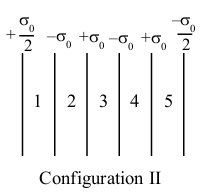
Six infinitely large and thin non-conducting sheets are fixed in configurations I and II. As shown in the figure, the sheets carry uniform surface charge densities which are

indicated in terms of σ0\sigma_{0}. The separation between any two consecutive sheets is 1μ m1 \mu \mathrm{~m}. The various regions between the sheets are denoted as 1,2,3,41,2,3,4 and 5. If σ0=9μC/m2\sigma_{0}=9 \mu \mathrm{C} / \mathrm{m}^{2}, then which of the following statements is/are correct: (Take permittivity of free space ϵ0=9×10⁻¹² F/m\epsilon_{0}=9 \times 10^{-12} \mathrm{~F} / \mathrm{m} ):

figure

  1. Option A:

    In region 4 of the configuration I, the magnitude of the electric field is zero.

    Correct
  2. Option B:

    In region 3 of the configuration II, the magnitude of the electric field is σ0ϵ0\frac{\sigma_{0}}{\epsilon_{0}}.

  3. Option C:

    Potential difference between the first and the last sheets of the configuration I is 5 V

  4. Option D:

    Potential difference between the first and the last sheets of the configuration II is zero

Answer: A

Step-by-step solution

figure

+σ0−σ0+σ0−σ0+σ0−σ0+\sigma_{0}-\sigma_{0}+\sigma_{0}-\sigma_{0}+\sigma_{0}-\sigma_{0}

Configuration I (E4)I=σ02ϵ0[1−1+1−1−1+1]=0\left(\mathrm{E}_{4}\right)_{\mathrm{I}}=\frac{\sigma_{0}}{2 \epsilon_{0}}[1-1+1-1-1+1]=0 (VFirst )I=−σ02ϵ0[−1+2−3+4−5]d\left(V_{\text {First }}\right)_{I}=\frac{-\sigma_{0}}{2 \epsilon_{0}}[-1+2-3+4-5] \mathrm{d}

=−σ02ϵ0[−3]d=σ03 d2ϵ0=\frac{-\sigma_{0}}{2 \epsilon_{0}}[-3] \mathrm{d}=\frac{\sigma_{0} 3 \mathrm{~d}}{2 \epsilon_{0}}

(VLast )I=−σ02ϵ0[1−2+3−4+5]\left(V_{\text {Last }}\right)_{I} =\frac{-\sigma_{0}}{2 \epsilon_{0}}[1-2+3-4+5]

=σ02ϵ0[−3 d] =\frac{\sigma_{0}}{2 \epsilon_{0}}[-3 \mathrm{~d}]

(VFirst −VLast )I \left(V_{\text {First }}\right. \left.-V_{\text {Last }}\right)_{I}

=3σ0 dϵ0 =\frac{3 \sigma_{0} \mathrm{~d}}{\epsilon_{0}}

=3×9×10−6×1×10−69×10−12=3volt =\frac{3 \times 9 \times 10^{-6} \times 1 \times 10^{-6}}{9 \times 10^{-12}}=3 \mathrm{volt} +σ02−σ0+σ0−σ0+σ0−σ01\frac{\sigma_{0}}{2}{ }^{-\sigma_{0}}+\sigma_{0}-\sigma_{0}+\sigma_{0}{ }^{-\sigma_{0}} 1

Configuration II (E3)II \left(\mathrm{E}_{3}\right)_{\mathrm{II}}

=σ02ϵ0[12−1+1+1−1+12]= \frac{\sigma_{0}}{2 \epsilon_{0}}\left[\frac{1}{2}-1+1+1-1+\frac{1}{2}\right]

=σ02ϵ0=−σ02ϵ0[−1+2−3+4−52]d=\frac{\sigma_{0}}{2 \epsilon_{0}} =\frac{-\sigma_{0}}{2 \epsilon_{0}}\left[-1+2-3+4-\frac{5}{2}\right] \mathrm{d}

=−σ02ϵ0[2−2.5]d=σ0 d4ϵ0( VLast )II =\frac{-\sigma_{0}}{2 \epsilon_{0}}[2-2.5] \mathrm{d}=\frac{\sigma_{0} \mathrm{~d}}{4 \epsilon_{0}} \left(\mathrm{~V}_{\text {Last }}\right)_{\text {II }}

=−σ02ϵ0[1−2+3−4+52]d=\frac{-\sigma_{0}}{2 \epsilon_{0}}\left[1-2+3-4+\frac{5}{2}\right] \mathrm{d}

=−σ02ϵ0[6.5−6]d=−σ0 d4ϵ0=\frac{-\sigma_{0}}{2 \epsilon_{0}}[6.5-6] \mathrm{d}=\frac{-\sigma_{0} \mathrm{~d}}{4 \epsilon_{0}}

( VFirst −VLast )II =σ0 d2ϵ0≠0\left(\mathrm{~V}_{\text {First }}-\mathrm{V}_{\text {Last }}\right)_{\text {II }}=\frac{\sigma_{0} \mathrm{~d}}{2 \epsilon_{0}} \neq 0
Solution figure

Answer key and solution verified before publishing.

Practise Electrostatics

Start with this question, then two more from the same chapter — with a tutor that explains every step. Free.

Exam
JEE Advanced 2025
Paper
Paper 2
Subject
Physics
Chapter
Electrostatics
Topic
Problems based on Application of Gauss's Law