Physics · Current Electricity

JEE Advanced 2020 — Paper 1 — Question 10

Shown in the figure is a semicircular metallic strip that has thickness tt and resistivity ρ\rho. Its inner radius is R1R_{1} and outer radius is R2R_{2}. If a voltage V0V_{0} is applied between its two ends, a current I flows in it. In addition, it is observed that a transverse voltage ΔV\Delta \mathrm{V} develops between its inner and outer surfaces due to purely kinetic effects of moving electrons (ignore any role of the magnetic field due to the current). Then (figure is schematic and not drawn to scale)
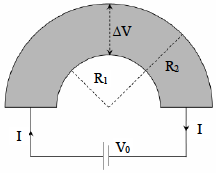
Question figure
  1. Option A:

    I=v0tπρln⁡(R2R1)\mathrm{I}=\frac{\mathrm{v}_{0} \mathrm{t}}{\pi \rho} \ln \left(\frac{\mathrm{R}_{2}}{\mathrm{R}_{1}}\right)

    Correct
  2. Option B:

    the outer surface is at a higher voltage than the inner surface

  3. Option C:

    the outer surface is at a lower voltage than the inner surface

    Correct
  4. Option D:

    ΔV∝I2\Delta V \propto I^{2}

    Correct

Answer: A, C, D

Step-by-step solution

Area of the strip = (t.dr)

dR=ρ(πrtdr)\mathrm{dR}=\rho\left(\frac{\pi \mathrm{r}}{\mathrm{tdr}}\right)

∑1dR=∫R1R2ddrπρr\sum \frac{1}{\mathrm{dR}}=\int_{\mathrm{R}_{1}}^{\mathrm{R}_{2}} \frac{\mathrm{ddr}}{\pi \rho \mathrm{r}}

1Req =(tπρ)Ln(R2R1)\frac{1}{\mathrm{R}_{\text {eq }}}=\left(\frac{\mathrm{t}}{\pi \rho}\right) \mathrm{L}_{\mathrm{n}}\left(\frac{\mathrm{R}_{2}}{\mathrm{R}_{1}}\right)

Req=πρt×ℓn(R2R1)R_{e q}=\frac{\pi \rho}{t \times \ell n\left(\frac{R_{2}}{R_{1}}\right)}

So, I=V0Req =(V0tπρ)ln⁡(R2R1)I=\frac{V_{0}}{R_{\text {eq }}}=\left(\frac{V_{0} t}{\pi \rho}\right) \ln \left(\frac{R_{2}}{R_{1}}\right)

figure

So, option (A) is correct.

Electrons are revolving in a circular path so there is a centripetal force on the electron, which provide a

transverse electric field. The direction of transverse electric field is radially out side hence inner surface

is at higher potential.

figure

So, option (C) is correct.

Current density J(r)=dl(tdr)J(r)=\frac{d l}{(t d r)}

figure

J(r)=V0(dr)(tdr)J(r)=\frac{V_{0}}{(d r)(t d r)}

J(r)=V0(ρπrtdr)(tdr)J(r)=\frac{V_{0}}{\left(\frac{\rho \pi r}{t d r}\right)(t d r)}

J(r)=V0(ρπr)J(r)=\frac{V_{0}}{(\rho \pi r)}

I=neAVd\mathrm{I}=\mathrm{ne}^{\mathrm{A}} \mathrm{V}_{\mathrm{d}}

J(r)=neVd\mathrm{J}(\mathrm{r})=\mathrm{neV}_{\mathrm{d}}

⇒Vd=(J(r)ne)=(V0ρπrne)…(i)\Rightarrow V_{d}=\left(\frac{J(r)}{n e}\right)=\left(\frac{V_{0}}{\rho \pi r n e}\right) …(i)

Centripetal force

eET=mevd2r…(ii)\begin{gathered} e E_{T}=\frac{m_{e} v_{d}^{2}}{r} …(ii) \end{gathered}

From (i) and (ii) ET∝V02E_{T} \propto V_{0}^{2}

ΔV=∫ETdr…(iii)\begin{gathered} \Delta V=\int E_{T} d r …(iii) \end{gathered} ⇒ΔV∝ET…(iv)\begin{gathered} \Rightarrow \Delta V \propto E_{T} …(iv) \end{gathered}

From (iii) and (iv)

ΔV∝V02\Delta \mathrm{V} \propto \mathrm{V}_{0}^{2}

I∝V0I \propto V_{0}

Hence ΔV∝I2\Delta V \propto I^{2}

Hence Option (D) is correct

Answer key and solution verified before publishing.

Practise Current Electricity

Start with this question, then two more from the same chapter — with a tutor that explains every step. Free.

Exam
JEE Advanced 2020
Paper
Paper 1
Subject
Physics
Chapter
Current Electricity
Topic
Ohm's Law and Calculation of Resistance