Physics · Motion in one Dimension

JEE Advanced 2020 — Paper 1 — Question 11

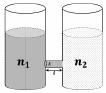
As shown schematically in the figure, two vessels contain water solutions (at temperature T) of potassium permanganate (KMnO4)\left(\mathrm{KMnO}_{4}\right) of different concentrations n1\mathrm{n}_{1} and n2(n1>n2)\mathrm{n}_{2}\left(\mathrm{n}_{1}>\mathrm{n}_{2}\right) molecules per unit volume with Δn=(n1−n2)≪n1\Delta \mathrm{n}=\left(\mathrm{n}_{1}-\mathrm{n}_{2}\right) \ll \mathrm{n}_{1}. When they are connected by a tube of small length ℓ\ell and cross-sectional area S,KMnO4\mathrm{S}, \mathrm{KMnO}_{4} starts to diffuse from the left to the right vessel through the tube. Consider the collection of molecules to behave as dilute ideal gases and the difference in their partial pressure in the two vessels causing the diffusion. The speed vv of the molecules is limited by the viscous force −βv-\beta v on each molecule, where β\beta is a constant. Neglecting all terms of the order (Δn)2(\Delta \mathrm{n})^{2}, which of the following is/are correct? ( kBk_{B} is the Boltzmann constant)

Question figure
  1. Option A:

    the force causing the molecules to move across the tube is ΔnkBTS\Delta n k_{B} T S

    Correct
  2. Option B:

    force balance implies n1βvl=ΔnkBTn_{1} \beta v l=\Delta n k_{B} T

    Correct
  3. Option C:

    total number of molecules going across the tube per sec is (Δnl)(kBtβ)S\left(\frac{\Delta n}{l}\right)\left(\frac{k_{B} t}{\beta}\right) \mathrm{S}

    Correct
  4. Option D:

    rate of molecules getting transferred through the tube does not change with time

Answer: A, B, C

Step-by-step solution

PV=NKT\mathrm{PV}=\mathrm{NKT}

P1=n1 KBT\mathrm{P}_{1}=\mathrm{n}_{1} \mathrm{~K}_{\mathrm{B}} \mathrm{T}

P2=n2 KBT\mathrm{P}_{2}=\mathrm{n}_{2} \mathrm{~K}_{\mathrm{B}} \mathrm{T}

n1,n2→\mathrm{n}_{1}, \mathrm{n}_{2} \rightarrow no. of molecules per unit volume

Force acting on the molecules

F=ΔPS\mathrm{F}=\Delta \mathrm{PS}

=(P1−P2)S=\left(\mathrm{P}_{1}-\mathrm{P}_{2}\right) \mathrm{S}

F=(n1−n2)KBTS=ΔnkBTS…\mathrm{F}=\left(\mathrm{n}_{1}-\mathrm{n}_{2}\right) \mathrm{K}_{\mathrm{B}} \mathrm{TS}=\Delta \mathrm{nk}_{\mathrm{B}} \mathrm{TS} \ldots (i)

So Option (A) is correct

Total no. of molecules in the tube =(n1 Sℓ)=\left(\mathrm{n}_{1} \mathrm{~S} \ell\right)

Force acting on each molecules

F=−βv\mathrm{F}=-\beta \mathrm{v} ℓ\ell

So total force acting on ( n1 Sℓ\mathrm{n}_{1} \mathrm{~S} \ell ) molecules =−=-

(βv)(n1 sℓ)…(ii)(\beta \mathrm{v})\left(\mathrm{n}_{1} \mathrm{~s} \ell\right) \ldots(\mathrm{ii})

From (i) and (ii)

ΔnKBTS=(βv)(n1 Sℓ)\Delta \mathrm{nK}_{\mathrm{B}} \mathrm{TS}=(\beta \mathrm{v})\left(\mathrm{n}_{1} \mathrm{~S} \ell\right)

So, ΔnKBT=(βvn1ℓ)…\Delta \mathrm{nK}_{\mathrm{B}} \mathrm{T}=\left(\beta \mathrm{vn}_{1} \ell\right) \ldots (iii)

So, Option (B) is correct.

No. of molecules going across the tube per second

=(svn1)=\left(\mathrm{svn}_{1}\right)

=(sn1)(ΔnKβTβn1ℓ)=(SΔnKβTβℓ)=\left(\mathrm{sn}_{1}\right)\left(\frac{\Delta \mathrm{nK}_{\beta} \mathrm{T}}{\beta \mathrm{n}_{1} \ell}\right)=\left(\frac{\mathrm{S} \Delta \mathrm{nK}_{\beta} \mathrm{T}}{\beta \ell}\right)

So, Option (C) is correct.

With respect to time Δn\Delta \mathrm{n} changes hence rate of molecules getting transferred through the tube

changes with time.

So, Option (D) is incorrect.
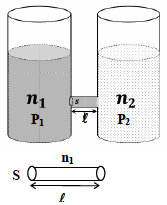
Solution figure

Answer key and solution verified before publishing.

Practise Motion in one Dimension

Start with this question, then two more from the same chapter — with a tutor that explains every step. Free.

Exam
JEE Advanced 2020
Paper
Paper 1
Subject
Physics
Chapter
Motion in one Dimension
Topic
Non-Uniformly Accelerated Motion
As shown schematically in the figure, two vessels contain water… | JEE Advanced 2020 PYQ with Solution · DhiX AI