Mathematics · Limits, Continuity and Differentiability

JEE Main 2025 — 22 January, Morning Shift — Question 2

Let f:R→Rf: \mathbf{R} \rightarrow \mathbf{R} be a twice differentiable function such that

f(x+y)=f(x)f(y)f(\mathrm{x}+\mathrm{y})=f(\mathrm{x}) f(\mathrm{y}) for all x,y∈R\mathrm{x}, \mathrm{y} \in \mathbf{R}. If f′(0)=4af^{\prime}(0)=4 \mathrm{a} and ff staisfies f′′(x)−3af′(x)−f(x)=0f^{\prime \prime}(\mathrm{x})-3 \mathrm{a} f^{\prime}(\mathrm{x})-f(\mathrm{x})=0, a>0\mathrm{a}>0,

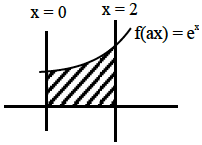
then the area of the region R={(x,y)∣0≤y≤f(ax),0≤x≤2}\mathrm{R}=\{(\mathrm{x}, \mathrm{y}) \mid 0 \leq \mathrm{y} \leq f(\mathrm{ax}), 0 \leq \mathrm{x} \leq 2\} is :

  1. Option A:

    e2−1e^{2}-1

    Correct
  2. Option B:

    e4+1e^{4}+1

  3. Option C:

    e4−1e^{4}-1

  4. Option D:

    e2+1e^{2}+1

Answer: A

Step-by-step solution

f(x+y)=f(x).f(y)f(x+y)=f(x) . f(y)

⇒f(x)=eλxf′(0)=4a\Rightarrow \mathrm{f}(\mathrm{x})=\mathrm{e}^{\lambda \mathrm{x}} \mathrm{f}^{\prime}(0)=4 \mathrm{a}

⇒f′(x)=λeλx⇒λ=4a\Rightarrow \mathrm{f}^{\prime}(\mathrm{x})=\lambda \mathrm{e}^{\lambda \mathrm{x}} \Rightarrow \lambda=4 \mathrm{a}

So, f(x)=e4axf(x)=e^{4ax}

f′′(x)−3af′(x)−f(x)=0f^{\prime \prime}(x)-3 a f^{\prime}(x)-f(x)=0

⇒λ2−3aλ−1=0\Rightarrow \lambda^{2}-3 \mathrm{a} \lambda-1=0

⇒16a2−12a2−1=0⇒4a2=1⇒a=12\Rightarrow 16 \mathrm{a}^{2}-12 \mathrm{a}^{2}-1=0 \Rightarrow 4 \mathrm{a}^{2}=1 \Rightarrow \mathrm{a}=\frac{1}{2}

F(x)=e2xF(x)=e^{2 x}

Area =∫02exdx=e2−1=\int_{0}^{2} \mathrm{e}^{\mathrm{x}} \mathrm{dx}=\mathrm{e}^{2}-1

Solution figure

Answer key and solution verified before publishing.

Practise Limits, Continuity and Differentiability

Start with this question, then two more from the same chapter — with a tutor that explains every step. Free.

Exam
JEE Main 2025
Subject
Mathematics
Chapter
Limits, Continuity and Differentiability
Topic
Differentiability
Let f: R rightarrow R be a twice differentiable function such that f(… | JEE Main 2025 PYQ with Solution · DhiX AI