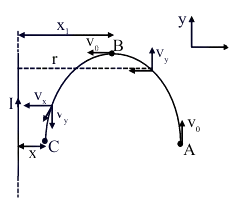
Consider a long thin conducting wire carrying a uniform current I. A particle having mass " M " and charge " q " is released at a distance " a " from the wire with a speed v_o along the direction of current in the wire. The particle gets attracted to the wire due to magnetic force. The particle turns round when it is at distance x from the wire. The value of x is [ μ_0 is vacuum permeability]
A
Option A:
a[1−2qμ0Imvo]
B
Option B:
2a
C
Option C:
a[1−qμ0Imvo]
D
Option D:
eqμI−4πmv0
Correct
Answer: D
Step-by-step solution
A→BV=−vxi+vyjvecB=2πrμ0I(−k)\text{vec{F}}=\text{q}\left( \text{\vec{v}}\times \text{\vec{B}} \right)=\frac{{{\mu }_{0}}\text{Iq}}{2\pi \text{r}}\left[ -{{\text{v}}_{\text{x}}}\overset{\text{}}{\mathop{\text{j}}}\,-{{\text{v}}_{\text{y}}}\overset{\text{}}{\mathop{\text{i}}}\, \right]ax=−2π mμ0Iq⋅rvyay=−2πmμ0Iq⋅rvxdrvxdvx=−2π mμ0Iqrvyvyvxdvx=−2π mμ0Iqrdr∫0v0v02−vx2vxdxvx=−2πmμ0IIqx1∫ardr
Let, z2=v02−vx22zdz=−2vxdvxzdz=−vxdxv02−vx2vxdvx=z−zdz=−dz
then integral becomes
−∫v00dz=−2π mμ0Iqlnax1v0=−2π mμ0Iqlnax1X1=ae−μ0Iq2πmv0
For B→Cv=−vxi−vyj\text{\vec{B}}=\frac{{{\mu }_{0}}\text{I}}{2\pi \text{r}}\left( -\overset{\text{}}{\mathop{\text{k}}}\, \right)F=q(v×B)=2πrμ0Iq(−vxj+vyi)ax=+2π mμ0Iqrvyay=−2π mμ0Iq⋅rvxdrvxdvx=2π mμ0Iqrvy∫v00v02−vx2vxdvx=2πmμ0Iq∫x1xrdr2π mμ0Iqlnx1x=−∫0v0dz=−v0x=x1e−μ0Iq2πmv0…
From equation 1 and 2
X=ae−μ0Iq4πmv0
Answer key and solution verified before publishing.
Practise Moving Charges and Magnetic Field
Start with this question, then two more from the same chapter — with a tutor that explains every step. Free.