Physics · Electrostatics
JEE Main 2024 — 27 January, Shift 1 — Question 49
A thin metallic wire having cross sectional area of is used to make a ring of radius 30 cm . A positive charge of is uniformly distributed over the ring, while another positive charge of 30 pC is kept at the centre of the ring. The tension in the ring is N ; provided that the ring does not get deformed (neglect the influence of gravity). (given, SI units)
Answer: 3
Numerical answer — enter this value.
Step-by-step solution
The tension in the ring is primarily caused by the electrostatic repulsion from the point charge located at its center. While a uniformly charged ring also experiences self-repulsion, in the context of such problems, the question often refers to the tension induced by the external force (in this case, from the central point charge on the distributed charge ).
Given values: Radius of the ring, . Charge uniformly distributed over the ring, . Point charge at the center of the ring, . Coulomb's constant, .
First, calculate the linear charge density of the ring:
Substitute the given values for and :
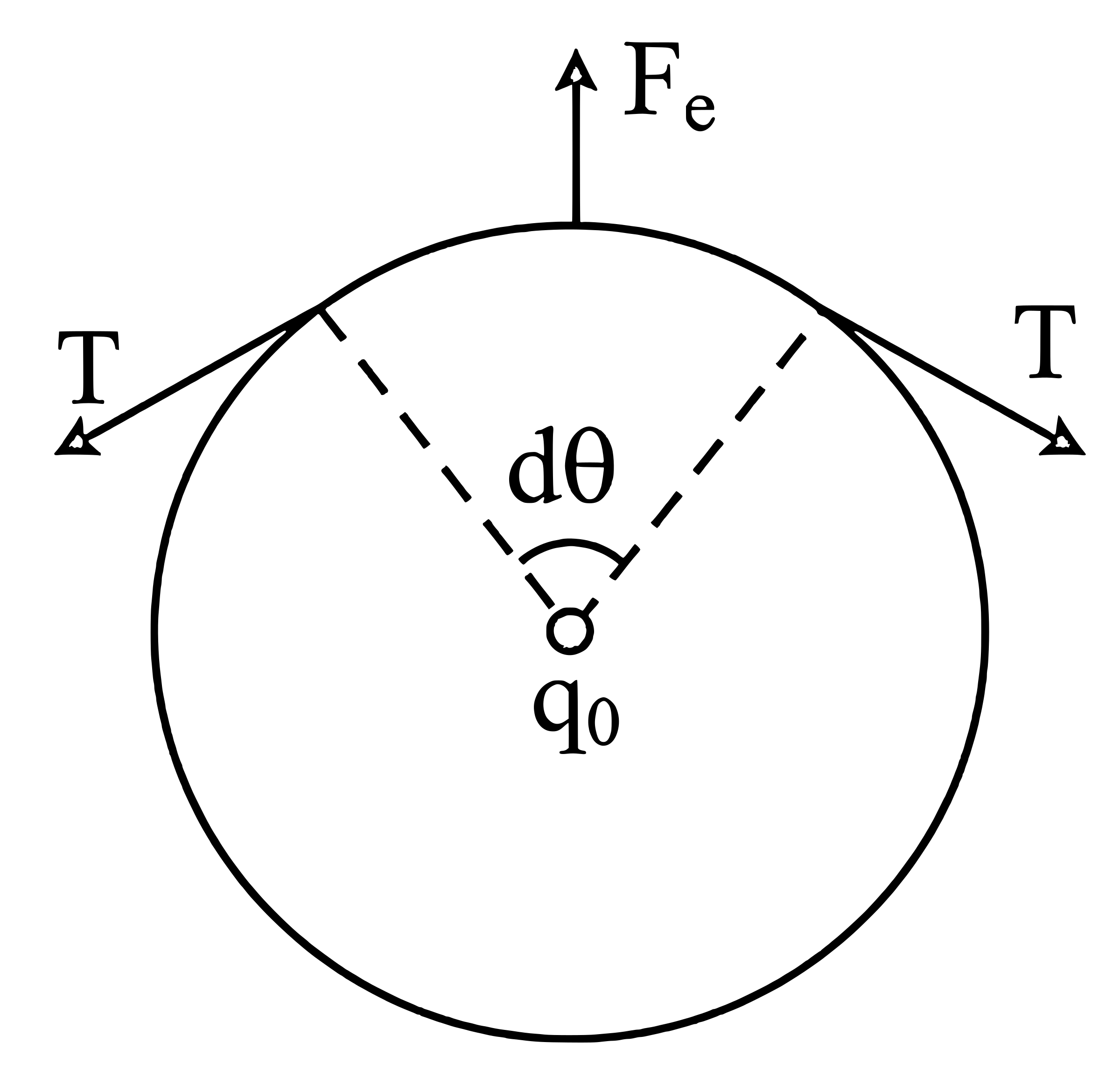
Now, consider a small element of the ring with charge . This element experiences a repulsive force from the central charge . The magnitude of this force is given by Coulomb's law:
Substitute :
This force acts radially outwards on the small element.
For the ring to be in equilibrium (not getting deformed), the radially outward force on this small element must be balanced by the radial component of the tension () in the ring. If is the tension in the ring, then the inward radial component of the tension from the two ends of the small segment of angle is . For small angles, . So, the inward radial component of tension is .
Equating the outward electrostatic force and the inward radial component of tension for equilibrium:
Divide by :
Now, substitute the numerical values for , , , and :
The tension in the ring is .
Answer key and solution verified before publishing.
Practise Electrostatics
Start with this question, then two more from the same chapter — with a tutor that explains every step. Free.
- Exam
- JEE Main 2024
- Paper
- 27 January, Shift 1
- Subject
- Physics
- Chapter
- Electrostatics
- Topic
- Properties of Electric Charge and Coulomb's Law