Mathematics · Application of Derivatives

JEE Advanced 2025 — Paper 2 — Question 24

Let R\mathbb{R} denote the set of all real numbers. Let f:R→Rf: \mathbb{R} \rightarrow \mathbb{R} be defined by

f(x)={6x+sin⁡x2x+sin⁡x if x≠073 if x=0f(x)= \begin{cases}\frac{6 x+\sin x}{2 x+\sin x} & \text { if } x \neq 0 \\ \frac{7}{3} & \text { if } x=0\end{cases}

Then which of the following statements is (are) TRUE?

  1. Option A:

    The point x=0x=0 is a point of local maxima of ff

  2. Option B:

    The point x=0x=0 is a point of local minima of ff

    Correct
  3. Option C:

    Number of points of local maxima of ff in the interval [π,6π][\pi, 6 \pi] is 3

    Correct
  4. Option D:

    Number of points of local minima of ff in the interval [2π,4π][2 \pi, 4 \pi] is 1

    Correct

Answer: B, C, D

Step-by-step solution

For x≠0x \neq 0, rewrite f(x)=6x+sin⁡x2x+sin⁡x=1+4x2x+sin⁡xf(x) = \dfrac{6x+\sin x}{2x+\sin x} = 1 + \dfrac{4x}{2x+\sin x}. Compute limit as x→0x \to 0: lim⁡x→0f(x)=lim⁡x→06x+sin⁡x2x+sin⁡x=6+12+1=3\lim_{x \to 0} f(x) = \lim_{x \to 0} \dfrac{6x+\sin x}{2x+\sin x} = \dfrac{6+1}{2+1} = 3, using sin⁡x∼x\sin x \sim x. Since f(0)=73<3f(0) = \dfrac{7}{3} < 3, x=0x = 0 is a point of local minima.

Hence option B is correct and A is false. Differentiate: f′(x)=ddx(1+4x2x+sin⁡x)=4[(2x+sin⁡x)⋅1−x(2+cos⁡x)](2x+sin⁡x)2=4(sin⁡x−xcos⁡x)(2x+sin⁡x)2f'(x) = \dfrac{d}{dx}\left(1 + \dfrac{4x}{2x+\sin x}\right) = \dfrac{4[(2x+\sin x)\cdot 1 - x(2+\cos x)]}{(2x+\sin x)^2} = \dfrac{4(\sin x - x \cos x)}{(2x+\sin x)^2}. Denominator (2x+sin⁡x)2>0(2x+\sin x)^2 > 0 for all x≠0x \neq 0, so sign of f′f' = sign of sin⁡x−xcos⁡x=cos⁡x(tan⁡x−x)\sin x - x \cos x = \cos x (\tan x - x). Critical points: f′(x)=0⇒tan⁡x=xf'(x) = 0 \Rightarrow \tan x = x.

For x>0x > 0, this equation has infinitely many solutions, one in each interval (π2+kπ,3π2+kπ)(\frac{\pi}{2} + k\pi, \frac{3\pi}{2} + k\pi) for integer k≥0k \geq 0.

The first few positive solutions are approximately 4.49,7.73,10.90,14.07,…4.49, 7.73, 10.90, 14.07, \dots.

Sign analysis: In (0,π2)(0, \frac{\pi}{2}): cos⁡>0\cos > 0, tan⁡x>x⇒f′>0\tan x > x \Rightarrow f' > 0.

In (π2,π)(\frac{\pi}{2}, \pi): cos⁡<0\cos < 0, tan⁡x−x<0⇒f′>0\tan x - x < 0 \Rightarrow f' > 0.

In (π,3π2)(\pi, \frac{3\pi}{2}): cos⁡<0\cos < 0, tan⁡x−x\tan x - x changes from negative to positive ⇒f′\Rightarrow f' changes from positive to negative, so first critical point (4.494.49) is a local maximum.

Next critical point (7.737.73) is a local minimum, next (10.9010.90) is a local maximum, next (14.0714.07) is a local minimum, etc. In the interval [π,6π]≈[3.14,18.85][\pi, 6\pi] \approx [3.14, 18.85], the local maxima occur at x≈4.49,10.90,x \approx 4.49, 10.90, and 17.0017.00 (the third maximum in this interval), giving 33 local maxima. Hence option C is correct. In the interval [2π,4π]≈[6.28,12.57][2\pi, 4\pi] \approx [6.28, 12.57], the only local minimum is at x≈7.73x \approx 7.73 (since 14.07>12.5714.07 > 12.57).

Hence number of local minima is 11.

Therefore option D is correct. Thus the correct options are B, C, D.
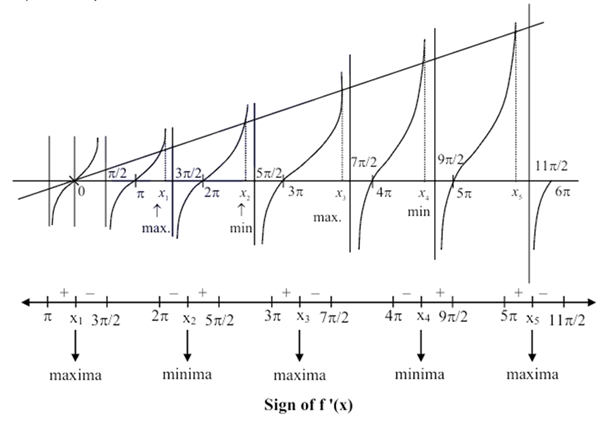
Solution figure

Answer key and solution verified before publishing.

Practise Application of Derivatives

Start with this question, then two more from the same chapter — with a tutor that explains every step. Free.

Exam
JEE Advanced 2025
Paper
Paper 2
Subject
Mathematics
Chapter
Application of Derivatives
Topic
Maxima and Minima
Let mathbb R denote the set of all real numbers. Let f: mathbb R… | JEE Advanced 2025 PYQ with Solution · DhiX AI