Mathematics · Hyperbola

JEE Advanced 2020 — Paper 2 — Question 41

Let a and b be positive real numbers such that a>1\mathrm{a}>1 and b<a\mathrm{b}<\mathrm{a}. Let P be a point in the first quadrant that lies on the hyperbola x2a2−y2b2=1\frac{x^{2}}{a^{2}}-\frac{y^{2}}{b^{2}}=1. Suppose the tangent to the hyperbola at PP passes through the point (1,0)(1,0), and suppose the normal to the hyperbola at P cuts off equal intercepts on the coordinate axes. Let Δ\Delta denote the area of the triangle formed by the tangent at P , the normal at P and the x -axis. If e denotes the eccentricity of the hyperbola, then which of the following statements is/are TRUE?

  1. Option A:

    1<e<21<\mathrm{e}<\sqrt{2}

    Correct
  2. Option B:

    2<e<2\sqrt{2} < e < 2

  3. Option C:

    Δ=a4\Delta=a^{4}

  4. Option D:

    Δ=b4\Delta=b^{4}

    Correct

Answer: A, D

Step-by-step solution

As in first quadrant if normal at P is making equal intercepts on axes, then slope of the normal =−1 = -1
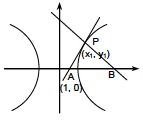
⇒slope of tangent =1\Rightarrow \text{slope of tangent } = 1 ⇒equation of tangent at P: y−0x−1=1 and equation of tangent\Rightarrow \text{equation of tangent at P: } \frac{y - 0}{x - 1} = 1 \text{ and equation of tangent} at (x1,y1):xx1a2−yy1b2=1\text{at } (x_1, y_1): \frac{xx_1}{a^2} - \frac{yy_1}{b^2} = 1 ⇒x1=a2 and y1=b2⇒P(x1,y1)=P(a2,b2)\Rightarrow x_1 = a^2 \text{ and } y_1 = b^2 \Rightarrow P(x_1, y_1) = P(a^2, b^2) ⇒equation of normal at P: x+y=a2+b2\Rightarrow \text{equation of normal at P: } x + y = a^2 + b^2 ⇒B=(a2+b2,0)\Rightarrow B = (a^2 + b^2, 0) ⇒Δ=12×b2×(a2+b2−1)=12×b2×2b2=b4⇒Δ=b4\Rightarrow \Delta = \frac{1}{2} \times b^2 \times (a^2 + b^2 - 1) = \frac{1}{2} \times b^2 \times 2b^2 = b^4 \Rightarrow \Delta = b^4 ∵(a2,b2) lies on x2a2−y2b2=1⇒(a2)2a2−(b2)2b2=1⇒a2−b2=1\because (a^2, b^2) \text{ lies on } \frac{x^2}{a^2} - \frac{y^2}{b^2} = 1 \Rightarrow \frac{(a^2)^2}{a^2} - \frac{(b^2)^2}{b^2} = 1 \Rightarrow a^2 - b^2 = 1 Also e=1+b2a2=1+a2−1a2=1+a2−1a2=a2a2=1\text{Also } e = \sqrt{1 + \frac{b^2}{a^2}} = \sqrt{1 + \frac{a^2 - 1}{a^2}} = \sqrt{\frac{1 + a^2 - 1}{a^2}} = \sqrt{\frac{a^2}{a^2}} = 1 ⇒e=1+b2a2=1+a2−1a2=a2+a2−1a2=2a2−1a2\Rightarrow e = \sqrt{1 + \frac{b^2}{a^2}} = \sqrt{1 + \frac{a^2 - 1}{a^2}} = \sqrt{\frac{a^2 + a^2 - 1}{a^2}} = \sqrt{\frac{2a^2 - 1}{a^2}} ⇒e=2−1a2⇒1<e<2\Rightarrow e = \sqrt{2 - \frac{1}{a^2}} \Rightarrow 1 < e < \sqrt{2} ⇒e∈(1,2)\Rightarrow e \in (1, \sqrt{2})
Solution figure

Answer key and solution verified before publishing.

Practise Hyperbola

Start with this question, then two more from the same chapter — with a tutor that explains every step. Free.

Exam
JEE Advanced 2020
Paper
Paper 2
Subject
Mathematics
Chapter
Hyperbola
Topic
Tangents & normals to hyperbola, chord of contact