Physics · Sound Waves

JEE Advanced 2025 — Paper 2 — Question 16

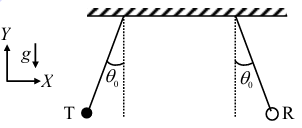
An audio transmitter (T) and a receiver (R) are hung vertically from two identical massless strings of length 8 m with their pivots well separated along the XX axis. They are pulled from the equilibrium position in opposite directions along the XX axis by a small angular amplitude θ0=cos⁡−1(0.9)\theta_{0}=\cos ^{-1}(0.9) and released simultaneously. If the natural frequency of the transmitter is 660 Hz and the speed of sound in air is 330 m/s330 \mathrm{~m} / \mathrm{s}, the maximum variation in the frequency (in Hz) as measured by the receiver (Take the acceleration due to gravity g=10 m/s2g=10 \mathrm{~m} / \mathrm{s}^{2} ) is \qquad

Question figure

Answer: 31.19

Numerical answer — enter this value.

Step-by-step solution

cos⁡θ0=1−θ022=0.9\cos \theta_{0}=1-\frac{\theta_{0}^{2}}{2}=0.9

θ022=0.1⇒θ0=10.2=15\frac{\theta_{0}^{2}}{2}=0.1 \Rightarrow \theta_{0}=10.2=\frac{1}{\sqrt{5}}

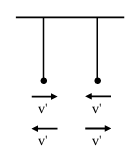
⇄v′→⇆−→v′\overrightarrow{\underset{\mathrm{v}^{\prime}}{\rightleftarrows}} \underset{\underset{\mathrm{v}^{\prime}}{\rightarrow}}{\stackrel{-}{\leftrightarrows}}

fmax =v+v′v−v′ff_{\text {max }}=\frac{v+v^{\prime}}{v-v^{\prime}} f

fmin =v−v′v+v′ff_{\text {min }}=\frac{v-v^{\prime}}{v+v^{\prime}} f

Δfmax =fmax −fmin =v+v′v−v′f−v−v′v+v′f\Delta \mathrm{f}_{\text {max }}=\mathrm{f}_{\text {max }}-\mathrm{f}_{\text {min }}=\frac{\mathrm{v}+\mathrm{v}^{\prime}}{\mathrm{v}-\mathrm{v}^{\prime}} \mathrm{f}-\frac{\mathrm{v}-\mathrm{v}^{\prime}}{\mathrm{v}+\mathrm{v}^{\prime}} \mathrm{f}

=(v+v′)2−(v−v′)2v2−v′2f=\frac{\left(v+v^{\prime}\right)^{2}-\left(v-v^{\prime}\right)^{2}}{v^{2}-v^{\prime 2}} \mathrm{f}

Δfmax =4vv′v2−v′2f\Delta \mathrm{f}_{\text {max }}=\frac{4 \mathrm{vv}^{\prime}}{\mathrm{v}^{2}-\mathrm{v}^{\prime 2}} \mathrm{f}

Here, v′=ℓΩmax⁡\mathrm{v}^{\prime}=\ell \Omega_{\max }

=ℓ⋅θ0⋅ω(ω==\ell \cdot \theta_{0} \cdot \omega \quad(\omega= angular frequency ))

=ℓθ0gℓ=\ell \theta_{0} \sqrt{\frac{g}{\ell}}

v′=θ0gℓv^{\prime}=\theta_{0} \sqrt{g \ell}

v′=1510×8\mathrm{v}^{\prime}=\frac{1}{\sqrt{5}} \sqrt{10 \times 8}

v′=4\mathrm{v}^{\prime}=4

Put in equation (i) Δfmax⁡=4×330×4×6603302−42\Delta \mathrm{f}_{\max }=\frac{4 \times 330 \times 4 \times 660}{330^{2}-4^{2}}

≈16×330×660330≈32\approx \frac{16 \times 330 \times 660}{330} \approx 32

Solution figure

Answer key and solution verified before publishing.

Practise Sound Waves

Start with this question, then two more from the same chapter — with a tutor that explains every step. Free.

Exam
JEE Advanced 2025
Paper
Paper 2
Subject
Physics
Chapter
Sound Waves
Topic
Doppler Effect of Sound
An audio transmitter (T) and a receiver (R) are hung vertically from… | JEE Advanced 2025 PYQ with Solution · DhiX AI