Physics · Thermodynamics
JEE Advanced 2020 — Paper 2 — Question 5
A thermally isolated cylindrical closed vessel of height 8 m is kept vertically. It is divided into two equal parts by a diathermic (perfect thermal conductor) frictionless partition of mass 8.3 kg . Thus the partition is held initially at a distance of 4 m from the top, as shown in the schematic figure below. Each of the two parts of the vessel contains 0.1 mole of an ideal gas at temperature 300 K . The partition is now released and moves without any gas leaking from one part of the vessel to the other. When equilibrium is reached, the distance of the partition from the top (in m ) will be (take the acceleration due to gravity and the universal gas constant ).
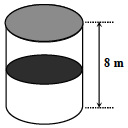
Answer: 6
Numerical answer — enter this value.
Step-by-step solution
Given: Height of vessel Mass of partition Moles of gas in each part Temperature Acceleration due to gravity Universal gas constant
Let be the distance of the partition from the top at equilibrium.
From ideal gas law, pressure on top part:
Pressure on bottom part:
Mechanical equilibrium of the partition:
Substitute pressures:
Simplify difference of fractions:
Substitute numerical values:
Calculate constants:
Rearranged:
Approximate fraction:
Expand:
Bring all terms to one side:
Multiply entire equation by 3:
Use quadratic formula:
Calculate discriminant:
Calculate roots:
Valid root:
Discard invalid negative root.
Final answer:
Answer key and solution verified before publishing.
Practise Thermodynamics
Start with this question, then two more from the same chapter — with a tutor that explains every step. Free.
- Exam
- JEE Advanced 2020
- Paper
- Paper 2
- Subject
- Physics
- Chapter
- Thermodynamics
- Topic
- Different Thermodynamic Processes